. 2022 Feb 3;11(3):448.
doi: 10.3390/foods11030448.

Antioxidant Potential of Cookies Formulated with Date Seed Powder

Affiliations

Antioxidant Potential of Cookies Formulated with Date Seed Powder

Zein Najjar et al. Foods. .

Abstract

Utilising major waste products from the food industry can have both a great environmental impact and be a means to improve consumer health. Date seed is a food industry byproduct that has been proven to have high nutritional value. The aim of this work was to measure the total polyphenolic content (TPC), flavonoids, and antioxidant activity of the seeds of six date fruit varieties, Fard, Khalas, Khinaizi, Sukkary, Shaham, and Zahidi, and to use those seeds to enhance the antioxidant value of cookies by partially substituting flour with ground date seed. Date seed powder (DSP) was extracted at three levels of sample to solvent ratio (5:1, 10:1 and 15:1 mg/mL). Cookies were prepared using three substitution levels of wheat flour (2.5, 5.0, and 7.5%, w/w) by DSP and two types of flour (white and whole wheat), and were baked at two different temperatures, 180 and 200 °C. The composite cookies were found to contain a significant amount of TPC and flavonoids, and showed increased antioxidant activity compared with the control samples.

Keywords: antioxidant; cookies; date seed; flavonoids; polyphenols.


Conflict of interest statement

The authors declare no conflict of interest.

Figures

Figure 1
Figure 1
(a) TPC (Gallic acid equivalent per gram (µg/g) of the sample); (b) Flavonoid content (w/w) % of six varieties of date seed powder extracted at three sample to solvent ratios (5:1, 10:1, and 15:1). Different uppercase superscript letters in a variety denote significant differences, p < 0.05.
Figure 2
Figure 2
(a) DPPH radical scavenging activity (µg Trolox equivalent/g sample); (b) ABTS radical scavenging (% Scavenging effect with ABTS/mg) %; (c) Ferric reducing assay, (µg equivalent Trolox/g) of six varieties of date seed powder extracted at three sample to solvent ratios (5:1, 10:1, and 15:1). Different uppercase superscript letters in a variety denote significant differences, p < 0.05.
Figure 3
Figure 3
TPC of composite cookies formulated with 2.5%, 5%, and 7.5% substitution of flour by date seed powder. (Data expressed as Gallic acid equivalent per gram (µg/g) of the cookie sample. Different uppercase superscript letters in a variety denote significant differences, p < 0.05. (A—180 °C, B—200 °C).
Figure 4
Figure 4
Total contents of Flavonoids of composite cookies formulated with 2.5%, 5%, and 7.5% substitution of flour by date seed powder. (Data expressed as Gallic acid equivalent per gram (µg/g) of the cookie sample. Different uppercase superscript letters in a variety denote significant differences, p < 0.05. (A—180 °C, B—200 °C).
Figure 5
Figure 5
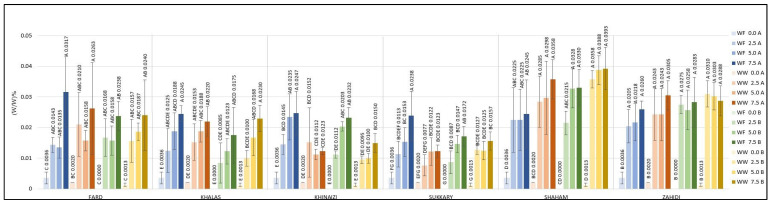
DPPH radical scavenging activity (µg Trolox equivalent/g) of composite cookies formulated with 2.5%, 5%, and 7.5 % substitution of flour by date seed powder Different uppercase superscript letters in a variety denote significant differences, p < 0.05. (A—180 °C, B—200 °C).
Figure 6
Figure 6
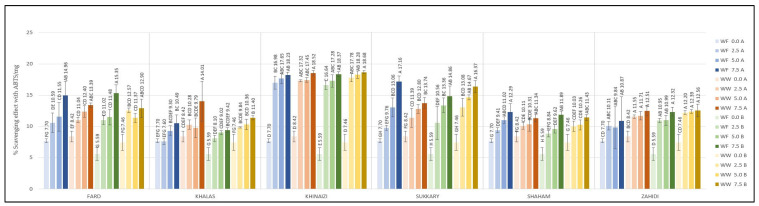
ABTS radical scavenging (% Scavenging effect with ABTS/mg) of composite cookies formulated with 2.5%, 5%, and 7.5 % substitution of flour by date seed powder. Different superscript letters in a variety denote significant differences, p < 0.05. (A—180 °C, B—200 °C).
Figure 7
Figure 7
Ferric reducing antioxidant power, (µg equivalent Trolox/g) of composite cookies formulated with 2.5%, 5%, and 7.5 % substitution of flour by date seed powder. Different superscript letters in a variety denote significant differences, p < 0.05 (A—180 °C, B—200 °C).

References

    1. Al-Farsi M.A., Lee C.Y. Optimization of phenolics and dietary fibre extraction from date seeds. Food Chem. 2008;108:977–985. doi: 10.1016/j.foodchem.2007.12.009. - DOI - PubMed
    1. Dowson V.H.W. Date Production and Protection with Special Reference to North Africa and the Near East. FAO; Rome, Italy: 1982. No. 35, FAO Technical Bulletin.
    1. Zaid A. Date Palm Cultivation. FAO; Rome, Italy: 1999. FAO No. 156.
    1. Ahmed A.W.K., Ahmed A.I., Robinson R.K. Chemical composition of date varieties as influenced by the stage of ripening. Food Chem. 1995;54:305–309. doi: 10.1016/0308-8146(95)00051-J. - DOI
    1. Al-Farsi M., Alasalvar C., Morris A., Baron M., Shahidi F. Comparison of antioxidant activity, anthocyanins, carotenoids, and phenolics of three native fresh and sun-dried date (Phoenix dactylifera L.) varieties grown in Oman. J. Agric. Food Chem. 2005;53:7592–7599. doi: 10.1021/jf050579q. - DOI - PubMed

LinkOut - more resources