


Recent Advances in the Surface Functionalization of PLGA-Based Nanomedicines
- PMID: 35159698
- PMCID: PMC8840194
- DOI: 10.3390/nano12030354
Recent Advances in the Surface Functionalization of PLGA-Based Nanomedicines
Abstract
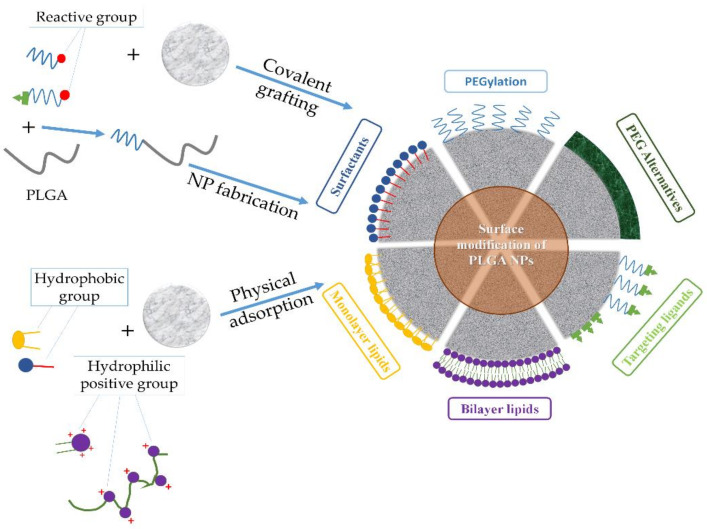
Therapeutics are habitually characterized by short plasma half-lives and little affinity for targeted cells. To overcome these challenges, nanoparticulate systems have entered into the disease arena. Poly(d,l-lactide-co-glycolide) (PLGA) is one of the most relevant biocompatible materials to construct drug nanocarriers. Understanding the physical chemistry of this copolymer and current knowledge of its biological fate will help in engineering efficient PLGA-based nanomedicines. Surface modification of the nanoparticle structure has been proposed as a required functionalization to optimize the performance in biological systems and to localize the PLGA colloid into the site of action. In this review, a background is provided on the properties and biodegradation of the copolymer. Methods to formulate PLGA nanoparticles, as well as their in vitro performance and in vivo fate, are briefly discussed. In addition, a special focus is placed on the analysis of current research in the use of surface modification strategies to engineer PLGA nanoparticles, i.e., PEGylation and the use of PEG alternatives, surfactants and lipids to improve in vitro and in vivo stability and to create hydrophilic shells or stealth protection for the nanoparticle. Finally, an update on the use of ligands to decorate the surface of PLGA nanomedicines is included in the review.
Keywords: PLGA; active drug targeting; ligand-mediated targeting; nanoparticle; passive drug targeting; stealth coating; surface functionalization.
Conflict of interest statement
The authors declare no conflict of interest.
Figures


References
-
- El-Hammadi M.M., Arias J.L. Advanced Engineering Approaches in the Development of PLGA-Based Nanomedicines. In: Aliofkhazraei M., editor. Handbook of Nanoparticles. Springer International Publishing AG; Cham, Switzerland: 2016. pp. 1009–1039. Chapter 39. - DOI
-
- Sharma S., Parmar A., Kori S., Sandhir R. PLGA-based nanoparticles: A new paradigm in biomedical applications. TrAC Trends Anal. Chem. 2016;80:30–40. doi: 10.1016/j.trac.2015.06.014. - DOI
Publication types
LinkOut - more resources
Full Text Sources
