


Traumatic Hip Dislocations in Major Trauma Patients: Epidemiology, Injury Mechanisms, and Concomitant Injuries
- PMID: 35159925
- PMCID: PMC8837148
- DOI: 10.3390/jcm11030472
Traumatic Hip Dislocations in Major Trauma Patients: Epidemiology, Injury Mechanisms, and Concomitant Injuries
Abstract
Introduction: Traumatic hip dislocations (THDs) are severe injuries associated with considerable morbidity. Delayed recognition of fracture dislocations and neurovascular deficits have been proposed to cause deleterious long-term clinical outcomes. Therefore, in this study, we aimed to identify characteristics of epidemiology, injury mechanisms, and associated injuries to identify patients at risk.
Methods: For this study based on the TraumaRegister DGU® (January 2002-December 2017), the inclusion criterion was an Injury Severity Score (ISS) ≥9 points. Exclusion criteria were an isolated head injury and early transfer to another hospital. The THD group was compared to a control group without hip dislocation. The ISS and New ISS were used for injury severity and the Abbreviated Injury Scale for associated injuries classification. Univariate and logistic regression analyses were performed.
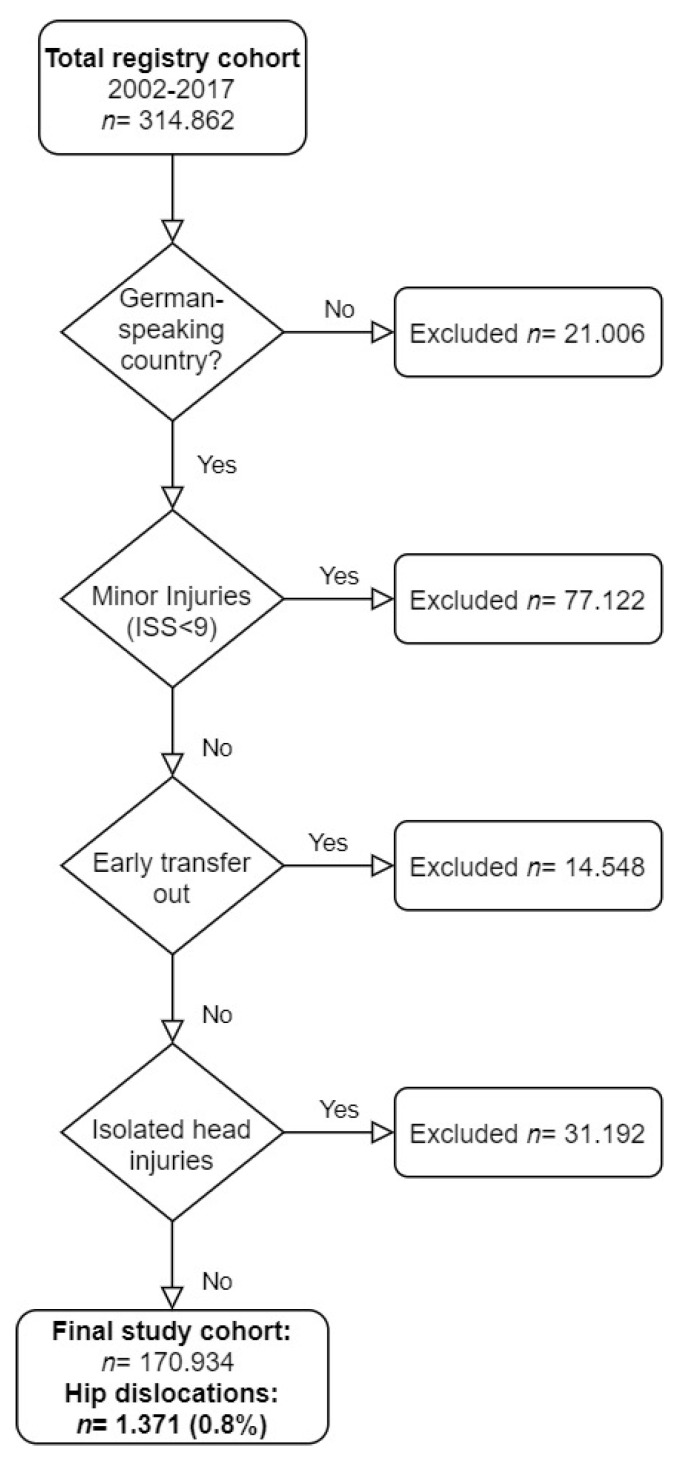
Results: The final study cohort comprised n = 170,934 major trauma patients. We identified 1359 individuals (0.8%) with THD; 12 patients had sustained bilateral hip dislocations. Patients with THD were predominantly male (79.5%, mean age 43 years, mean ISS 22.4 points). Aortic injuries (2.1% vs. 0.9%, p ≤ 0.001) were observed more frequently in the THD group. Among the predictors for THDs were specific injury mechanisms, including motor vehicle accidents (odds ratio (OR) 2.98, 95% confidence interval (CI) 2.57-3.45, p ≤ 0.001), motorcycle accidents (OR 1.99, 95% CI 1.66-2.39, p ≤ 0.001), and suicide attempts (OR 1.36, 95% CI 1.06-1.75, p = 0.016). Despite a lower rate of head injuries and a comparable level of care measured by trauma center admission, both intensive care unit and total hospital stay were prolonged in patients with THD.
Conclusions: Since early diagnosis, as well as timely and sufficient treatment, of THDs are of high relevance for long-term outcomes of severely injured individuals, knowledge of patients at risk for this injury pattern is of utmost importance. THDs are frequently related to high-energy mechanisms and associated with severe concomitant injuries in major trauma patients.
Keywords: acetabular fracture; aortic injury; injury mechanisms; ischial nerve injury; orthopedic emergency; traumatic hip dislocation.
Conflict of interest statement
The authors declare no conflict of interest with respect to the research, authorship, and/or publication of this article.
Figures
References
-
- Maccagnano G., Notarnicola A., Sammarco G.J., Scialpi L., Scialpi B. Traumatic Dislocation of Three Major Joints in the Lower Limb: Management and Outcome. Muscles Ligam. Tendons J. 2020;10:146. doi: 10.32098/mltj.01.2020.21. - DOI
-
- Pascarella R., Fantasia R., Sangiovanni P., Maresca A., Massetti D., Politano R., Cerbasi S. Traumatic hip fracture-dislocation: A middle-term follow up study and a proposal of new classification system of hip joint associated injury. Injury. 2019;50((Suppl. S4)):S11–S20. doi: 10.1016/j.injury.2019.01.011. - DOI - PubMed
LinkOut - more resources
Full Text Sources
