


Shoulder Replacement in the Elderly with Anatomic versus Reverse Total Prosthesis? A Prospective 2-Year Follow-Up Study
- PMID: 35159992
- PMCID: PMC8836421
- DOI: 10.3390/jcm11030540
Shoulder Replacement in the Elderly with Anatomic versus Reverse Total Prosthesis? A Prospective 2-Year Follow-Up Study
Abstract
Background: In older patients requiring a total shoulder replacement (TSR) and with an intact rotator cuff, there is currently uncertainty on whether an anatomic TSR (aTSR) or a reverse TSR (rTSR) is best for the patient. This comparison study of same-aged patients aims to assess clinical and radiological outcomes of older patients (≥75 years) who received either an aTSR or an rTSR.
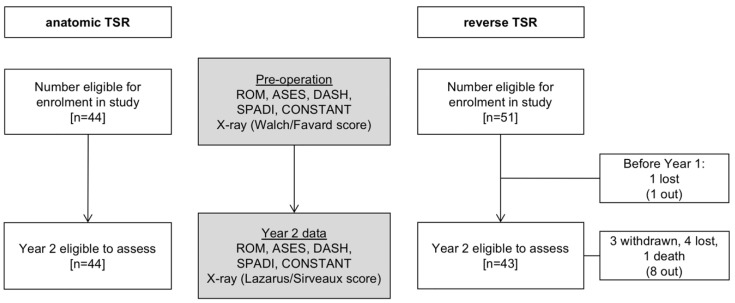
Methods: Consecutive patients with a minimum age of 75 years who received an aTSR (n = 44) or rTSR (n = 51) were prospectively studied. Pre- and post-operative clinical evaluations included the ASES score, Constant score, SPADI score, DASH score, range of motion (ROM) and pain and patient satisfaction for a follow-up of 2 years. Radiological assessment identified glenoid and humeral component osteolysis, including notching with an rTSR.
Results: We found postoperative improvement for ROM and all clinical assessment scores for both groups. There were significantly better patient reported outcome scores (PROMs) in the aTSR group compared with the rTSR patients (p < 0.001). Both groups had only minor osteolysis on radiographs. No revisions were required in either group. The main complications were scapular stress fractures for the rTSR (n = 11) patients and acromioclavicular joint pain for both groups (aTSR = 2; rTSR = 6).
Conclusions: This study of older patients (≥75 years) demonstrated that an aTSR for a patient with good rotator cuff muscles can lead to a better clinical outcome and less early complications than an rTSR.
Level of evidence: Level II-prospective cohort study.
Keywords: Lazarus score; Sirveaux score; anatomic total shoulder replacement; clinical scores; older patients; reverse total shoulder replacement.
Conflict of interest statement
Maciej Simon: This author, their immediate family, and any research foundation with which they are affiliated did not receive any financial payments or other benefits from any commercial entity related to the subject of this article. Jennifer Coghlan: Receives funds for data collection, entry and storage through her Department of Monash University from Mathys Bettlach, Switzerland, Mathys Australia and Wright Medical, Australia. Simon Bell: Has a consultancy agreement with Mathys Ltd. Bettlach, Switzerland, and Wright Medical, Australia.
Figures
References
-
- Mellano C.R., Chalmers P.N., Mascarenhas R., Kupfer N., Forsythe B., Romeo A.A., Nicholson G.P. Reverse total shoulder arthroplast for the treatment of osteoarthritis without rotator cuff tear. Orthop. Proc. 2016;98-B:9. doi: 10.1302/1358-992x.98bsupp_21.Coa2016-009. - DOI
LinkOut - more resources
Full Text Sources
Research Materials
