


Sutureless versus Hand-Sewn Coronary Anastomoses: A Systematic Review and Meta-Analysis
- PMID: 35160201
- PMCID: PMC8837108
- DOI: 10.3390/jcm11030749
Sutureless versus Hand-Sewn Coronary Anastomoses: A Systematic Review and Meta-Analysis
Abstract
Background: Sutureless coronary anastomotic devices are intended to facilitate minimally invasive coronary artery bypass grafting (MICS-CABG) by easing and eventually standardizing the anastomotic technique. Within this systematic review and meta-analysis, we aim to determine patency and to evaluate safety outcomes for the sutureless anastomoses.
Methods: CENTRAL, MEDLINE, and EMBASE were searched from database start till August 2021 in a predefined search strategy combining the key concepts: 'coronary artery bypass grafting', 'sutureless coronary anastomoses', and 'hand-sewn coronary anastomoses' by the Boolean operation 'AND'. Study characteristics, patient demographics, interventional details, and all available outcome data were extracted. A meta-analysis was performed on patency at longest follow-up. Safety outcomes were presented.
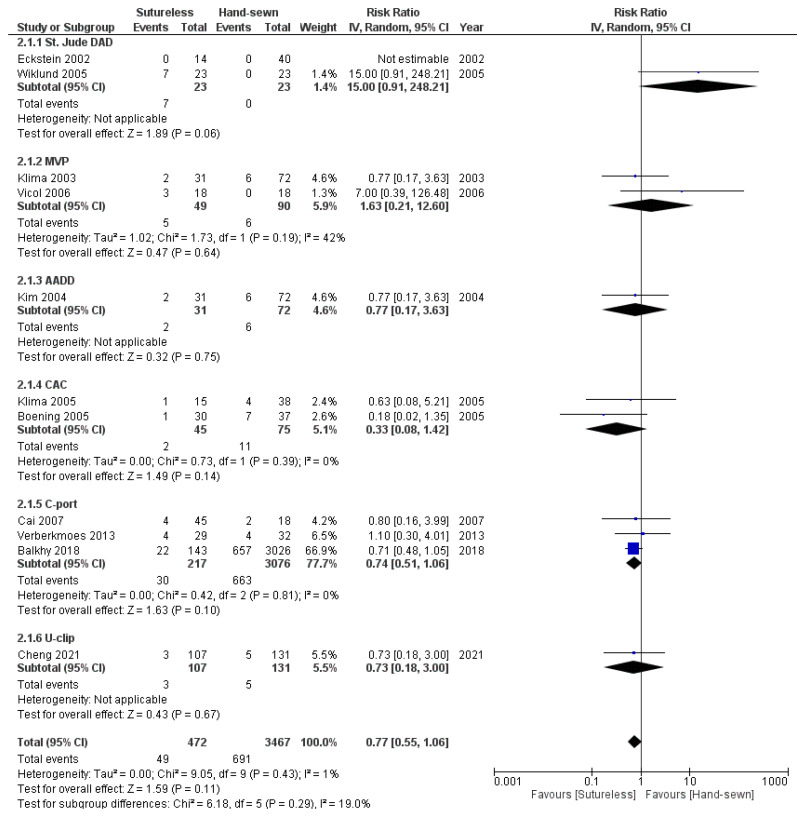
Results: A total of eleven trials towards six sutureless anastomotic devices were included, comprising 3724 patients (490 sutureless and 3234 hand-sewn). There was no significant difference in patency at a mean follow-up duration of 546.3 (range 1.5-2691) days, with a risk ratio of 0.77 (95% CI 0.55-1.06). MACE was reported in 4.5% sutureless and 3.9% hand-sewn patients, including all-cause mortality (resp. 1.3 vs. 1.9%), myocardial infarction (resp. 1.6 vs. 1.7%), and coronary revascularization (resp. 1.8 vs. 0.5%). Incomplete hemostasis occurred in 24.8% of the sutureless anastomoses. Intra-operative device failure forced conversion to hand-sewn or redo-anastomosis in 5.8% of the sutureless cases.
Conclusion: Based on the systematic review and meta-analysis including six devices, we conclude that sutureless coronary anastomotic devices appear safe and effective when used by well-trained and dedicated surgical teams.
Keywords: anastomosis; coronary artery bypass grafting; minimally invasive; sutureless coronary anastomotic device.
Conflict of interest statement
The authors declare no conflict of interest.
Figures


References
Publication types
LinkOut - more resources
Full Text Sources
