


Ga2O3 and Related Ultra-Wide Bandgap Power Semiconductor Oxides: New Energy Electronics Solutions for CO2 Emission Mitigation
- PMID: 35161108
- PMCID: PMC8838167
- DOI: 10.3390/ma15031164
Ga2O3 and Related Ultra-Wide Bandgap Power Semiconductor Oxides: New Energy Electronics Solutions for CO2 Emission Mitigation
Abstract
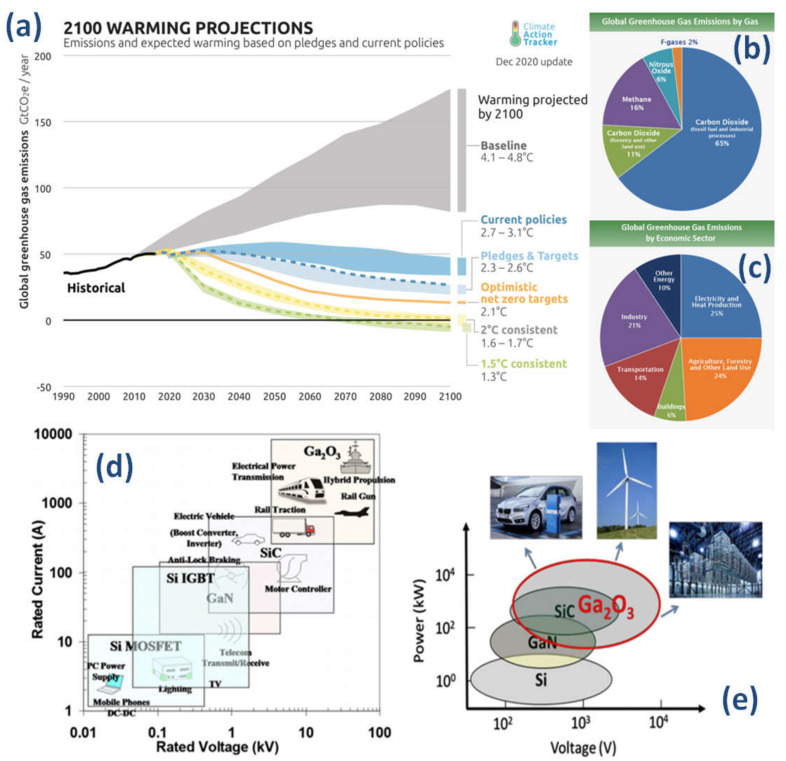
Currently, a significant portion (~50%) of global warming emissions, such as CO2, are related to energy production and transportation. As most energy usage will be electrical (as well as transportation), the efficient management of electrical power is thus central to achieve the XXI century climatic goals. Ultra-wide bandgap (UWBG) semiconductors are at the very frontier of electronics for energy management or energy electronics. A new generation of UWBG semiconductors will open new territories for higher power rated power electronics and solar-blind deeper ultraviolet optoelectronics. Gallium oxide-Ga2O3 (4.5-4.9 eV), has recently emerged pushing the limits set by more conventional WBG (~3 eV) materials, such as SiC and GaN, as well as for transparent conducting oxides (TCO), such asIn2O3, ZnO and SnO2, to name a few. Indeed, Ga2O3 as the first oxide used as a semiconductor for power electronics, has sparked an interest in oxide semiconductors to be investigated (oxides represent the largest family of UWBG). Among these new power electronic materials, AlxGa1-xO3 may provide high-power heterostructure electronic and photonic devices at bandgaps far beyond all materials available today (~8 eV) or ZnGa2O4 (~5 eV), enabling spinel bipolar energy electronics for the first time ever. Here, we review the state-of-the-art and prospects of some ultra-wide bandgap oxide semiconductor arising technologies as promising innovative material solutions towards a sustainable zero emission society.
Keywords: Ga2O3; ZnGa2O4; diodes; energy electronics; gallium oxide; power electronics; spinel; transistors; ultra-wide bandgap.
Conflict of interest statement
The authors declare no conflict of interest.
Figures


References
-
- IPCC Working Group I Report, Climate Change 2021: The Physical Science Basis. [(accessed on 9 August 2021)]. Available online: www.ipcc.ch.
-
- US Environmental Protection Agency (EPA) Greenhouse Gas Emissions: Global Greenhouse Gas Emissions Data. [(accessed on 6 November 2017)];2021 Available online: https://www.epa.gov/ghgemissions/global-greenhouse-gas-emissions-data.
-
- Leo Lorenz, Power Device Development Trends—From Silicon to Wide Bandgap? [(accessed on 16 December 2021)]. Available online: www.power-and-beyond.com.
-
- Pearton S.J., Ren F., Tadjer M., Kim J. Perspective: Ga2O3 for ultra-high power rectifiers and MOSFETS. J. Appl. Phys. 2018;124:220901. doi: 10.1063/1.5062841. - DOI
-
- Reese S.B., Remo T., Green J., Zakutayev A. How Much Will Gallium Oxide Power Electronics Cost? Joule. 2019;3:903–907. doi: 10.1016/j.joule.2019.01.011. - DOI
Publication types
LinkOut - more resources
Full Text Sources
Other Literature Sources
Research Materials
