. 2022 Jan 26;22(3):951.
doi: 10.3390/s22030951.

Wearable Electrochemical Sensors in Parkinson's Disease

Affiliations

Wearable Electrochemical Sensors in Parkinson's Disease

Francesco Asci et al. Sensors (Basel). .

Abstract

Parkinson's disease (PD) is a neurodegenerative disorder associated with widespread aggregation of α-synuclein and dopaminergic neuronal loss in the substantia nigra pars compacta. As a result, striatal dopaminergic denervation leads to functional changes in the cortico-basal-ganglia-thalamo-cortical loop, which in turn cause most of the parkinsonian signs and symptoms. Despite tremendous advances in the field in the last two decades, the overall management (i.e., diagnosis and follow-up) of patients with PD remains largely based on clinical procedures. Accordingly, a relevant advance in the field would require the development of innovative biomarkers for PD. Recently, the development of miniaturized electrochemical sensors has opened new opportunities in the clinical management of PD thanks to wearable devices able to detect specific biological molecules from various body fluids. We here first summarize the main wearable electrochemical technologies currently available and their possible use as medical devices. Then, we critically discuss the possible strengths and weaknesses of wearable electrochemical devices in the management of chronic diseases including PD. Finally, we speculate about possible future applications of wearable electrochemical sensors in PD, such as the attractive opportunity for personalized closed-loop therapeutic approaches.

Keywords: L-Dopa; Parkinson’s disease; biosensors; electrochemical monitoring; wearable sensors.


Conflict of interest statement

The authors declare no conflict of interest.

Figures
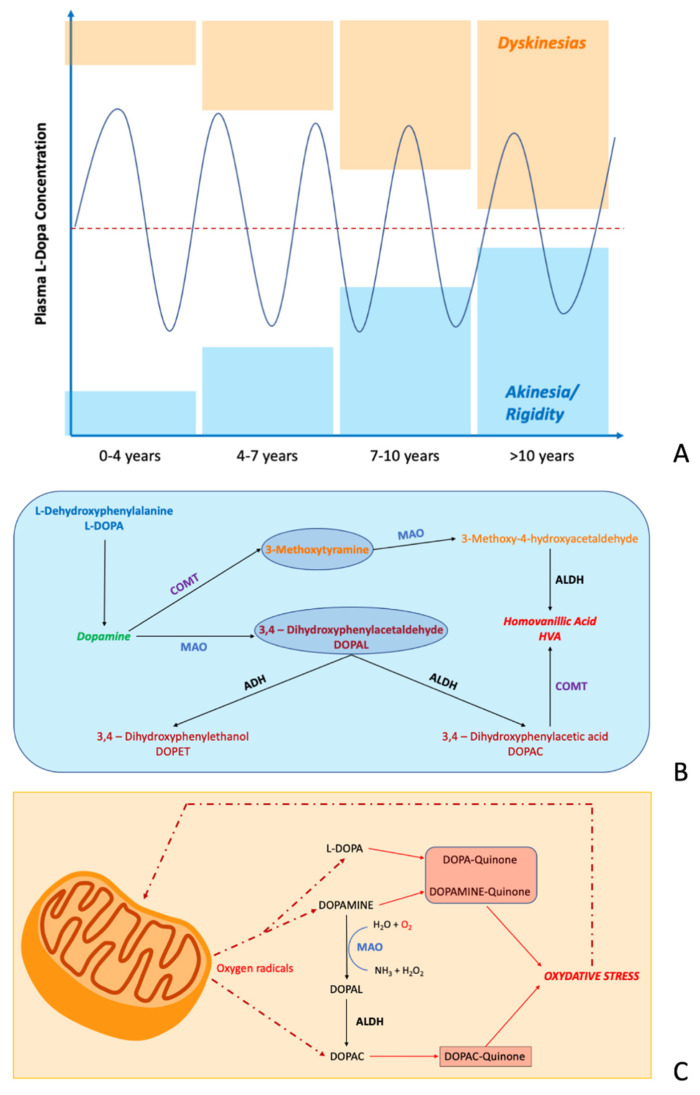
Figure 1
Figure 1
The metabolism of dopamine in Parkinson’s disease. (A) Progressive narrowing of the L-DOPA therapeutic window during disease progression, with the occurrence of an increased risk of developing dyskinesia (orange boxes) and motor blocks characterized by akinesia and rigidity (blue boxes). (B) Dopamine catabolism regulated by different enzymes including Mono-Amine-Oxidase (MAO), Catechol-O-Methyl Transferase (COMT), Aldehyde Hydrogenase (ADH) and Aldehyde De-Hydrogenase (ALDH). (C) Oxidation process of dopamine and L-DOPA in DOPA-quinone and Dopamine-quinone by oxygen radicals produced during mitochondrial respiration.
Figure 2
Figure 2
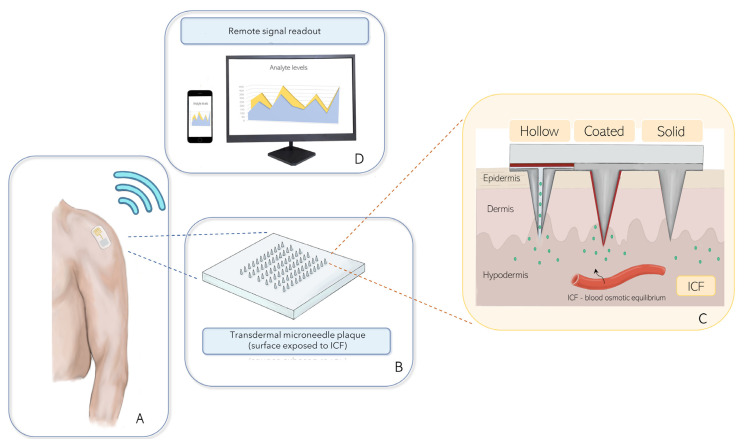
Possible application of a wearable transdermal MN-based biosensing system for the remote comprehensive monitoring of dopamine in patients with Parkinson’s disease. (A) Example of a wearable MN biosensing patch; (B) Simplified transdermal microneedle plaque; (C) Types of MN-based biosensors for detecting dopamine from the interstitial fluid; (D) Remote signal readout for telemedicine purposes.

References

    1. Armstrong M.J., Okun M.S. Diagnosis and Treatment of Parkinson Disease: A Review. JAMA. 2020;323:548–560. doi: 10.1001/jama.2019.22360. - DOI - PubMed
    1. Postuma R.B., Berg D., Stern M., Poewe W., Olanow C.W., Oertel W., Obeso J., Marek K., Litvan I., Lang A.E., et al. MDS Clinical Diagnostic Criteria for Parkinson’s Disease. Mov. Disord. 2015;30:1591–1601. doi: 10.1002/mds.26424. - DOI - PubMed
    1. Postuma R.B., Poewe W., Litvan I., Lewis S., Lang A.E., Halliday G., Goetz C.G., Chan P., Slow E., Seppi K., et al. Validation of the MDS Clinical Diagnostic Criteria for Parkinson’s Disease. Mov. Disord. 2018;33:1601–1608. doi: 10.1002/mds.27362. - DOI - PubMed
    1. Thévenot D.R., Toth K., Durst R.A., Wilson G.S. Electrochemical Biosensors: Recommended Definitions and Classification. Biosens. Bioelectron. 2001;16:121–131. doi: 10.1016/S0956-5663(01)00115-4. - DOI - PubMed
    1. Dickson D.W. Neuropathology of Parkinson Disease. Parkinsonism Relat. Disord. 2018;46((Suppl. 1)):S30–S33. doi: 10.1016/j.parkreldis.2017.07.033. - DOI - PMC - PubMed