


Identifying and Monitoring the Daily Routine of Seniors Living at Home
- PMID: 35161739
- PMCID: PMC8840439
- DOI: 10.3390/s22030992
Identifying and Monitoring the Daily Routine of Seniors Living at Home
Abstract
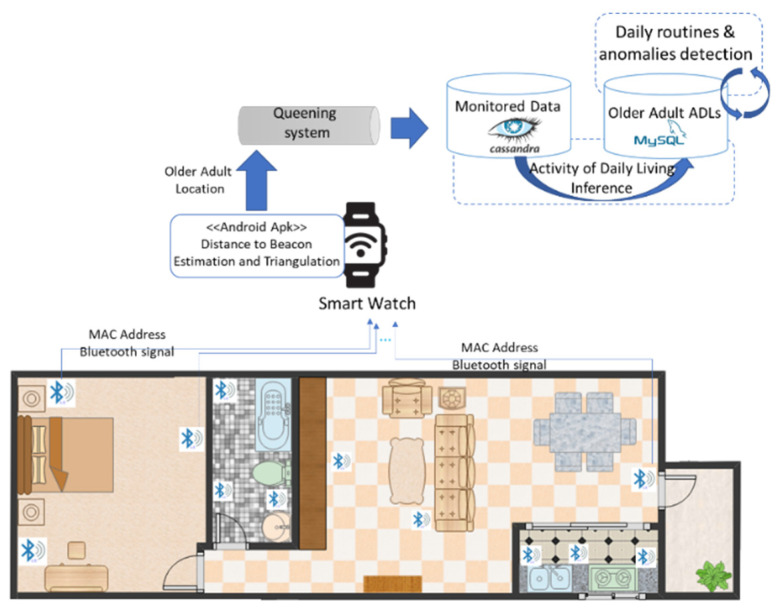
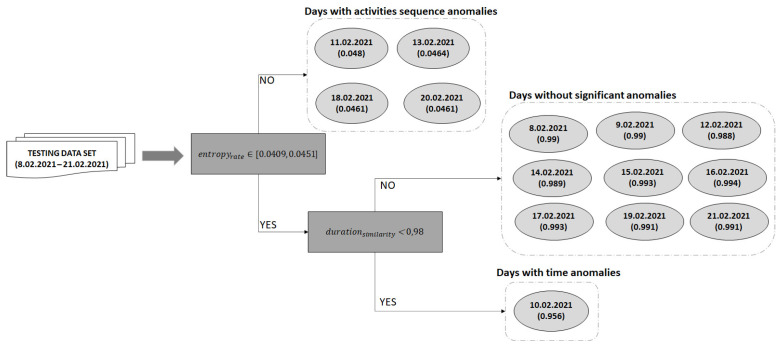
As the population in the Western world is rapidly aging, the remote monitoring solutions integrated into the living environment of seniors have the potential to reduce the care burden helping them to self-manage problems associated with old age. The daily routine is considered a useful tool for addressing age-related problems having additional benefits for seniors like reduced stress and anxiety, increased feeling of safety and security. In this paper, we propose a solution for identifying the daily routines of seniors using the monitored activities of daily living and for inferring deviations from the routines that may require caregivers' interventions. A Markov model-based method is defined to identify the daily routines, while entropy rate and cosine functions are used to measure and assess the similarity between the daily monitored activities in a day and the inferred routine. A distributed monitoring system was developed that uses Beacons and trilateration techniques for monitoring the activities of older adults. The results are promising, the proposed techniques can identify the daily routines with confidence concerning the activity duration of 0.98 and the sequence of activities in the interval of [0.0794, 0.0829]. Regarding deviation identification, our method obtains 0.88 as the best sensitivity value with an average precision of 0.95.
Keywords: Beacons; Markov model; activities of daily living; daily routine; deviations from routines; entropy rate and cosine functions.
Conflict of interest statement
The authors declare no conflict of interest.
Figures
References
-
- Ageing Europe—Statistics on Population Developments. [(accessed on 15 December 2021)]. Available online: https://ec.europa.eu/eurostat/statistics-explained/index.php?title=Agein....
-
- Vos E.E., de Bruin S.R., van der Beek A.J., Proper K.I. “It’s Like Juggling, Constantly Trying to Keep All Balls in the Air”: A Qualitative Study of the Support Needs of Working Caregivers Taking Care of Older Adults. Int. J. Environ. Res. Public Health. 2021;18:5701. doi: 10.3390/ijerph18115701. - DOI - PMC - PubMed
MeSH terms
Grants and funding
- AAL159/2020 H2HCare/Unitatea Executiva Pentru Finantarea Invatamantului Superior a Cercetarii Dezvoltarii si Inovarii
- AAL59/2018 Remind/Unitatea Executiva Pentru Finantarea Invatamantului Superior a Cercetarii Dezvoltarii si Inovarii
- AAL264/2021 engAGE/Unitatea Executiva Pentru Finantarea Invatamantului Superior a Cercetarii Dezvoltarii si Inovarii
- AAL162/2020 ReMember-Me/Unitatea Executiva Pentru Finantarea Invatamantului Superior a Cercetarii Dezvoltarii si Inovarii
LinkOut - more resources
Full Text Sources
Medical
Research Materials
