


HIV, Tuberculosis, and Food Insecurity in Africa-A Syndemics-Based Scoping Review
- PMID: 35162131
- PMCID: PMC8834641
- DOI: 10.3390/ijerph19031101
HIV, Tuberculosis, and Food Insecurity in Africa-A Syndemics-Based Scoping Review
Abstract
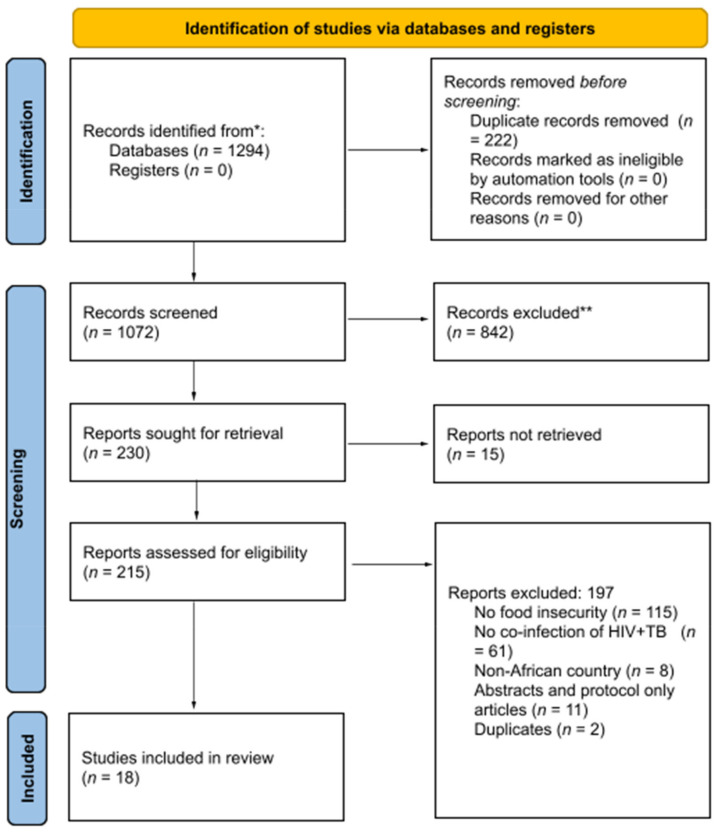
The double burden of HIV/AIDS and tuberculosis (TB), coupled with endemic and problematic food insecurity in Africa, can interact to negatively impact health outcomes, creating a syndemic. For people living with HIV/AIDS (PWH), food insecurity is a significant risk factor for acquiring TB due to the strong nutritional influences and co-occurring contextual barriers. We aim to synthesize evidence on the syndemic relationship between HIV/AIDS and TB co-infection and food insecurity in Africa. We conducted a scoping review of studies in Africa that included co-infected adults and children, with evidence of food insecurity, characterized by insufficient to lack of access to macronutrients. We sourced information from major public health databases. Qualitative, narrative analysis was used to synthesize the data. Of 1072 articles screened, 18 articles discussed the syndemic effect of HIV/AIDS and TB co-infection and food insecurity. Reporting of food insecurity was inconsistent, however, five studies estimated it using a validated scale. Food insecure co-infected adults had an average BMI of 16.5-18.5 kg/m2. Negative outcomes include death (n = 6 studies), depression (n = 1 study), treatment non-adherence, weight loss, wasting, opportunistic infections, TB-related lung diseases, lethargy. Food insecurity was a precursor to co-infection, especially with the onset/increased incidence of TB in PWH. Economic, social, and facility-level factors influenced the negative impact of food insecurity on the health of co-infected individuals. Nutritional support, economic relief, and psychosocial support minimized the harmful effects of food insecurity in HIV-TB populations. Interventions that tackle one or more components of a syndemic interaction can have beneficial effects on health outcomes and experiences of PWH with TB in Africa.
Keywords: Africa; HIV/AIDs; food insecurity; syndemics; tuberculosis.
Conflict of interest statement
The authors declare no conflict of interest.
Figures

References
-
- HIV/AIDS UNPo . UNAIDS DATA 2020. UNAIDS; Geneva, Switzerland: 2020. [(accessed on 9 December 2021)]. Available online: https://www.unaids.org/sites/default/files/media_asset/2020_aids-data-bo....
-
- World Health Organization HIV/AIDS. WHO Regional Office for Africa. Published 2021. [(accessed on 9 December 2021)]. Available online: https://www.afro.who.int/health-topics/hivaids.
-
- HIV/AIDS UNPo . UNAIDS DATA 2018. UNAIDS; Geneva, Switzerland: 2018. [(accessed on 9 December 2021)]. Available online: https://www.unaids.org/sites/default/files/media_asset/unaids-data-2018_....
-
- World Health Organization . Consolidated Guidelines on the Use of Antiretroviral Drugs for Treating and Preventing HIV Infection 2016 Recommendations for a Public Health Approach. World Health Organization; Geneva, Switzerland: 2016. - PubMed
-
- World Health Organization . Consultation on Nutrition and HIV/AIDS in Africa: Evidence, Lessons, and Recommendations for Action. Durban, South Africa. World Health Organization; Geneva, Switzerland: 2015.
Publication types
MeSH terms
LinkOut - more resources
Full Text Sources
Medical
