


Characteristics of Official Wheelchair Basketball Games in Hot and Temperate Conditions
- PMID: 35162273
- PMCID: PMC8835511
- DOI: 10.3390/ijerph19031250
Characteristics of Official Wheelchair Basketball Games in Hot and Temperate Conditions
Abstract
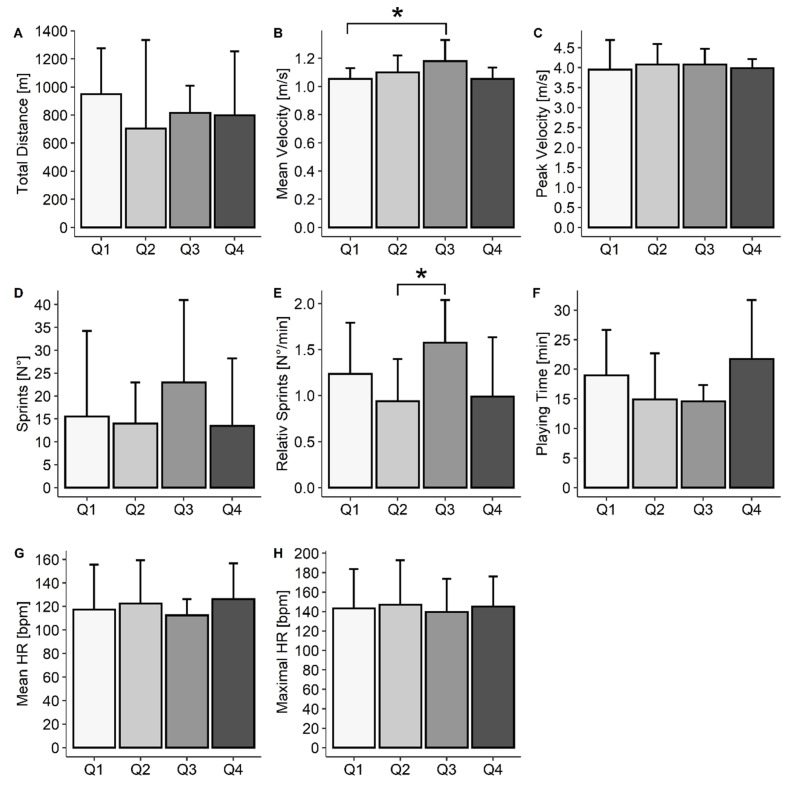
This study compared performance parameters of two wheelchair basketball games under hot (30.3 °C, 52% relative humidity) and temperate (21.6 °C, 30% relative humidity) environmental conditions and described the characteristics of wheelchair basketball. Eight wheelchair basketball players from two teams were monitored during two games using an indoor position tracking system. Total distance, mean- and peak-speed, playing-time, number of sprints, sprints per minute, heart rate and rate of perceived exertion were recorded. Additionally, athletes with a lesion level above and below T6 were compared. No measured parameter differed between the games. Across quarters (Q) mean velocity (m/s) (Q1: 1.01; Q2: 1.10; Q3: 1.18; Q4: 1.06; p < 0.001) and sprints per minute (Q1: 16; Q2: 14; Q3: 23; Q4: 14; p = 0.033) differed significantly, independent of the conditions. Descriptive statistics did not reveal differences between the groups with a lesion level below or above T6. In the present study, hot environmental conditions seemed not to have an impact on activity parameters of wheelchair basketball players. It was speculated that the game intensity and therefore metabolic heat production was too low; consequently, the athletes had a sufficient heat loss to prevent a decrease in performance during the play in hot conditions.
Keywords: exercise; heat stress; spinal cord injury; thermoregulation.
Conflict of interest statement
The authors declare no conflict of interest.
Figures

References
-
- Bloxham L.A., Bell G.J., Bhambhani Y., Steadward R.D. Time Motion Analysis and Physiological Profile of Canadian World Cup Wheelchair Basketball Players. Sports Med. Train. Rehabil. 2001;10:183–198. doi: 10.1080/10578310210398. - DOI
MeSH terms
LinkOut - more resources
Full Text Sources
