


Childlessness: Concept Analysis
- PMID: 35162484
- PMCID: PMC8834711
- DOI: 10.3390/ijerph19031464
Childlessness: Concept Analysis
Abstract
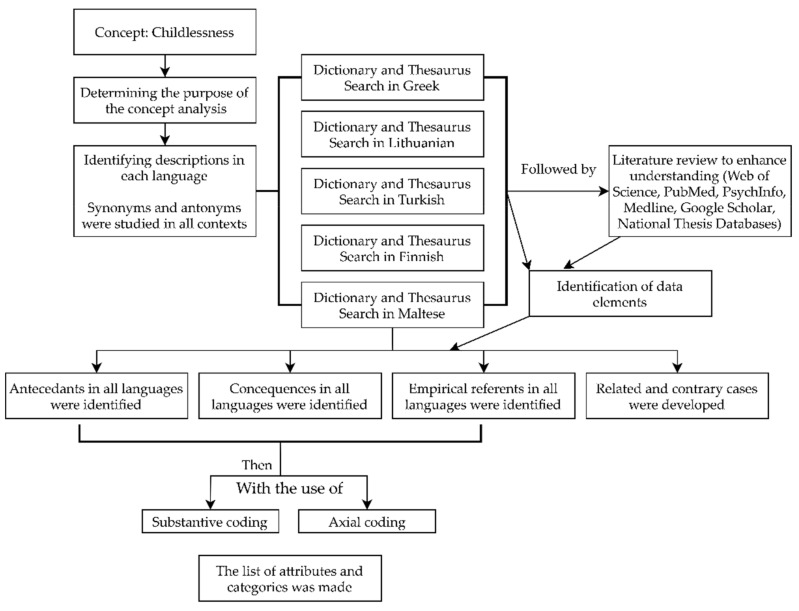
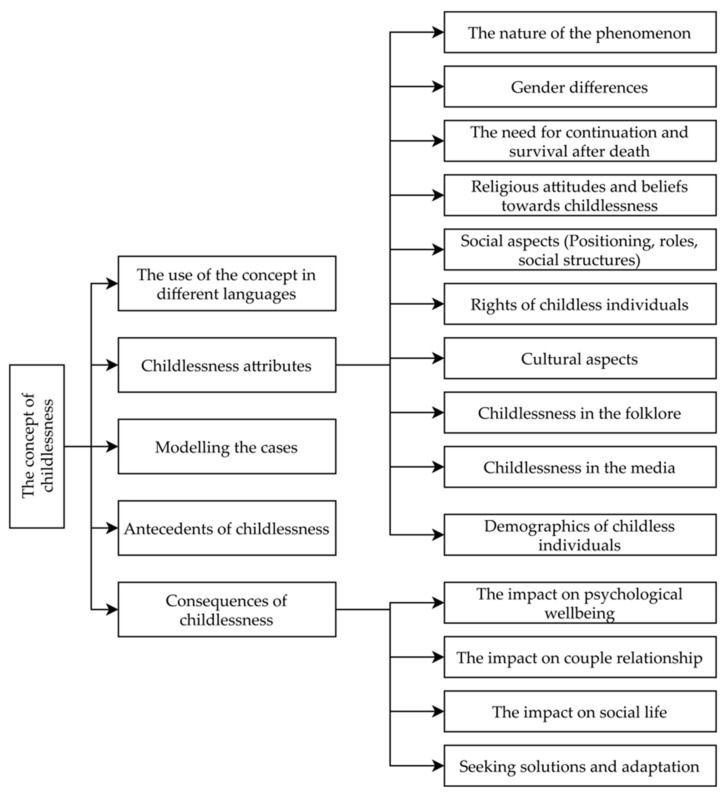
The purpose of this concept analysis is to explore childlessness and provide understanding to professionals involved in the field of infertility. Walker and Avant's method was used to identify descriptions, antecedents, consequences, and empirical referents of the concept. A model with related and contrary cases was developed. The analysis was based on the definition of the term in major dictionaries in the Greek, Lithuanian, Finnish, Maltese, and Turkish languages, while further literature searches utilized the Web of Science, PubMed, PsychInfo, Medline, Google Scholar, and National Thesis Databases. The literature search was limited to papers/books published in the authors' national languages and English. As a result, childlessness is defined as the absence of children in the life of an individual, and this can be voluntary or involuntary. However, the deeper analysis of the concept may be preceded and amplified through cultural, psychological, biological, philosophical, theological, sociological, anthropological, and linguistic aspects throughout history. These elements presented challenges for childless individuals, ultimately influencing their choices to resort to alternative ways of becoming parents, such as in vitro fertilization (IVF), surrogacy, adoption, or other forms of childbearing. Historically, childlessness has been viewed with negative connotations due to its potential impact on the survival of the human species. This negativity can be directed even to individuals who may decide to opt to voluntarily remain childfree. The long-term impact of the experience, both on an individual and collective level, continues to cause pain to those who are involuntarily childless. In conclusion, health professionals and other stakeholders who have a deep understanding of childlessness, including the antecedents and attributes, can minimize the potential negative consequences of those factors contributing to childlessness, whether voluntary or involuntary. In fact, they can capitalize on a powerful impact of change adaptation by providing support to those in their practice to recover the lost homeostasis.
Keywords: antinatalism; barrenness; child-free; childlessness; infertile; sterile.
Conflict of interest statement
The authors declare that they have no conflict of interest.
Figures
References
-
- Miettinen A., Rotkirch A., Szalma I., Donno A., Tanturri M.L. Increasing childlessness in Europe: Time trends and country differences. Families and Societies. Work. Pap. Ser. 2015;33:1–46.
-
- World Health Organization . International Classification of Diseases, 11th Revision (ICD-11) WHO; Geneva, Switzerland: 2018. [(accessed on 2 June 2021)]. Available online: https://www.who.int/news-room/fact-sheets/detail/infertility.
-
- Biaggi C. The significance of the nudity, obesity and sexuality of the Maltese goddess figures. In: Bonanno A., editor. Archaeology and Fertility Cult in the Ancient Mediterranean, Proceedings of the First International Conference on Archaeology of the Ancient Mediterranean, Msida, Malta, 2–5 September 1985. University of Malta Press; Msida, Malta: 1986. pp. 131–140.
-
- Istomina N., Razbadauskas A. Socialiniai ir multikultūriniai nevaisingumo aspektai Lietuvoje (The social and multicultural problems of infertility in Lithuania) Tiltai. 2003;4:65–73.
Publication types
MeSH terms
LinkOut - more resources
Full Text Sources
Medical
Research Materials
