


The Life Histories of Intermediate Hosts and Parasites of Schistosoma haematobium and Schistosoma mansoni in the White Nile River, Sudan
- PMID: 35162527
- PMCID: PMC8835159
- DOI: 10.3390/ijerph19031508
The Life Histories of Intermediate Hosts and Parasites of Schistosoma haematobium and Schistosoma mansoni in the White Nile River, Sudan
Abstract
Background: The epidemiology of schistosomiasis transmission varies depending on the circumstances of the surrounding water bodies and human behaviors. We aimed to explore cercarial emergence patterns from snails that are naturally affected by human schistosomiasis and non-human trematodes. In addition, this study aimed to explore how schistosomiasis infection affects snail survival, reproduction, and growth.
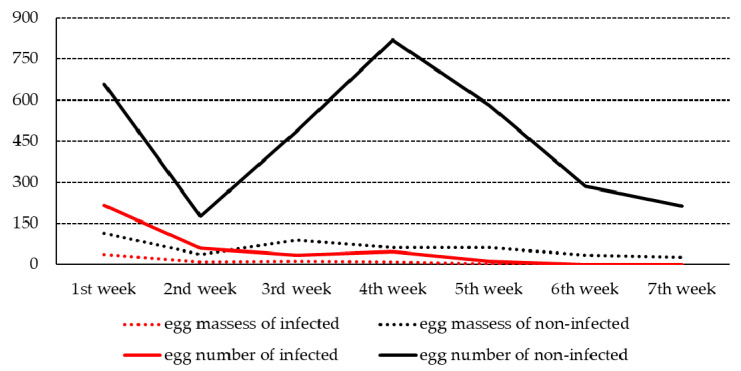
Methods: We measured the survival rate, fecundity, and size of Biomphalaria pfeifferi snails and the cercarial rhythmicity of S. haematobium and S. mansoni. The number of egg masses, eggs per egg mass, and snail deaths were counted for 7 weeks. The survival rate and cumulative hazard were assessed for infected and non-infected snails.
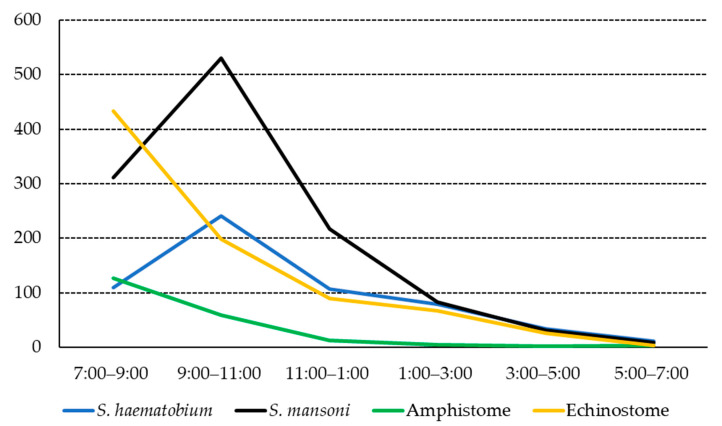
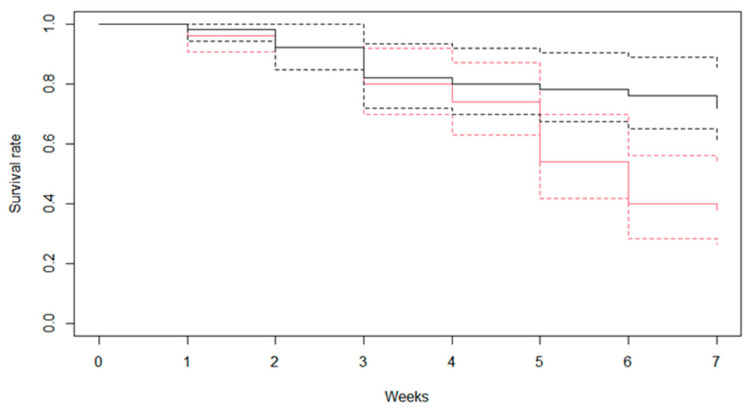
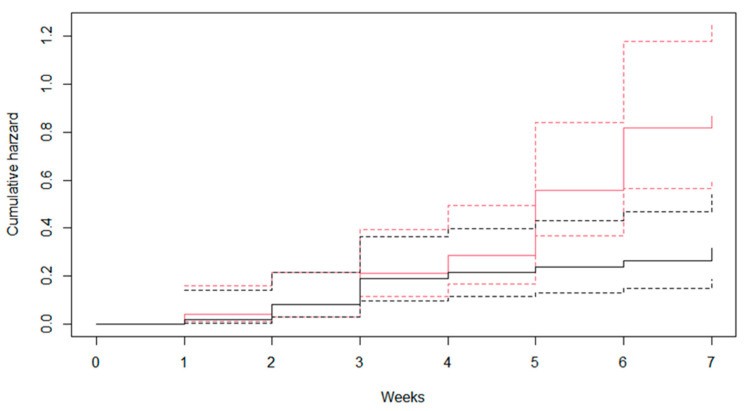
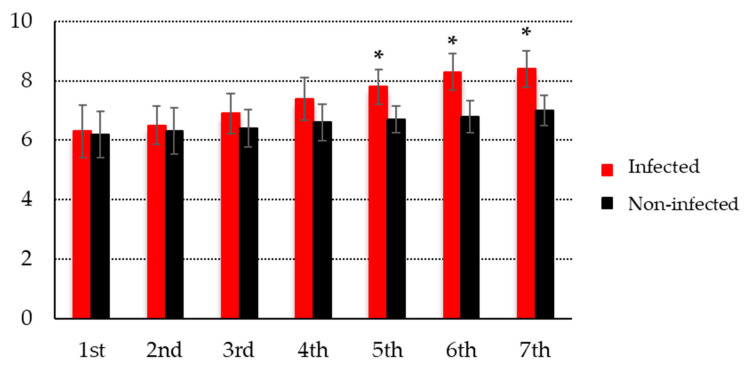
Results: S. haematobium and S. mansoni cercariae peaked at 9:00-11:00 a.m. Infection significantly reduced the survival rate of B. pfeifferi, which was 35% and 51% for infected and non-infected snails, respectively (p = 0.02), at 7 weeks after infection. The hazard ratio of death for infected snails compared to non-infected snails was 1.65 (95% confidence interval: 1.35-1.99; p = 0.01).
Conclusions: An understanding of the dynamics of schistosomiasis transmission will be helpful for formulating schistosomiasis control and elimination strategies. Cercarial rhythmicity can be reflected in health education, and the reproduction and survival rate of infected snails can be used as parameters for developing disease modeling.
Keywords: Biomphalaria pfeifferi; Bulinus truncatus; Sudan; cercarial rhythmicity; cumulative hazard ratio; schistosomiasis; snail; survival rate.
Conflict of interest statement
The authors declare no conflict of interest.
Figures
References
-
- WHO . Factsheet/Schistosomiasis. World Health Organization; Geneva, Switzerland: 2021. [(accessed on 30 November 2021)]. Available online: https://www.who.int/news-room/fact-sheets/detail/schistosomiasis.
-
- WHO . Global Health Estimates 2016: Deaths by Cause, Age, Sex, by Country and by Region, 2000–2016. World Health Organization; Geneva, Switzerland: 2019.
-
- WHO . Prevention and Control of Schistosomiasis and Soil-Transmitted Helminthiasis (WHO/CDS/CPE/PVC/2004.9) World Health Organization; Geneva, Switzerland: 2004.
-
- Sturrock H.J., Picon D., Sabasio A., Oguttu D., Robinson E., Lado M., Rumunu J., Brooker S., Kolaczinski J.H. Integrated mapping of neglected tropical diseases: Epidemiological findings and control implications for northern Bahr-el-Ghazal State, Southern Sudan. PLoS Negl. Trop. Dis. 2009;3:e537. doi: 10.1371/journal.pntd.0000537. - DOI - PMC - PubMed
MeSH terms
LinkOut - more resources
Full Text Sources
Research Materials
