


An Electromyographic Analysis of Romanian, Step-Romanian, and Stiff-Leg Deadlift: Implication for Resistance Training
- PMID: 35162922
- PMCID: PMC8835508
- DOI: 10.3390/ijerph19031903
An Electromyographic Analysis of Romanian, Step-Romanian, and Stiff-Leg Deadlift: Implication for Resistance Training
Abstract
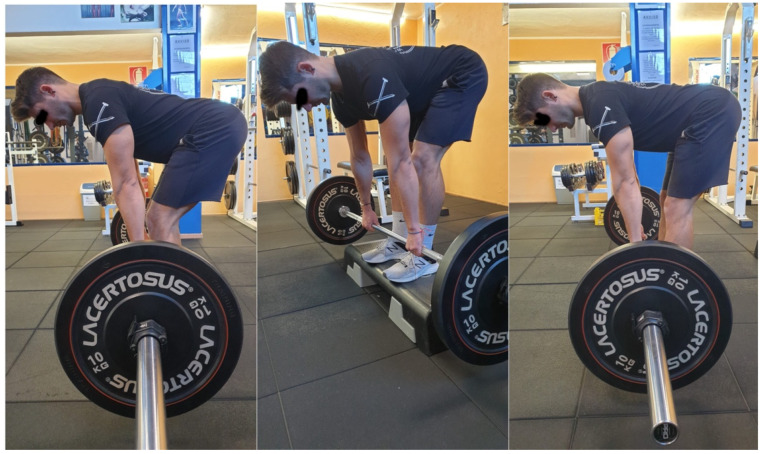
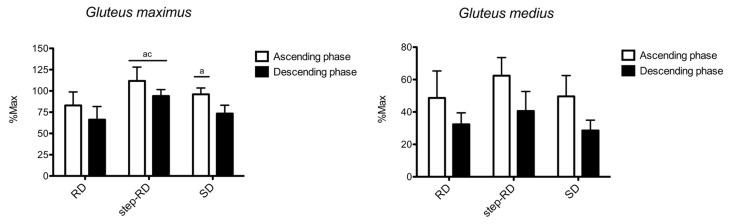
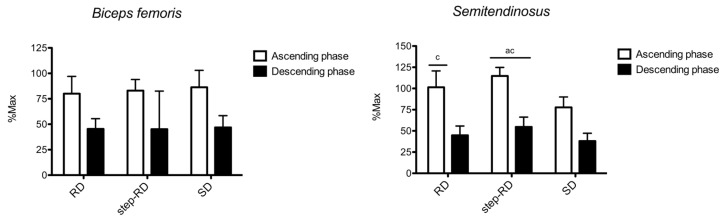
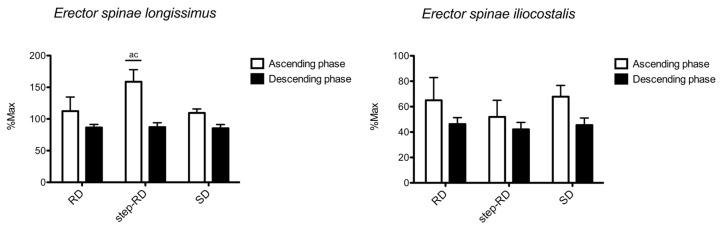
The present study examined the posterior chain muscle excitation in different deadlift variations. Ten competitive bodybuilders (training seniority of 10.6 ± 1.8 years) performed the Romanian (RD), Romanian standing on a step (step-RD), and stiff-leg deadlift (SD) with an 80% 1-RM. The excitation of the gluteus maximus, gluteus medius, biceps femoris, semitendinosus, erector spinae longissimus, and iliocostalis was assessed during both the ascending and descending phases. During the ascending phase, the RMS of the gluteus maximus was greater in the step-RD than in the RD (effect size (ES): 1.70, 0.55/2.84) and SD (ES: 1.18, 0.11/2.24). Moreover, a greater RMS was found in the SD than in the RD (ES: 0.99, 0.04/1.95). The RMS of the semitendinosus was greater in the step-RD than in the RD (ES: 0.82, 0.20/1.44) and SD (ES: 3.13, 1.67/4.59). Moreover, a greater RMS was found in the RD than in the SD (ES: 1.38, 0.29/2.48). The RMS of the longissimus was greater in the step-RD than in the RD (ES: 2.12, 0.89/3.34) and SD (ES: 3.28, 1.78/4.78). The descending phase had fewer differences between the exercises. No further differences between the exercises were found. The step-RD increased the overall excitation of the posterior chain muscles, possibly because of the greater range of movement and posterior muscle elongation during the anterior flexion. Moreover, the RD appeared to target the semitendinosus more than the SD, while the latter excited the gluteus maximus more.
Keywords: electromyography; erector spinae; gluteus; hamstrings; muscle activation; muscle excitation; strength training; weight training.
Conflict of interest statement
The authors declare no conflict of interest.
Figures
References
-
- Coratella G., Beato M., Bertinato L., Milanese C., Venturelli M., Schena F. Including the Eccentric Phase in Resistance Training to Counteract the Effects of Detraining in Women: A Randomized Controlled Trial. [(accessed on 8 December 2021)]; Available online: https://pubmed.ncbi.nlm.nih.gov/34537804/ - PMC - PubMed
-
- Bezerra E.S., Simao R., Fleck S.J., Paz G.A., Maia M.F., Costa P.B., Amadio A.C., Miranda H., Serrao J.C. Electromyographic activity of lower body muscles during deadlift and stiff-legged deadlift. J. Exerc. Physiol. Online. 2013;16:12–22.
MeSH terms
LinkOut - more resources
Full Text Sources
Miscellaneous
