Review
. 2022 Jan 21;23(3):1209.
doi: 10.3390/ijms23031209.

Clinical Implication of Phosphodiesterase-4-Inhibition

Affiliations
Review

Clinical Implication of Phosphodiesterase-4-Inhibition

Martin Alexander Schick et al. Int J Mol Sci. .

Abstract

The pleiotropic function of 3',5'-cyclic adenosine monophosphate (cAMP)-dependent pathways in health and disease led to the development of pharmacological phosphodiesterase inhibitors (PDE-I) to attenuate cAMP degradation. While there are many isotypes of PDE, a predominant role of PDE4 is to regulate fundamental functions, including endothelial and epithelial barrier stability, modulation of inflammatory responses and cognitive and/or mood functions. This makes the use of PDE4-I an interesting tool for various therapeutic approaches. However, due to the presence of PDE4 in many tissues, there is a significant danger for serious side effects. Based on this, the aim of this review is to provide a comprehensive overview of the approaches and effects of PDE4-I for different therapeutic applications. In summary, despite many obstacles to use of PDE4-I for different therapeutic approaches, the current data warrant future research to utilize the therapeutic potential of phosphodiesterase 4 inhibition.

Keywords: PDE; PDE4-I; phosphodiesterase; phosphodiesterase-4; phosphodiesterase-inhibitors.


Conflict of interest statement

The authors declare no conflict of interest.

Figures
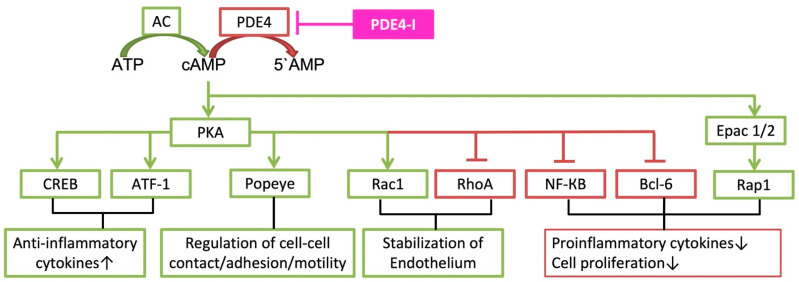
Figure 1
Figure 1
Description of cAMP cascades, which are involved in clinical implications of phosphodiesterase-4-inhibition. ATP (adenosine triphosphate); AC (adenylyl cyclase); cAMP (3′,5′-cyclic adenosine monophosphate); PDE4 (phosphodiesterase-4); PDE4-I (phosphodiesterase-4-inhibitor); 5’AMP (5′-adenosine monophosphate); PKA (protein kinase A); Epac 1/2 (exchange protein directly activated by cAMP 1 and 2); CREB (cAMP response element binding protein); ATF-1 (cAMP-dependent activating transcription factor 1); Popeye (Popeye domain family Rac1 (Ras-related C3 botulinum toxin substrate 1)); RhoA (Ras homolog family member A); NF-κB (nuclear factor ‘kappa-light-chain-enhancer’ of activated B-cells); Bcl-6 (B-cell lymphoma 6 protein); Rap 1 (Ras-related protein 1).
Figure 2
Figure 2
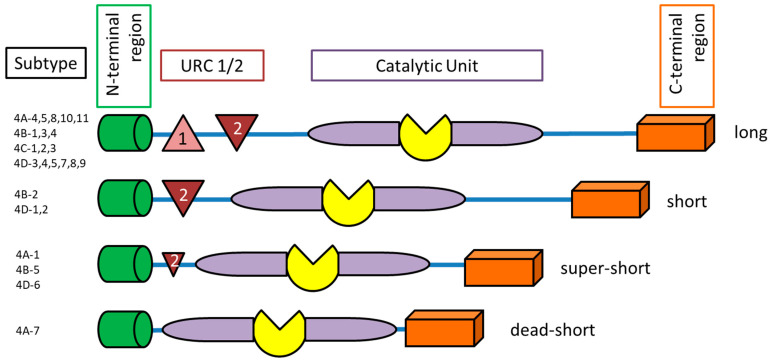
Schematic structure of phosphodiesterase-4 isoforms. UCR (upstream conserved region).
Figure 3
Figure 3
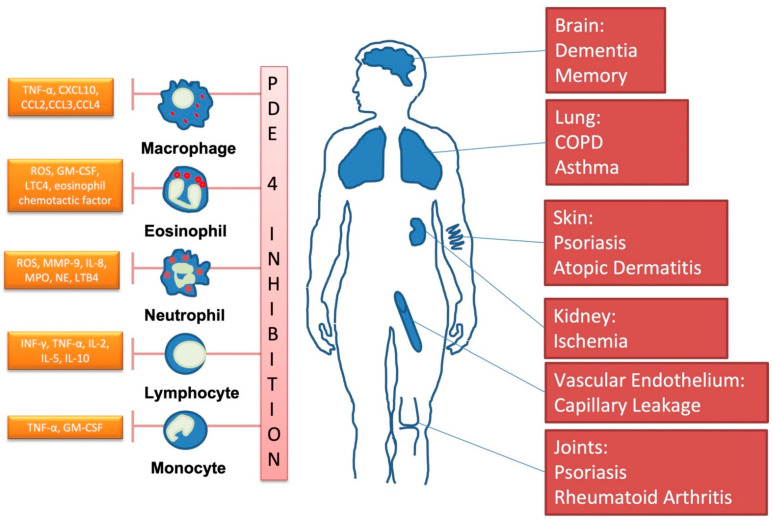
Important clinical targets of phosphodiesterase-4-inhibition. (Own drawing, modified based on [23]).

References

    1. Baillie G.S. Compartmentalized signalling: Spatial regulation of cAMP by the action of compartmentalized phosphodiesterases. FEBS J. 2009;276:1790–1799. doi: 10.1111/j.1742-4658.2009.06926.x. - DOI - PubMed
    1. Beavo J.A., Brunton L.L. Cyclic nucleotide research—Still expanding after half a century. Nat. Rev. Mol. Cell Biol. 2002;3:710–718. doi: 10.1038/nrm911. - DOI - PubMed
    1. Tibbo A.J., Baillie G.S. Phosphodiesterase 4B: Master regulator of brain signaling. Cells. 2020;9:1254. doi: 10.3390/cells9051254. - DOI - PMC - PubMed
    1. Sanders O., Rajagopal L. Phosphodiesterase inhibitors for Alzheimer’s disease: A systematic review of clinical trials and epidemiology with a mechanistic rationale. J. Alzheimers Dis. Rep. 2020;4:185–215. doi: 10.3233/ADR-200191. - DOI - PMC - PubMed
    1. Norman T.R., Judd F.K., Burrows G.D. New pharmacological approaches to the management of depression: From theory to clinical practice. Aust. N. Z. J. Psychiatry. 1992;26:73–81. doi: 10.3109/00048679209068311. - DOI - PubMed

MeSH terms

Substances