


An Overview on Single-Cell Technology for Hepatocellular Carcinoma Diagnosis
- PMID: 35163329
- PMCID: PMC8835749
- DOI: 10.3390/ijms23031402
An Overview on Single-Cell Technology for Hepatocellular Carcinoma Diagnosis
Abstract
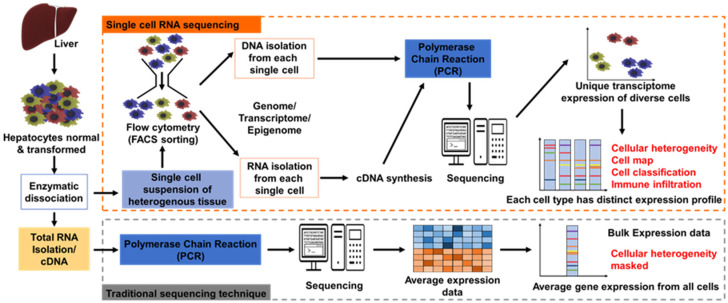
Hepatocellular carcinoma is a primary liver cancer caused by the accumulation of genetic mutation patterns associated with epidemiological conditions. This lethal malignancy exhibits tumor heterogeneity, which is considered as one of the main reasons for drug resistance development and failure of clinical trials. Recently, single-cell technology (SCT), a new advanced sequencing technique that analyzes every single cell in a tumor tissue specimen, aids complete insight into the genetic heterogeneity of cancer. This helps in identifying and assessing rare cell populations by analyzing the difference in gene expression pattern between individual cells of single biopsy tissue which normally cannot be identified from pooled cell gene expression pattern (traditional sequencing technique). Thus, SCT improves the clinical diagnosis, treatment, and prognosis of hepatocellular carcinoma as the limitations of other techniques impede this cancer research progression. Application of SCT at the genomic, transcriptomic, and epigenomic levels to promote individualized hepatocellular carcinoma diagnosis and therapy. The current review has been divided into ten sections. Herein we deliberated on the SCT, hepatocellular carcinoma diagnosis, tumor microenvironment analysis, single-cell genomic sequencing, single-cell transcriptomics, single-cell omics sequencing for biomarker development, identification of hepatocellular carcinoma origination and evolution, limitations, challenges, conclusions, and future perspectives.
Keywords: RNA sequencing; hepatocellular carcinoma; liver cancer; single-cell technology.
Conflict of interest statement
The authors declare no conflict of interest.
Figures
References
-
- Abou-Alfa G.K., Jarnagin W., El Dika I., D’Angelica M., Lowery M., Brown K., Ludwig E., Kemeny N., Covey A., Crane C.H. Abeloff’s Clinical Oncology. Elsevier; Amsterdam, The Netherlands: 2020. Liver and Bile Duct Cancer; pp. 1314–1341.e11.
-
- Hui Y., Zeng H., Feng Y., Qin W., Chen P., Huang L., Zhong W., Lin L., Lv H., Qin X. Regulatory Role of SFN Gene in Hepatocellular Carcinoma and Its Mechanism. Biotechnol. Bioprocess Eng. 2021;26:375–383. doi: 10.1007/s12257-020-0292-2. - DOI
Publication types
MeSH terms
Grants and funding
LinkOut - more resources
Full Text Sources
Medical
