Review
. 2022 Jan 26;23(3):1415.
doi: 10.3390/ijms23031415.

Recent Progress in Biopolymer-Based Hydrogel Materials for Biomedical Applications

Affiliations
Review

Recent Progress in Biopolymer-Based Hydrogel Materials for Biomedical Applications

Ayaz Mahmood et al. Int J Mol Sci. .

Abstract

Hydrogels from biopolymers are readily synthesized, can possess various characteristics for different applications, and have been widely used in biomedicine to help with patient treatments and outcomes. Polysaccharides, polypeptides, and nucleic acids can be produced into hydrogels, each for unique purposes depending on their qualities. Examples of polypeptide hydrogels include collagen, gelatin, and elastin, and polysaccharide hydrogels include alginate, cellulose, and glycosaminoglycan. Many different theories have been formulated to research hydrogels, which include Flory-Rehner theory, Rubber Elasticity Theory, and the calculation of porosity and pore size. All these theories take into consideration enthalpy, entropy, and other thermodynamic variables so that the structure and pore sizes of hydrogels can be formulated. Hydrogels can be fabricated in a straightforward process using a homogeneous mixture of different chemicals, depending on the intended purpose of the gel. Different types of hydrogels exist which include pH-sensitive gels, thermogels, electro-sensitive gels, and light-sensitive gels and each has its unique biomedical applications including structural capabilities, regenerative repair, or drug delivery. Major biopolymer-based hydrogels used for cell delivery include encapsulated skeletal muscle cells, osteochondral muscle cells, and stem cells being delivered to desired locations for tissue regeneration. Some examples of hydrogels used for drug and biomolecule delivery include insulin encapsulated hydrogels and hydrogels that encompass cancer drugs for desired controlled release. This review summarizes these newly developed biopolymer-based hydrogel materials that have been mainly made since 2015 and have shown to work and present more avenues for advanced medical applications.

Keywords: biopolymer; drug delivery; hydrogel; polypeptide; polysaccharide; protein; tissue engineering.


Conflict of interest statement

The authors declare no conflict of interest.

Figures
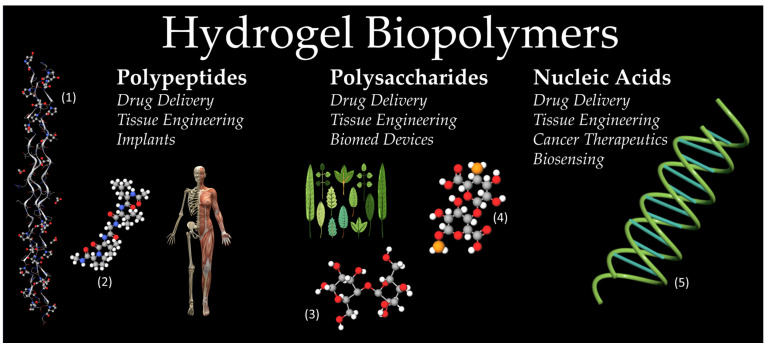
Figure 1
Figure 1
Examples of typical hydrogel biopolymers. Polypeptide column showcases collagen (1) and elastin (2) structures, which are found in musculoskeletal systems. Polysaccharide column shows the cellulose (3) structure and alginate (4) structures, as the majority of polysaccharides are derived from plant life. A double-helix DNA molecule (5) is shown as a typical nucleic acid. (Images of the musculoskeletal system and the plant life are open source provided by pixabay.com, and images of collagen, elastin, cellulose and alginate are open source provided by molview.org).
Figure 2
Figure 2
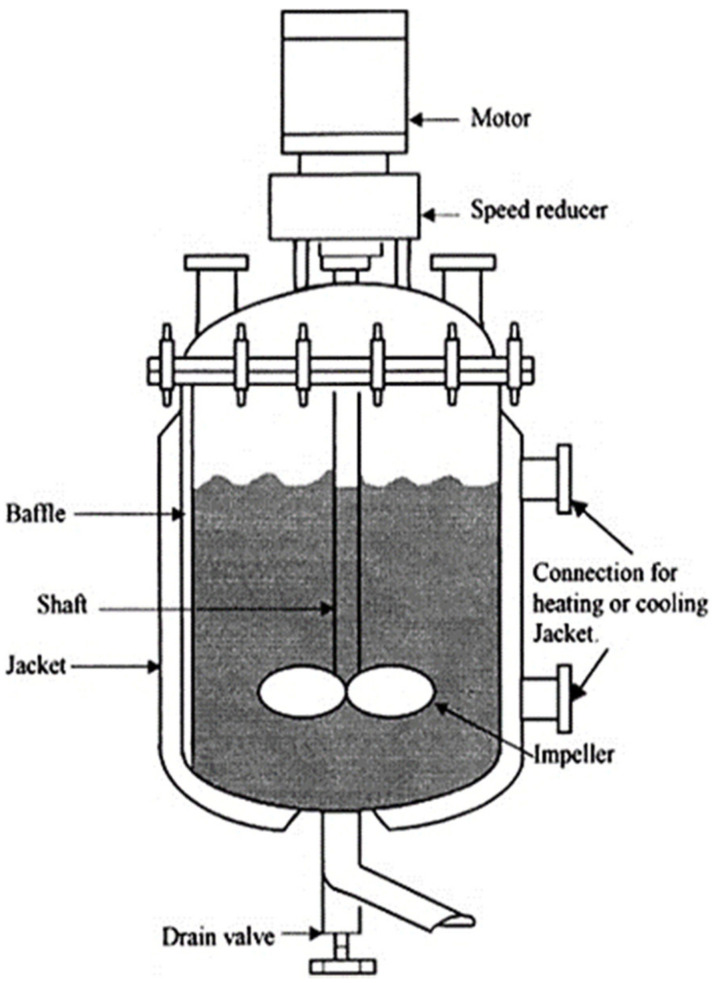
Hydrogel fabrication method in controlled batch reactor chamber. Parts such as motor, speed reducer, baffle, shaft, jacket, connection for heating or cooling, impeller, and drain valve are presented [19]. Adapted with permission from Elsevier, 2015.
Figure 3
Figure 3
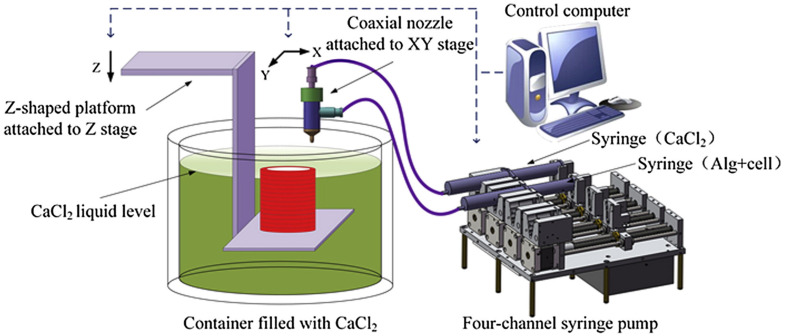
3D printing/bioprinting system with a coaxial nozzle. This is an example of alginate and cells (first syringe) being printed with CaCl2 (second syringe) on a Z-shaped platform from the coaxial nozzle in a CaCl2 liquid bath [74]. Adapted with permission from Elsevier, 2015.
Figure 4
Figure 4
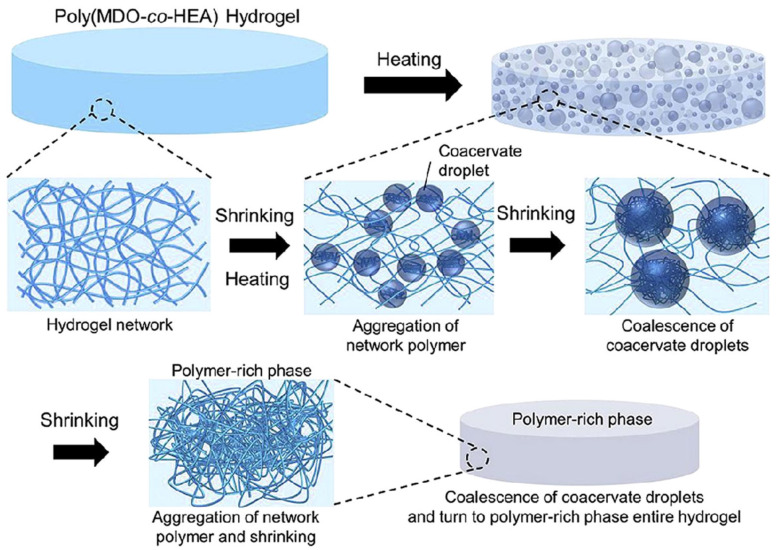
Hydrogel crosslinking on the molecular level, displaying change from raw material and solution to finished crosslinked hydrogel product that can be later used for several different biomedical applications [77]. Adapted with permission from Elsevier, 2019.
Figure 5
Figure 5
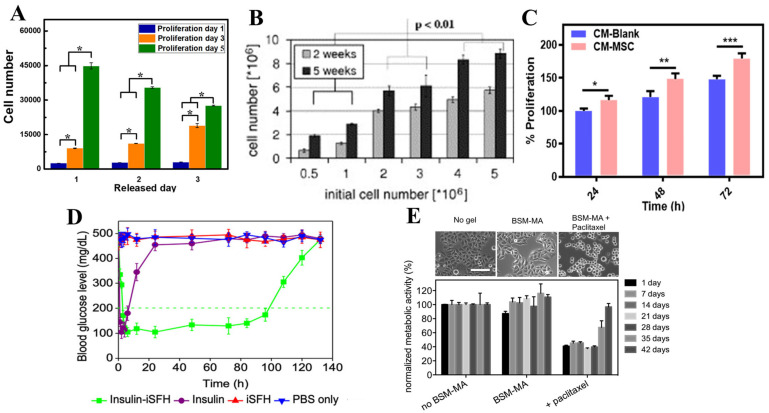
(A) The proliferation of the C2C12 cells on dextran-graft-aniline tetramer-graft-4-formylbenzoic acid and N-carboxyethyl chitosan hydrogels after being released for 1–3 days (* p < 0.05) [82]. (B) The effects of the initial chondrocyte cell number on the cell proliferation of fibrin with calcium ion hydrogels in weeks 2 and 5 [85]. (C) The proliferation of fibroblast from carboxymethyl chitosan and carboxymethyl cellulose dialdehyde hydrogel with and without mesenchymal stem cells (*** p ≤ 0.001, ** p ≤ 0.01, and * p ≤ 0.05) [86]. (D) Blood glucose levels with several methods demonstrate that insulin-loaded injectable silk-fibroin protein hydrogel maintains blood glucose levels the longest [87]. (E) Changes in morphological and metabolic activity of HeLA epithelial cancer cells during release of anti-cancer drug paclitaxel from mucin glycoprotein-based hydrogel (scale bar is 40 μm) [88]. Reproduced with permissions: (A) is from Elsevier, 2019; (B) is from Elsevier, 2007; (C) is from American Chemical Society, 2019; (D) is from American Chemical Society, 2020; (E) is from Elsevier, 2015.
Figure 6
Figure 6
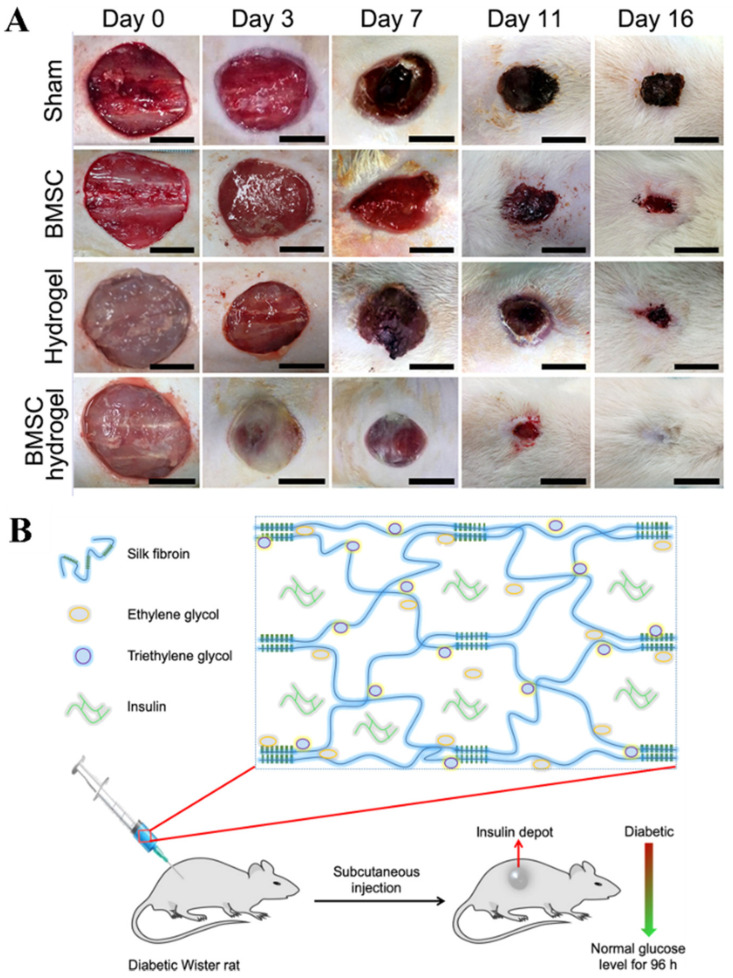
(A) Wound closure after different treatments visually presenting that chitin nanofiber-based hydrogel encapsulating bone marrow mesenchymal cells provide the best outcomes [92]. (B) Silk fibroin with additives of ethylene glycol and triethylene glycol to release insulin over 4 days [87]. Reproduced with permissions: (A) is from John Wiley and Sons, 2017; (B) is from American Chemical Society, 2020.

References

    1. Gough C.R., Callaway K., Spencer E., Leisy K., Jiang G., Yang S., Hu X. Biopolymer-Based Filtration Materials. ACS Omega. 2021;6:11804–11812. doi: 10.1021/acsomega.1c00791. - DOI - PMC - PubMed
    1. Tabani H., Alexovic M., Sabo J., Ramos Payan M. An overview on the recent applications of agarose as a green biopolymer in micro-extraction-based sample preparation techniques. Talanta. 2021;224:121892. doi: 10.1016/j.talanta.2020.121892. - DOI - PubMed
    1. Pattanashetti N.A., Heggannavar G.B., Kariduraganavar M.Y. Smart Biopolymers and their Biomedical Applications. Procedia Manuf. 2017;12:263–279. doi: 10.1016/j.promfg.2017.08.030. - DOI
    1. Gough C.R., Rivera-Galletti A., Cowan D.A., Salas-de la Cruz D., Hu X. Protein and Polysaccharide-Based Fiber Materials Generated from Ionic Liquids: A Review. Molecules. 2020;25:3362. doi: 10.3390/molecules25153362. - DOI - PMC - PubMed
    1. Bealer E.J., Onissema-Karimu S., Rivera-Galletti A., Francis M., Wilkowski J., Salas-de la Cruz D., Hu X. Protein-Polysaccharide Composite Materials: Fabrication and Applications. Polymers. 2020;12:464. doi: 10.3390/polym12020464. - DOI - PMC - PubMed

LinkOut - more resources