


Diagnostic Performance of Pancreatic Cytology with the Papanicolaou Society of Cytopathology System: A Systematic Review, before Shifting into the Upcoming WHO International System
- PMID: 35163571
- PMCID: PMC8835850
- DOI: 10.3390/ijms23031650
Diagnostic Performance of Pancreatic Cytology with the Papanicolaou Society of Cytopathology System: A Systematic Review, before Shifting into the Upcoming WHO International System
Abstract
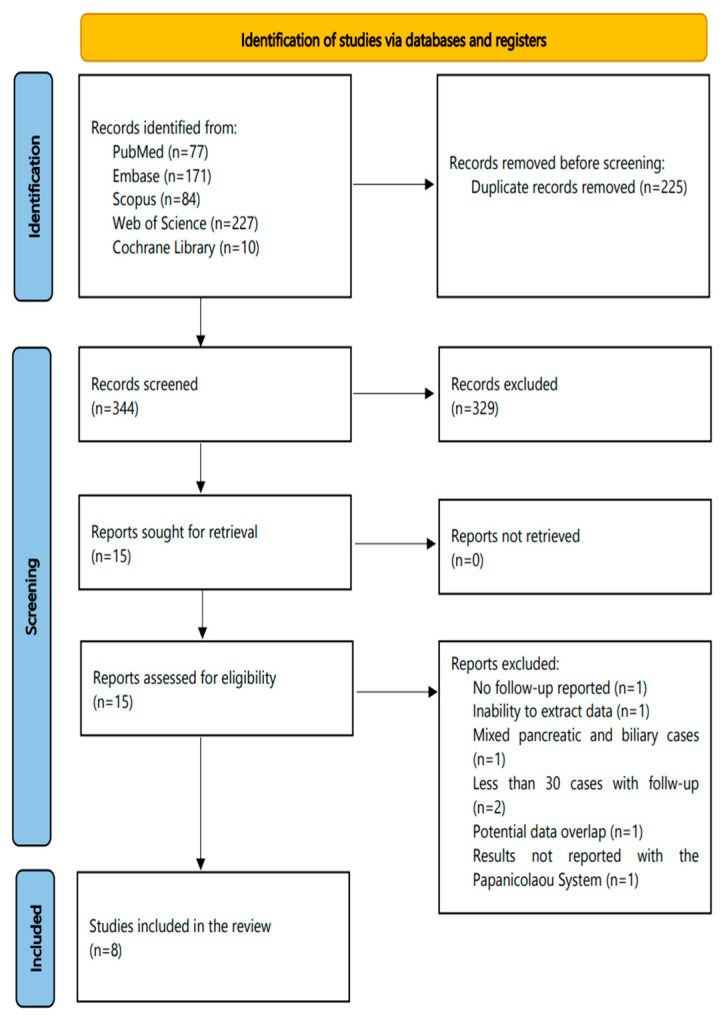
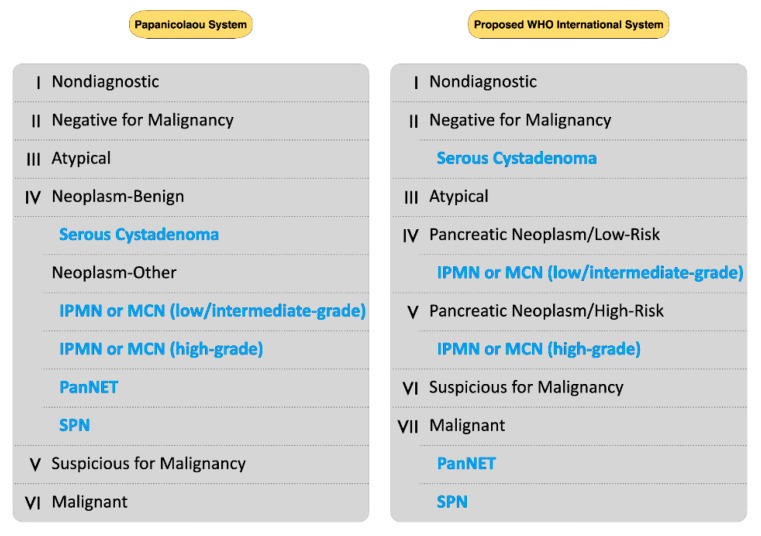
The Papanicolaou Society of Cytopathology (PSC) reporting system classifies pancreatobiliary samples into six categories (I-VI), providing guidance for personalized management. As the World Health Organization (WHO) has been preparing an updated reporting system for pancreatobiliary cytopathology, this systematic review aimed to evaluate the risk of malignancy (ROM) of each PSC category, also the sensitivity and specificity of pancreatic FNA cytology using the current PSC system. Five databases were investigated with a predefined search algorithm. Inclusion and exclusion criteria were applied to select the eligible studies for subsequent data extraction. A study quality assessment was also performed. Eight studies were included in the qualitative analysis. The ROM of the PSC categories I, II, III, IV, V, VI were in the ranges of 8-50%, 0-40%, 28-100%, 0-31%, 82-100%, and 97-100%, respectively. Notably, the ROM IVB ("neoplastic-benign") subcategory showed a 0% ROM. Four of the included studies reported separately the ROMs for the IVO subcategory ("neoplastic-other"; its overall ROM ranged from 0 to 34%) with low (LGA) and high-grade atypia (HGA). ROM for LGA ranged from 4.3 to 19%, whereas ROM for HGA from 64 to 95.2%. When the subcategory IVO with HGA was considered as cytologically positive, together with the categories V and VI, there was a higher sensitivity of pancreatic cytology, at minimal expense of the specificity. Evidence suggests the proposed WHO international system changes-shifting the IVB entities into the "benign/negative for malignancy" category and establishing two new categories, the "pancreatic neoplasm, low-risk/grade" and "pancreatic neoplasm, high-risk/grade"-could stratify pancreatic neoplasms more effectively than the current PSC system.
Keywords: cancer; diagnosis; endoscopic ultrasound-guided fine needle aspiration (EUS-FNA); immunohistochemistry; molecular; neuroendocrine tumors; pancreas; pancreatic intraductal neoplasms; pathology; sensitivity and specificity.
Conflict of interest statement
The authors declare no conflict of interest.
Figures
References
-
- Pitman M.B., Centeno B.A., Ali S.Z., Genevay M., Stelow E., Mino-Kenudson M., Fernandez-del Castillo C., Max Schmidt C., Brugge W., Layfield L., et al. Standardized Terminology and Nomenclature for Pancreatobiliary Cytology: The Papanicolaou Society of Cytopathology Guidelines. Diagn. Cytopathol. 2014;42:338–350. doi: 10.1002/dc.23092. - DOI - PubMed
-
- Layfield L.J., Ehya H., Filie A.C., Hruban R.H., Jhala N., Joseph L., Vielh P., Pitman M.B. Papanicolaou Society of Cytopathology Utilization of Ancillary Studies in the Cytologic Diagnosis of Biliary and Pancreatic Lesions: The Papanicolaou Society of Cytopathology Guidelines for Pancreatobiliary Cytology. Diagn. Cytopathol. 2014;42:351–362. doi: 10.1002/dc.23093. - DOI - PMC - PubMed
Publication types
MeSH terms
LinkOut - more resources
Full Text Sources
Medical
Research Materials
