


Nitric Oxide Signaling and Its Association with Ubiquitin-Mediated Proteasomal Degradation in Plants
- PMID: 35163578
- PMCID: PMC8835921
- DOI: 10.3390/ijms23031657
Nitric Oxide Signaling and Its Association with Ubiquitin-Mediated Proteasomal Degradation in Plants
Erratum in
-
Correction: Pande et al. Nitric Oxide Signaling and Its Association with Ubiquitin-Mediated Proteasomal Degradation in Plants. Int. J. Mol. Sci. 2022, 23, 1657.Int J Mol Sci. 2022 May 18;23(10):5628. doi: 10.3390/ijms23105628. Int J Mol Sci. 2022. PMID: 35628671 Free PMC article.
Abstract
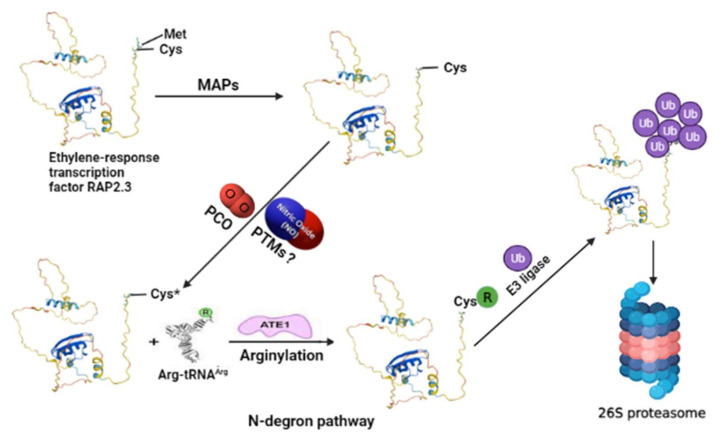
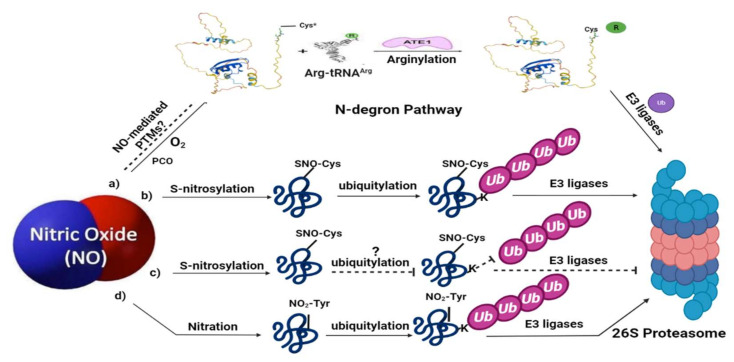
Nitric oxide (NO) is a versatile signaling molecule with diverse roles in plant biology. The NO-mediated signaling mechanism includes post-translational modifications (PTMs) of target proteins. There exists a close link between NO-mediated PTMs and the proteasomal degradation of proteins via ubiquitylation. In some cases, ubiquitin-mediated proteasomal degradation of target proteins is followed by an NO-mediated post-translational modification on them, while in other cases NO-mediated PTMs can regulate the ubiquitylation of the components of ubiquitin-mediated proteasomal machinery for promoting their activity. Another pathway that links NO signaling with the ubiquitin-mediated degradation of proteins is the N-degron pathway. Overall, these mechanisms reflect an important mechanism of NO signal perception and transduction that reflect a close association of NO signaling with proteasomal degradation via ubiquitylation. Therefore, this review provides insight into those pathways that link NO-PTMs with ubiquitylation.
Keywords: S-nitrosylation; nitric oxide; proteasome; proteolysis; ubiquitylation.
Conflict of interest statement
The authors declare no conflict of interest.
Figures
References
Publication types
MeSH terms
Substances
LinkOut - more resources
Full Text Sources
Miscellaneous
