Review
. 2022 Jan 18;27(3):619.
doi: 10.3390/molecules27030619.

Recent Advances in Visible-Light Photoredox Catalysis for the Thiol-Ene/Yne Reactions

Affiliations
Review

Recent Advances in Visible-Light Photoredox Catalysis for the Thiol-Ene/Yne Reactions

Qian Xiao et al. Molecules. .

Abstract

Visible-light photoredox catalysis has been established as a popular and powerful tool for organic transformations owing to its inherent characterization of environmental friendliness and sustainability in the past decades. The thiol-ene/yne reactions, the direct hydrothiolation of alkenes/alkynes with thiols, represents one of the most efficient and atom-economic approaches for the carbon-sulfur bonds construction. In traditional methodologies, harsh conditions such as stoichiometric reagents or a specialized UV photo-apparatus were necessary suffering from various disadvantages. In particular, visible-light photoredox catalysis has also been demonstrated to be a greener and milder protocol for the thiol-ene/yne reactions in recent years. Additionally, unprecedented advancements have been achieved in this area during the past decade. In this review, we will summarize the recent advances in visible-light photoredox catalyzed thiol-ene/yne reactions from 2015 to 2021. Synthetic strategies, substrate scope, and proposed reaction pathways are mainly discussed.

Keywords: green chemistry; photoredox catalysis; synthetic methodologies; thiol-ene/yne reaction.


Conflict of interest statement

The authors declare no conflict of interest.

Figures

Figure 1
Figure 1
Selected pharmaceuticals bearing thioether moiety.
Scheme 1
Scheme 1
The general reaction pathway for the thiol-ene/yne reactions.
Scheme 2
Scheme 2
Visible-light-promoted thiol-ene reaction using titanium dioxide.
Scheme 3
Scheme 3
Visible-light-photocatalyzed radical thiol-ene reaction using bismuth oxide.
Scheme 4
Scheme 4
Visible-light-photocatalyzed thiol-ene reaction by phenylglyoxylic acid.
Scheme 5
Scheme 5
Visible-light-photocatalyzed thiol-ene reaction by benzophenone.
Scheme 6
Scheme 6
Visible-light-photocatalyzed thiol-ene reaction using 9-mesityl-10-methylacridinium tetrafluoroborate.
Scheme 7
Scheme 7
Visible-light-photocatalyzed thiol-ene reaction for modification of natural lignin.
Scheme 8
Scheme 8
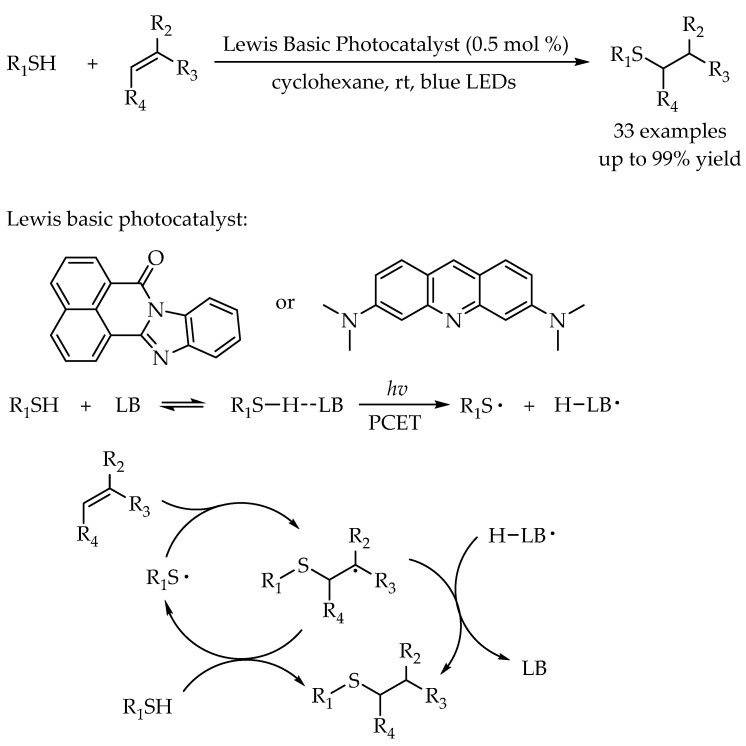
Visible-light-photocatalyzed thiol-ene reaction via a proton-coupled electron transfer process.
Scheme 9
Scheme 9
Cysteine-specific bioconjugation by photocatalytic thiol-ene reaction under biocompatible conditions.
Scheme 10
Scheme 10
Photocatalyzed thiol-ene reaction for difluorostyrenes functionalization with tetrafluoropyridine-4-thiol.
Scheme 11
Scheme 11
Visible-light-photocatalyzed thiol-yne reaction by Eosin Y.
Scheme 12
Scheme 12
Visible-light-photocatalyzed thiol-yne reaction by 9-mesityl-10-methylacridinium tetrafluoroborate.
Scheme 13
Scheme 13
Visible-light-photocatalyzed thiol-ene/yne reaction by ZnIn2S4.
Scheme 14
Scheme 14
General strategy for synthesis of β-hydroxysulfides/β-ketone sulfides.
Scheme 15
Scheme 15
Visible-light-photocatalyzed gem-difunctionalization of alkynes for the synthesis of α,α-aminothio-substituted carbonyl compounds.
Scheme 16
Scheme 16
Visible-light photocatalysis for the synthesis of β-hydroxydithioacetals.
Scheme 17
Scheme 17
Light-promoted hydroxysulfenylation of alkenes with thiophenols in the presence of tertiary amines.
Scheme 18
Scheme 18
Strategy for synthesis of sulfoxides via thiol–ene/oxidation tandem reaction.
Scheme 19
Scheme 19
(ac) Photocatalyzed selective synthesis of sulfoxides via thiol–ene/yne reaction. (d) General reaction mechanism.
Scheme 20
Scheme 20
The general mechanism of photoredox synthesis of sulfoxides.
Scheme 21
Scheme 21
Photocatalyzed Markovnikov-selective hydrothiolation of enamides and enecarbamates.
Scheme 22
Scheme 22
Photoredox/cobalt catalyzed Markovnikov-selective thiol-ene reaction.
Scheme 23
Scheme 23
Photocatalytic Markovnikov-selective addition of p-toluenethiol to phenylacetylene.
Scheme 24
Scheme 24
A photocatalyzed Markovnikov thiol-yne reaction via associative electron upconversion.

References

    1. Jacob C. A Scent of Therapy: Pharmacological Implications of Natural Products Containing Redox-Active Sulfur Atoms. Nat. Prod. Rep. 2006;23:851–863. doi: 10.1039/b609523m. - DOI - PubMed
    1. Clayden J., MacLellan P. Asymmetric Synthesis of Tertiary Thiols and Thioethers. Beilstein J. Org. Chem. 2011;7:582–595. doi: 10.3762/bjoc.7.68. - DOI - PMC - PubMed
    1. Feng M., Tang B., Liang S.H., Jiang X. Sulfur Containing Scaffolds in Drugs: Synthesis and Application in Medicinal Chemistry. Curr. Top. Med. Chem. 2016;16:1200–1216. doi: 10.2174/1568026615666150915111741. - DOI - PMC - PubMed
    1. Wang N., Saidhareddy P., Jiang X. Construction of Sulfur-Containing Moieties in the Total Synthesis of Natural Products. Nat. Prod. Rep. 2020;37:246–275. doi: 10.1039/C8NP00093J. - DOI - PubMed
    1. Han J., Jia Y., Takeda K., Shiraishi Y., Okamoto M., Dakhama A., Gelfand E.W. Montelukast during Primary Infection Prevents Airway Hyperresponsiveness and Inflammation after Reinfection with Respiratory Syncytial Virus. Am. J. Respir. Crit. Care Med. 2010;182:455–463. doi: 10.1164/rccm.200912-1811OC. - DOI - PMC - PubMed

LinkOut - more resources