


Physicochemical and Functional Properties of 2S, 7S, and 11S Enriched Hemp Seed Protein Fractions
- PMID: 35164322
- PMCID: PMC8840737
- DOI: 10.3390/molecules27031059
Physicochemical and Functional Properties of 2S, 7S, and 11S Enriched Hemp Seed Protein Fractions
Abstract
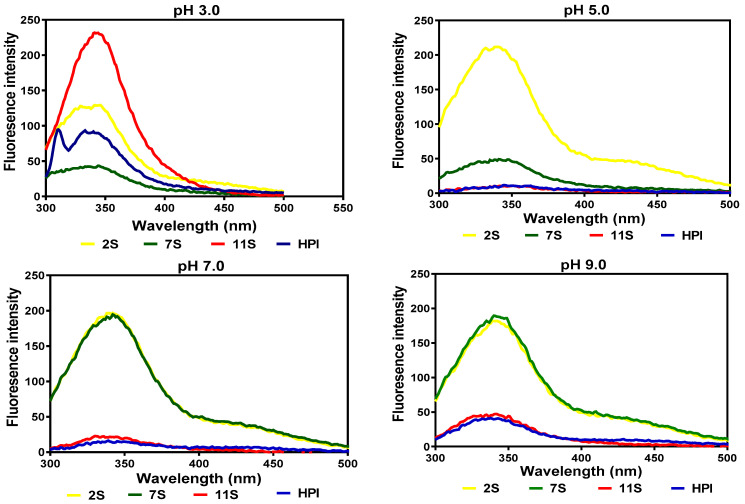
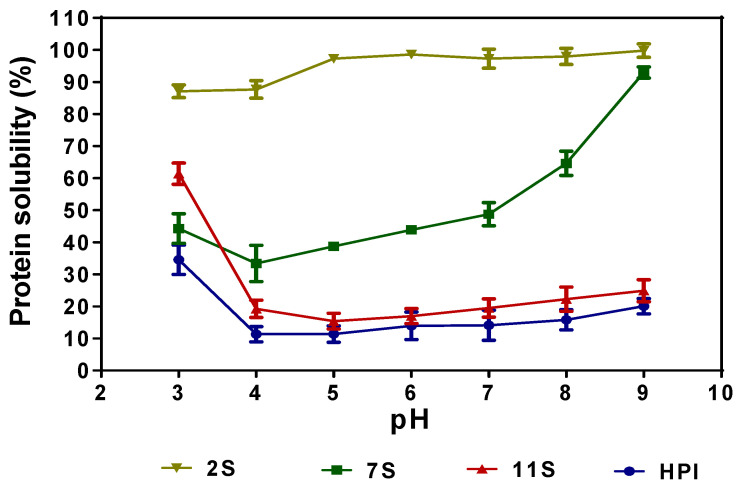
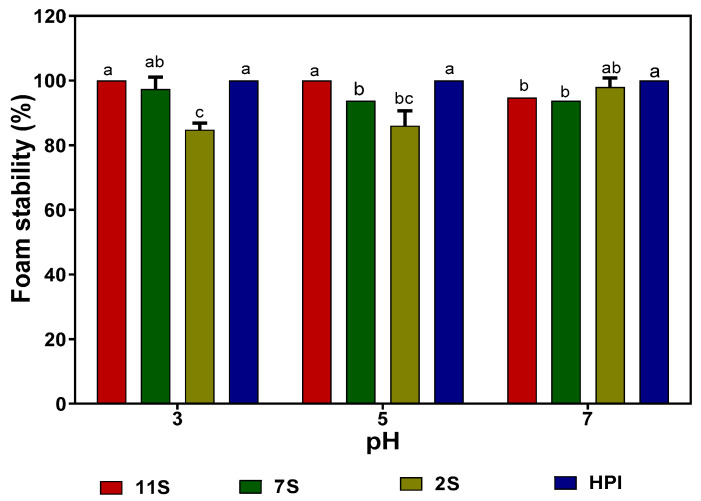
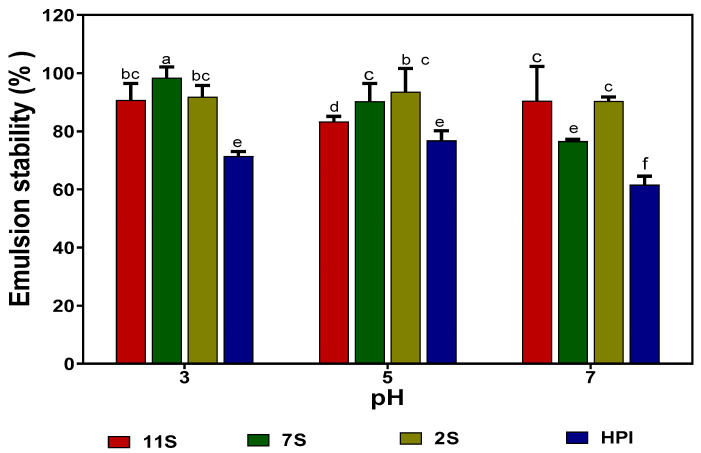
The hemp seed contains protein fractions that could serve as useful ingredients for food product development. However, utilization of hemp seed protein fractions in the food industry can only be successful if there is sufficient information on their levels and functional properties. Therefore, this work provides a comparative evaluation of the structural and functional properties of hemp seed protein isolate (HPI) and fractions that contain 2S, 7S, or 11S proteins. HPI and protein fractions were isolated at pH values of least solubility. Results showed that the dominant protein was 11S, with a yield of 72.70 ± 2.30%, while 7S and 2S had values of 1.29 ± 0.11% and 3.92 ± 0.15%, respectively. The 2S contained significantly (p < 0.05) higher contents of sulfhydryl groups at 3.69 µmol/g when compared to 7S (1.51 µmol/g), 11S (1.55 µmol/g), and HPI (1.97 µmol/g). The in vitro protein digestibility of the 2S (72.54 ± 0.52%) was significantly (p < 0.05) lower than those of the other isolated proteins. The intrinsic fluorescence showed that the 11S had a more rigid structure at pH 3.0, which was lost at higher pH values. We conclude that the 2S fraction has superior solubility, foaming capacity, and emulsifying activity when compared to the 7S, 11S, and HPI.
Keywords: albumin; amino acid composition; circular dichroism; functional properties; globulins; hemp seed; intrinsic fluorescence; protein digestibility.
Conflict of interest statement
The authors declare no conflict of interest. The funders had no role in the design of the study; in the collection, analyses, or interpretation of data; in the writing of the manuscript; or in the decision to publish the results.
Figures
References
-
- Grand View Research Protein Ingredients Market Size, Share & Trends Analysis Report by Product (Plant Proteins, Animal/Dairy Proteins, Microbe-Based Proteins, Insect Proteins), by Application, by Region and Segment Forecasts. 2020. [(accessed on 10 December 2021)]. pp. 2021–2028. Available online: https://www.grandviewresearch.com/industry-analysis/protein-ingredients-....
-
- Naghshi S., Sadeghi O., Willett W.C., Esmaillzadeh A. Dietary intake of total, animal, and plant proteins and risk of all cause, cardiovascular, and cancer mortality: Systematic review and dose-response meta-analysis of prospective cohort studies. BMJ. 2020;370:m2412. doi: 10.1136/bmj.m2412. - DOI - PMC - PubMed
-
- Dapcevic-Hadnadev T., Dizdar M., Pojić M., Krstonošić V., Zychowski L.M., Hadnadev M. Emulsifying properties of hemp proteins: Effect of isolation technique. Food Hydrocoll. 2019;89:912–920. doi: 10.1016/j.foodhyd.2018.12.002. - DOI
-
- Hadnadev M., Dapcevic-Hadnadev T., Lazaridou A., Moschakis T., Michaelidou A.M., Popovic S., Biliaderis C.G. Hempseed meal protein isolates prepared by different isolation techniques. Part I. physicochemical properties. Food Hydrocoll. 2018;79:526–533. doi: 10.1016/j.foodhyd.2017.12.015. - DOI
MeSH terms
Substances
Grants and funding
LinkOut - more resources
Full Text Sources
