


Racial-Ethnic Residential Clustering and Early COVID-19 Vaccine Allocations in Five Urban Texas Counties
- PMID: 35164599
- PMCID: PMC9716049
- DOI: 10.1177/00221465221074915
Racial-Ethnic Residential Clustering and Early COVID-19 Vaccine Allocations in Five Urban Texas Counties
Abstract
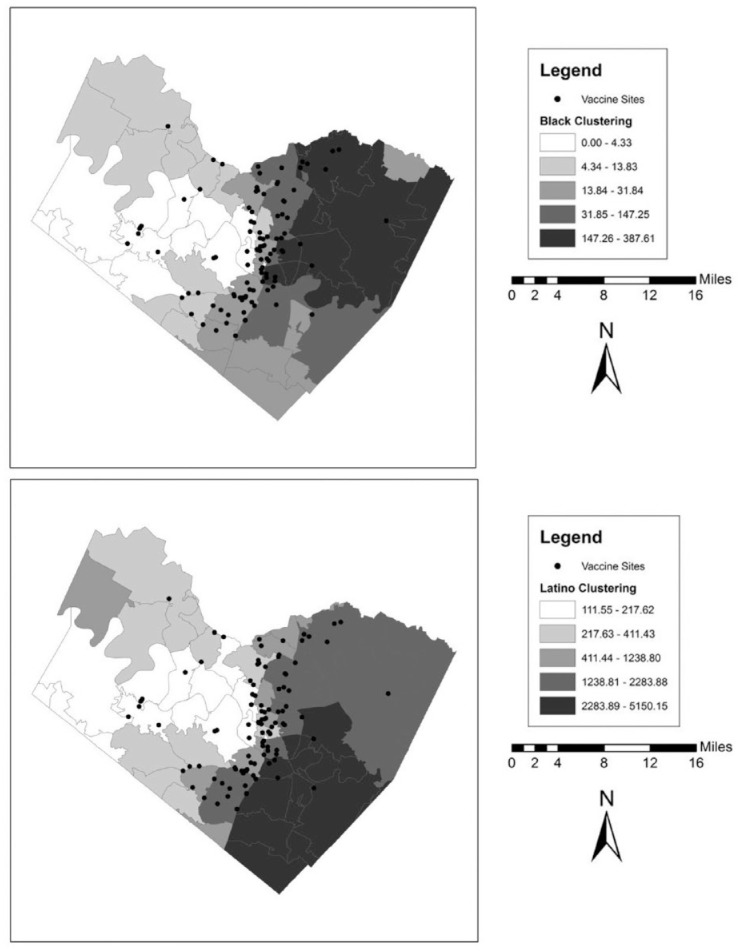
Previous research has indicated that racial-ethnic minority communities lack a wide variety of health-related organizations. We examine how this relates to the early COVID-19 vaccine rollout. In a series of spatial error and linear growth models, we analyze how racial-ethnic residential segregation is associated with the distribution of vaccine sites and vaccine doses across ZIP codes in the five largest urban counties in Texas. We find that Black and Latino clustered ZIP codes are less likely to have vaccine distribution sites and that this disparity is partially explained by the lack of hospitals and physicians' offices in these areas. Moreover, Black clustering is also negatively related to the number of allocated vaccine doses, and again, this is largely explained by the unequal distribution of health care resources. These results suggest that extant disparities in service provision are key to understanding racial-ethnic inequality in an acute crisis like the COVID-19 pandemic.
Keywords: COVID-19; health care; race-ethnicity; residential segregation; vaccines.
Figures
References
-
- Acevedo-Garcia Dolores. 2000. “Residential Segregation and the Epidemiology of Infectious Diseases.” Social Science & Medicine 51(8):1143–61. - PubMed
-
- Allard Scott W.2009. Out of Reach: Place, Poverty, and the New American Welfare State. New Haven, CT: Yale University Press.
-
- Anderson Kathryn Freeman. 2017. “Racial Residential Segregation and the Distribution of Health-Related Organizations in Urban Neighborhoods.” Social Problems 64(2):256–76.
MeSH terms
Substances
LinkOut - more resources
Full Text Sources
Medical
