


The ambiguous role of obesity in oncology by promoting cancer but boosting antitumor immunotherapy
- PMID: 35164764
- PMCID: PMC8842976
- DOI: 10.1186/s12929-022-00796-0
The ambiguous role of obesity in oncology by promoting cancer but boosting antitumor immunotherapy
Abstract
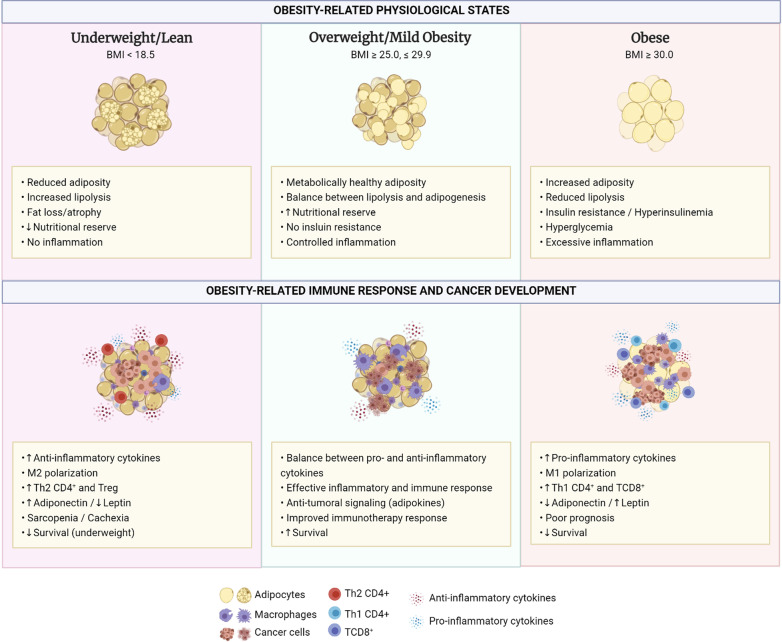
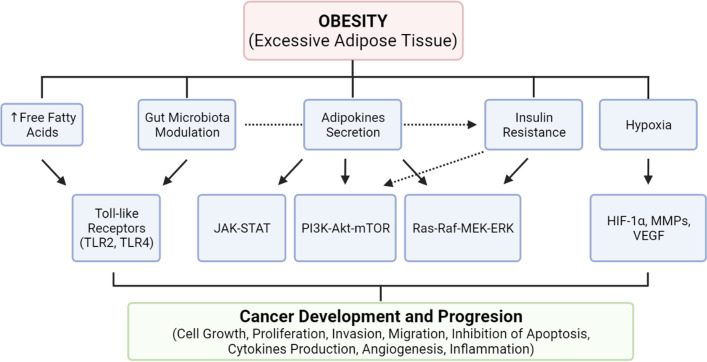
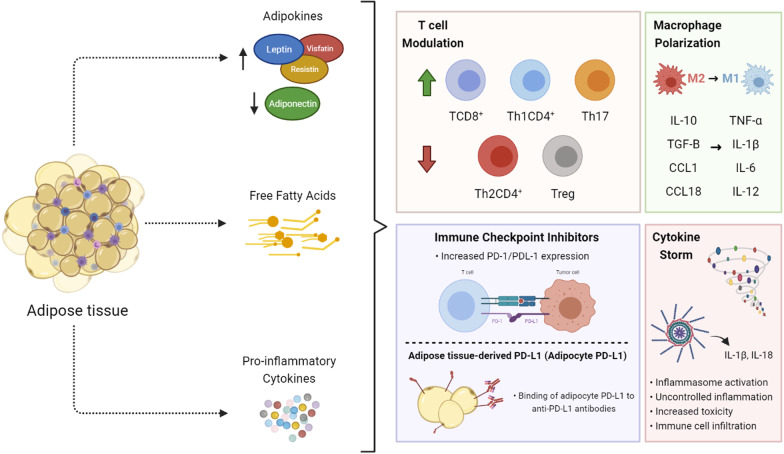
Obesity is nowadays considered a pandemic which prevalence's has been steadily increasingly in western countries. It is a dynamic, complex, and multifactorial disease which propitiates the development of several metabolic and cardiovascular diseases, as well as cancer. Excessive adipose tissue has been causally related to cancer progression and is a preventable risk factor for overall and cancer-specific survival, associated with poor prognosis in cancer patients. The onset of obesity features a state of chronic low-grade inflammation and secretion of a diversity of adipocyte-derived molecules (adipokines, cytokines, hormones), responsible for altering the metabolic, inflammatory, and immune landscape. The crosstalk between adipocytes and tumor cells fuels the tumor microenvironment with pro-inflammatory factors, promoting tissue injury, mutagenesis, invasion, and metastasis. Although classically established as a risk factor for cancer and treatment toxicity, recent evidence suggests mild obesity is related to better outcomes, with obese cancer patients showing better responses to treatment when compared to lean cancer patients. This phenomenon is termed obesity paradox and has been reported in different types and stages of cancer. The mechanisms underlying this paradoxical relationship between obesity and cancer are still not fully described but point to systemic alterations in metabolic fitness and modulation of the tumor microenvironment by obesity-associated molecules. Obesity impacts the response to cancer treatments, such as chemotherapy and immunotherapy, and has been reported as having a positive association with immune checkpoint therapy. In this review, we discuss obesity's association to inflammation and cancer, also highlighting potential physiological and biological mechanisms underlying this association, hoping to clarify the existence and impact of obesity paradox in cancer development and treatment.
Keywords: Adipose tissue; Cancer; Immunotherapy; Inflammation; Obesity.
© 2022. The Author(s).
Conflict of interest statement
The authors declare that they have no competing interests.
Figures
References
-
- Swinburn BA, Kraak VI, Allender S, Atkins VJ, Baker PI, Bogard JR, et al. The global syndemic of obesity, undernutrition, and climate change: the Lancet commission report. Lancet. 2019;393:791–846. - PubMed
-
- Bray F, Ferlay J, Soerjomataram I, Siegel RL, Torre LA, Jemal A. Global cancer statistics 2018: GLOBOCAN estimates of incidence and mortality worldwide for 36 cancers in 185 countries. CA Cancer J Clin. 2018;68:394–424. - PubMed
-
- Li J, Ma J, Wang KS, Mi C, Wang Z, Piao LX, et al. Baicalein inhibits TNF-α-induced NFkB activation and expression of NFkB-regulated target gene products. Oncol Rep. 2016;36:2771–2776. - PubMed
-
- National Cancer Institute, NIH D. Cancer trends progress report. National Cancer Institute. 2020.
Publication types
MeSH terms
Substances
LinkOut - more resources
Full Text Sources
Medical
