. 2022 Feb 22;119(8):e2113947119.
doi: 10.1073/pnas.2113947119.

Pharmaceutical pollution of the world's rivers

John L Wilkinson  1 Alistair B A Boxall  2 Dana W Kolpin  3 Kenneth M Y Leung  4 Racliffe W S Lai  4 Cristóbal Galbán-Malagón  5 Aiko D Adell  6 Julie Mondon  7 Marc Metian  8 Robert A Marchant  2 Alejandra Bouzas-Monroy  2 Aida Cuni-Sanchez  2 Anja Coors  9 Pedro Carriquiriborde  10 Macarena Rojo  10 Chris Gordon  11 Magdalena Cara  12 Monique Moermond  13 Thais Luarte  14 Vahagn Petrosyan  15 Yekaterina Perikhanyan  15 Clare S Mahon  16 Christopher J McGurk  16 Thilo Hofmann  17 Tapos Kormoker  18 Volga Iniguez  19 Jessica Guzman-Otazo  20 Jean L Tavares  21 Francisco Gildasio De Figueiredo  21 Maria T P Razzolini  22 Victorien Dougnon  23 Gildas Gbaguidi  24 Oumar Traoré  25 Jules M Blais  26 Linda E Kimpe  26 Michelle Wong  27 Donald Wong  27 Romaric Ntchantcho  28 Jaime Pizarro  29 Guang-Guo Ying  30 Chang-Er Chen  30 Martha Páez  31 Jina Martínez-Lara  31 Jean-Paul Otamonga  32 John Poté  33 Suspense A Ifo  34 Penelope Wilson  35 Silvia Echeverría-Sáenz  36 Nikolina Udikovic-Kolic  37 Milena Milakovic  37 Despo Fatta-Kassinos  38 Lida Ioannou-Ttofa  38 Vladimíra Belušová  39 Jan Vymazal  39 María Cárdenas-Bustamante  2 Bayable A Kassa  40 Jeanne Garric  41 Arnaud Chaumot  41 Peter Gibba  42 Ilia Kunchulia  43 Sven Seidensticker  44 Gerasimos Lyberatos  45 Halldór P Halldórsson  46 Molly Melling  2 Thatikonda Shashidhar  47 Manisha Lamba  48 Anindrya Nastiti  49 Adee Supriatin  49 Nima Pourang  50 Ali Abedini  50 Omar Abdullah  2 Salem S Gharbia  51 Francesco Pilla  52 Benny Chefetz  53 Tom Topaz  53 Koffi Marcellin Yao  54 Bakhyt Aubakirova  55 Raikhan Beisenova  56 Lydia Olaka  57 Jemimah K Mulu  57 Peter Chatanga  58 Victor Ntuli  58 Nathaniel T Blama  59 Sheck Sherif  59 Ahmad Zaharin Aris  60 Ley Juen Looi  60 Mahamoudane Niang  61 Seydou T Traore  61 Rik Oldenkamp  62 Olatayo Ogunbanwo  63 Muhammad Ashfaq  64 Muhammad Iqbal  64 Ziad Abdeen  65 Aaron O'Dea  66 Jorge Manuel Morales-Saldaña  66 María Custodio  67 Heidi de la Cruz  67 Ian Navarrete  68 Fabio Carvalho  69 Alhaji Brima Gogra  70 Bashiru M Koroma  70 Vesna Cerkvenik-Flajs  71 Mitja Gombač  71 Melusi Thwala  72 Kyungho Choi  73 Habyeong Kang  73 John L Celestino Ladu  74 Andreu Rico  75 Priyanie Amerasinghe  76 Anna Sobek  77 Gisela Horlitz  77 Armin K Zenker  78 Alex C King  78 Jheng-Jie Jiang  79 Rebecca Kariuki  2 Madaka Tumbo  80 Ulas Tezel  81 Turgut T Onay  81 Julius B Lejju  82 Yuliya Vystavna  83 Yuriy Vergeles  84 Horacio Heinzen  85 Andrés Pérez-Parada  86 Douglas B Sims  87 Maritza Figy  27 David Good  88 Charles Teta  89
Affiliations

Pharmaceutical pollution of the world's rivers

John L Wilkinson et al. Proc Natl Acad Sci U S A. .

Abstract

Environmental exposure to active pharmaceutical ingredients (APIs) can have negative effects on the health of ecosystems and humans. While numerous studies have monitored APIs in rivers, these employ different analytical methods, measure different APIs, and have ignored many of the countries of the world. This makes it difficult to quantify the scale of the problem from a global perspective. Furthermore, comparison of the existing data, generated for different studies/regions/continents, is challenging due to the vast differences between the analytical methodologies employed. Here, we present a global-scale study of API pollution in 258 of the world's rivers, representing the environmental influence of 471.4 million people across 137 geographic regions. Samples were obtained from 1,052 locations in 104 countries (representing all continents and 36 countries not previously studied for API contamination) and analyzed for 61 APIs. Highest cumulative API concentrations were observed in sub-Saharan Africa, south Asia, and South America. The most contaminated sites were in low- to middle-income countries and were associated with areas with poor wastewater and waste management infrastructure and pharmaceutical manufacturing. The most frequently detected APIs were carbamazepine, metformin, and caffeine (a compound also arising from lifestyle use), which were detected at over half of the sites monitored. Concentrations of at least one API at 25.7% of the sampling sites were greater than concentrations considered safe for aquatic organisms, or which are of concern in terms of selection for antimicrobial resistance. Therefore, pharmaceutical pollution poses a global threat to environmental and human health, as well as to delivery of the United Nations Sustainable Development Goals.

Keywords: antimicrobials; aquatic contamination; global pollution; pharmaceuticals; wastewater.


Conflict of interest statement

The authors declare no competing interest.

Figures
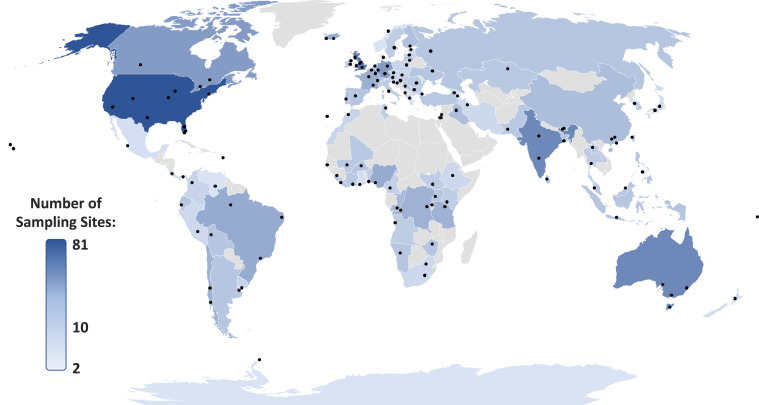
Fig. 1.
Fig. 1.
Locations of studied rivers/catchments (n = 137) for our global study (Dataset S2). Points indicate groups of sampling sites across respective river catchments and countries are shaded based upon the total number of sampling sites.
Fig. 2.
Fig. 2.
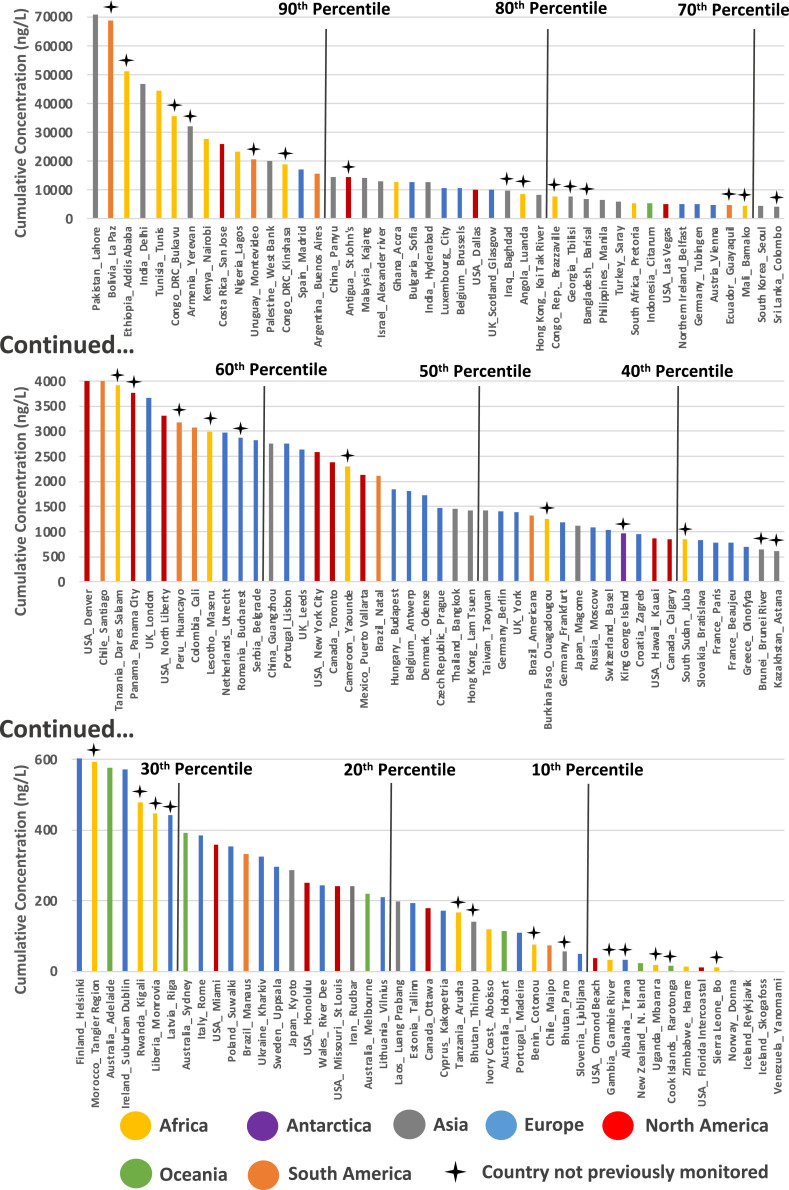
Cumulative API concentrations quantified across 137 studied river catchments (Dataset S6) organized by descending cumulative concentration (ng/L). Percentiles are marked by black lines and countries not previously monitored by crosses above the plot. The cumulative concentrations reported here are calculated as the average of the sum concentration of all quantifiable API residues at each sampling site within respective river catchments.
Fig. 3.
Fig. 3.
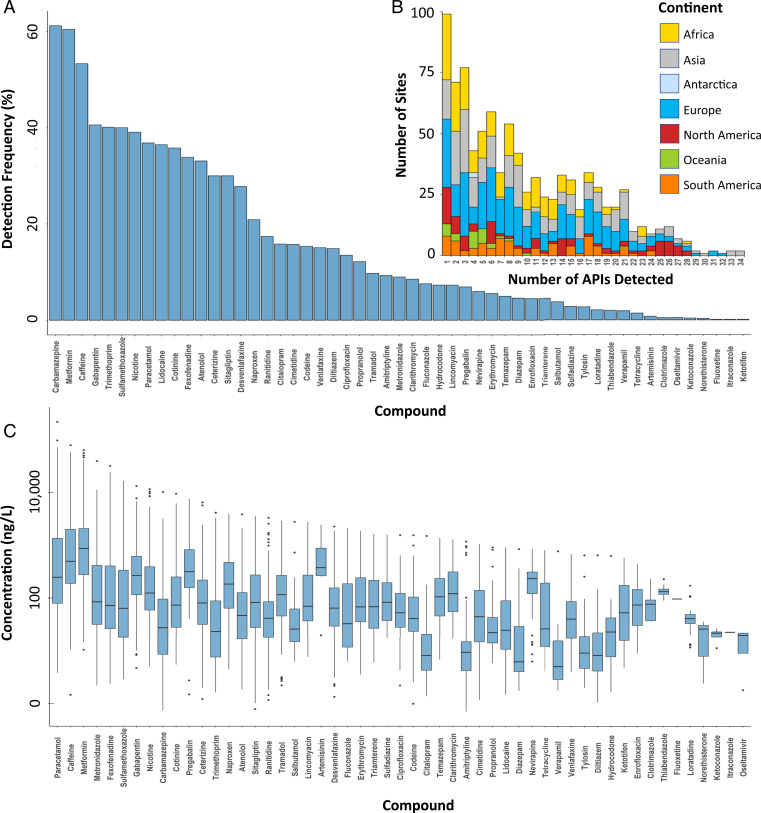
(A) Detection frequencies (Dataset S5) and (B) number of APIs detected at sampling sites in the global monitoring study (Dataset S4), excluding sites without the detection of any API, and (C) box-and-whisker plots of concentrations (ng/L) of individual APIs (Dataset S4), indicating the mean, minimum, maximum, and upper and lower quartile concentrations for each API globally.
Fig. 4.
Fig. 4.
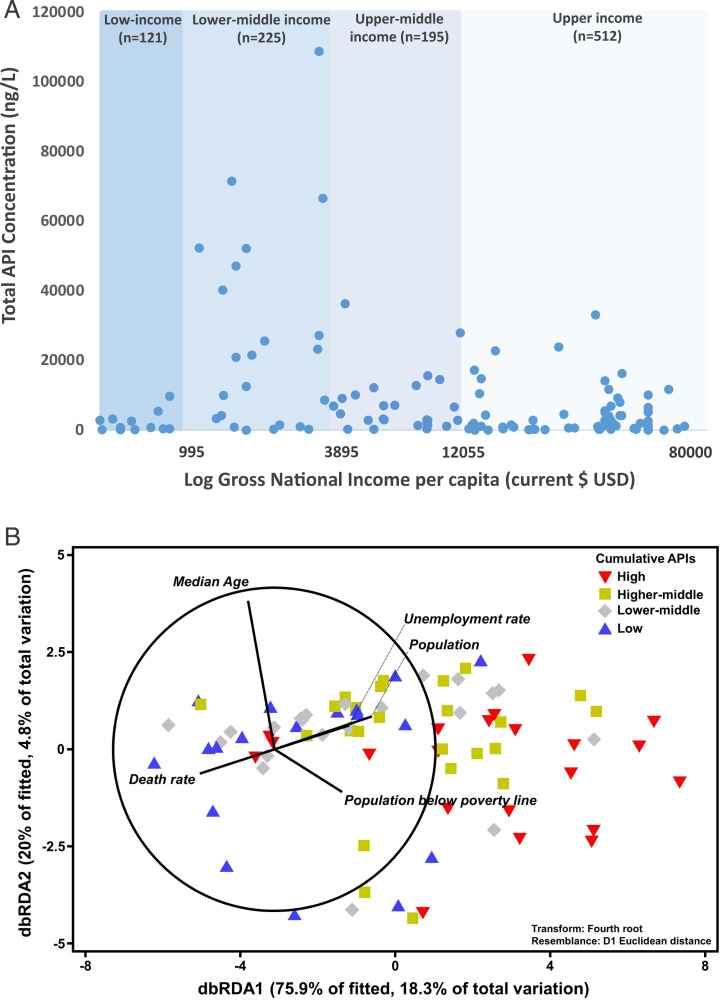
(A) Cumulative concentration of APIs (Dataset S6) observed across respective river catchments (signified by a blue dot, n = number of sampling sites) organized by World Bank GNI per capita (33) and (B) distance-based redundancy analysis (dbRDA) illustrating the best model of socioeconomic indicators to explain the measured concentration of different classes of pharmaceuticals in respective countries according to the distance-based linear model (DISTLM, AICc = 325.26, r2 = 0.241). Vector projections with center coordination at (−3, 0) were performed with multiple partial correlation. Length and direction of the vectors represent the strength and direction of the relationship. Data from each country were classified according to their cumulative active pharmaceutical ingredient concentration: that is, Low: first quartile (the lowest 25%); Lower-middle: second quartile (the next 25%); Higher-middle: third quartile (the next 25%); and High: fourth quartile (the top 25%). Raw data can be found in Dataset S9.
Fig. 5.
Fig. 5.
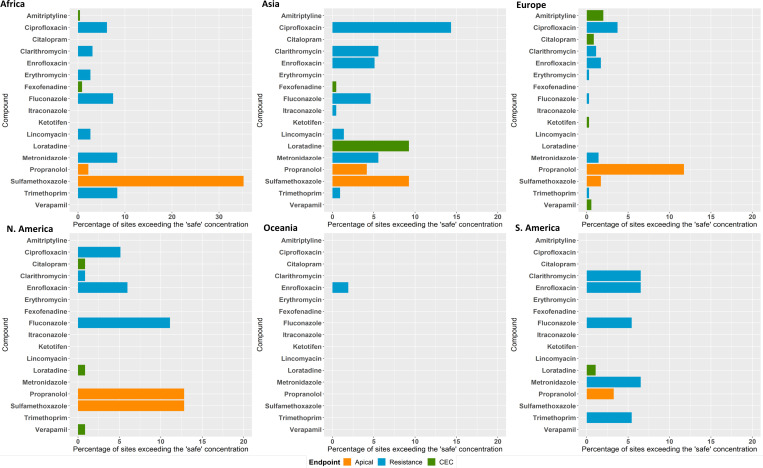
Percent of sites in the global monitoring study where concentrations exceeded: lowest PNECs (Dataset S12) derived from apical ecotoxicological endpoints for algae, fish, and daphnia (orange bars); CECs estimated based on human plasma therapeutic concentrations and uptake predictions for fish (green bars); and “safe” target concentrations for AMR selection (blue bars).

References

    1. Kidd K. A., et al. , Collapse of a fish population after exposure to a synthetic estrogen. Proc. Natl. Acad. Sci. U.S.A. 104, 8897–8901 (2007). - PMC - PubMed
    1. Wellington E. M., et al. , The role of the natural environment in the emergence of antibiotic resistance in gram-negative bacteria. Lancet Infect. Dis. 13, 155–165 (2013). - PubMed
    1. Brodin T., Fick J., Jonsson M., Klaminder J., Dilute concentrations of a psychiatric drug alter behavior of fish from natural populations. Science 339, 814–815 (2013). - PubMed
    1. Horký P., et al. , Methamphetamine pollution elicits addiction in wild fish. J. Exp. Biol. 224, jeb242145 (2021). - PubMed
    1. Umwelt Bundesamt, “Database- Pharmaceuticals in the environment” Umwelt Bundesamt (2021). https://www.umweltbundesamt.de/en/database-pharmaceuticals-in-the-enviro.... Accessed 2 January 2021.