Deep Learning Analysis to Automatically Detect the Presence of Penetration or Aspiration in Videofluoroscopic Swallowing Study
- PMID: 35166079
- PMCID: PMC8845107
- DOI: 10.3346/jkms.2022.37.e42
Deep Learning Analysis to Automatically Detect the Presence of Penetration or Aspiration in Videofluoroscopic Swallowing Study
Abstract
Background: Videofluoroscopic swallowing study (VFSS) is currently considered the gold standard to precisely diagnose and quantitatively investigate dysphagia. However, VFSS interpretation is complex and requires consideration of several factors. Therefore, considering the expected impact on dysphagia management, this study aimed to apply deep learning to detect the presence of penetration or aspiration in VFSS of patients with dysphagia automatically.
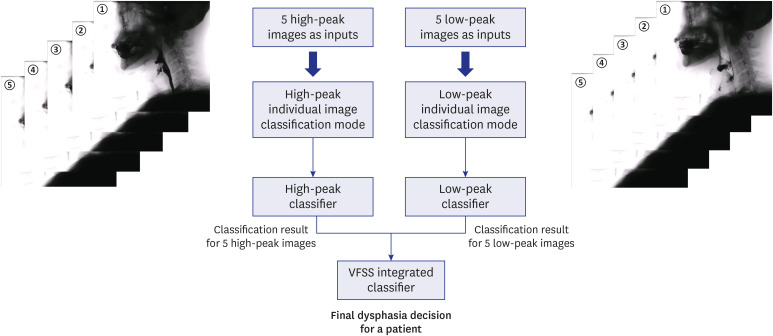
Methods: The VFSS data of 190 participants with dysphagia were collected. A total of 10 frame images from one swallowing process were selected (five high-peak images and five low-peak images) for the application of deep learning in a VFSS video of a patient with dysphagia. We applied a convolutional neural network (CNN) for deep learning using the Python programming language. For the classification of VFSS findings (normal swallowing, penetration, and aspiration), the classification was determined in both high-peak and low-peak images. Thereafter, the two classifications determined through high-peak and low-peak images were integrated into a final classification.
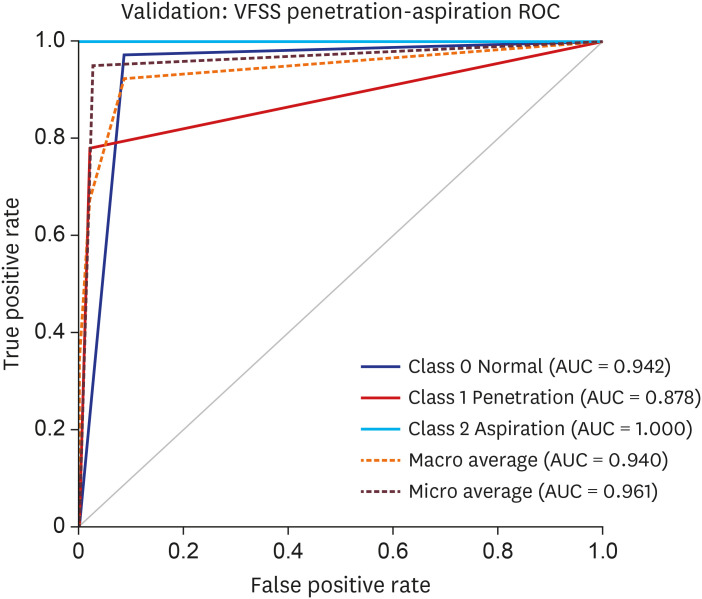
Results: The area under the curve (AUC) for the validation dataset of the VFSS image for the CNN model was 0.942 for normal findings, 0.878 for penetration, and 1.000 for aspiration. The macro average AUC was 0.940 and micro average AUC was 0.961.
Conclusion: This study demonstrated that deep learning algorithms, particularly the CNN, could be applied for detecting the presence of penetration and aspiration in VFSS of patients with dysphagia.
Keywords: Deep Learning; Deglutition; Swallowing Reflex; VFSS.
© 2022 The Korean Academy of Medical Sciences.
Conflict of interest statement
The authors have no potential conflicts of interest to disclose.
Figures
References
MeSH terms
Grants and funding
LinkOut - more resources
Full Text Sources
Medical