Workload of Healthcare Workers During the COVID-19 Outbreak in Korea: A Nationwide Survey
- PMID: 35166085
- PMCID: PMC8845106
- DOI: 10.3346/jkms.2022.37.e49
Workload of Healthcare Workers During the COVID-19 Outbreak in Korea: A Nationwide Survey
Abstract
Background: As the coronavirus disease 2019 (COVID-19) pandemic is ongoing, heavy workload of healthcare workers (HCWs) is a concern. This study investigated the workload of HCWs responding to the COVID-19 outbreak in South Korea.
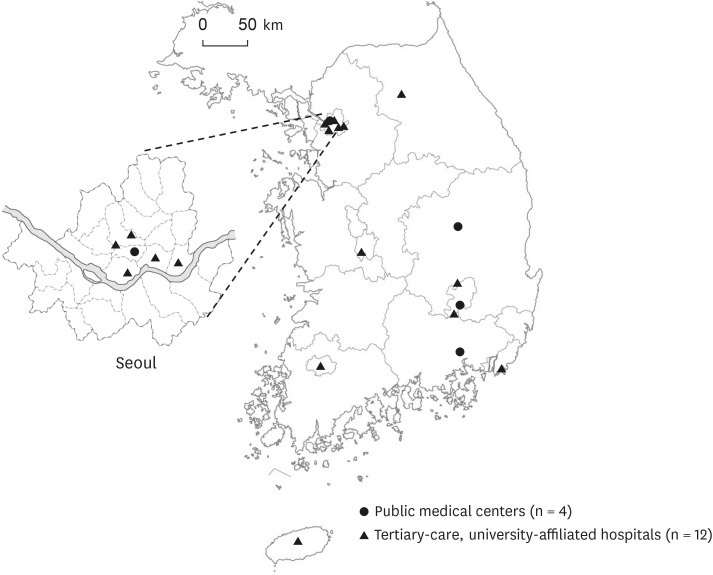
Methods: A nationwide cross-sectional survey was conducted from September 16 to October 15, 2020, involving 16 healthcare facilities (4 public medical centers, 12 tertiary-care hospitals) that provide treatment for COVID-19 patients.
Results: Public medical centers provided the majority (69.4%) of total hospital beds for COVID-19 patients (n = 611), on the other hand, tertiary care hospitals provided the majority (78.9%) of critical care beds (n = 57). The number of beds per doctor (median [IQR]) in public medical centers was higher than in tertiary care hospitals (20.2 [13.0, 29.4] versus 3.0 [1.3, 6.6], P = 0.006). Infectious Diseases physicians are mostly (80%) involved among attending physicians. The number of nurses per patient (median [interquartile range, IQR]) in tertiary-care hospitals was higher than in public medical centers (4.6 [3.4-5] vs. 1.1 [0.8-2.1], P = 0.089). The median number of nurses per patient for COVID-19 patients was higher than the highest national standard in South Korea (3.8 vs. 2 for critical care). All participating healthcare facilities were also operating screening centers, for which a median of 2 doctors, 5 nurses, and 2 administrating staff were necessary.
Conclusion: As the severity of COVID-19 patients increases, the number of HCWs required increases. Because the workload of HCWs responding to the COVID-19 outbreak is much greater than other situations, a workforce management plan regarding this perspective is required to prevent burnout of HCWs.
Keywords: Burnout; Health Facilities; Health Workforce; SARS-CoV-2.
© 2022 The Korean Academy of Medical Sciences.
Conflict of interest statement
The authors have no potential conflicts of interest to disclose.
Figures
References
-
- World Health Organization. Coronavirus disease (COVID-19), weekly epidemiological update. [Updated 2022]. [Accessed March 29, 2021]. https://www.who.int/publications/m .
-
- Korean Disease Control and Prevention Agency. [Updated 2022]. [Accessed March 30, 2021]. http://ncov.mohw.go.kr/
-
- Oh J, Lee JK, Schwarz D, Ratcliffe HL, Markuns JF, Hirschhorn LR. National Response to COVID-19 in the Republic of Korea and lessons learned for other countries. Health Syst Reform. 2020;6(1):e1753464. - PubMed
MeSH terms
Grants and funding
LinkOut - more resources
Full Text Sources
Medical
Research Materials
Miscellaneous