


Efficacy and safety of psilocybin-assisted treatment for major depressive disorder: Prospective 12-month follow-up
- PMID: 35166158
- PMCID: PMC8864328
- DOI: 10.1177/02698811211073759
Efficacy and safety of psilocybin-assisted treatment for major depressive disorder: Prospective 12-month follow-up
Abstract
Background: Preliminary data suggest that psilocybin-assisted treatment produces substantial and rapid antidepressant effects in patients with major depressive disorder (MDD), but little is known about long-term outcomes.
Aims: This study sought to examine the efficacy and safety of psilocybin through 12 months in participants with moderate to severe MDD who received psilocybin.
Methods: This randomized, waiting-list controlled study enrolled 27 patients aged 21-75 with moderate to severe unipolar depression (GRID-Hamilton Depression Rating Scale (GRID-HAMD) ⩾ 17). Participants were randomized to an immediate or delayed (8 weeks) treatment condition in which they received two doses of psilocybin with supportive psychotherapy. Twenty-four participants completed both psilocybin sessions and were followed through 12 months following their second dose.
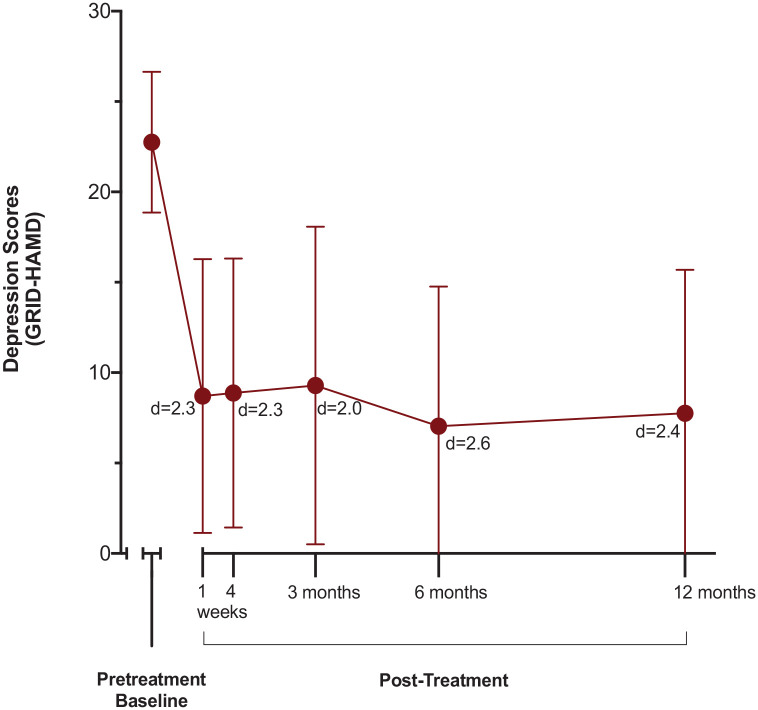
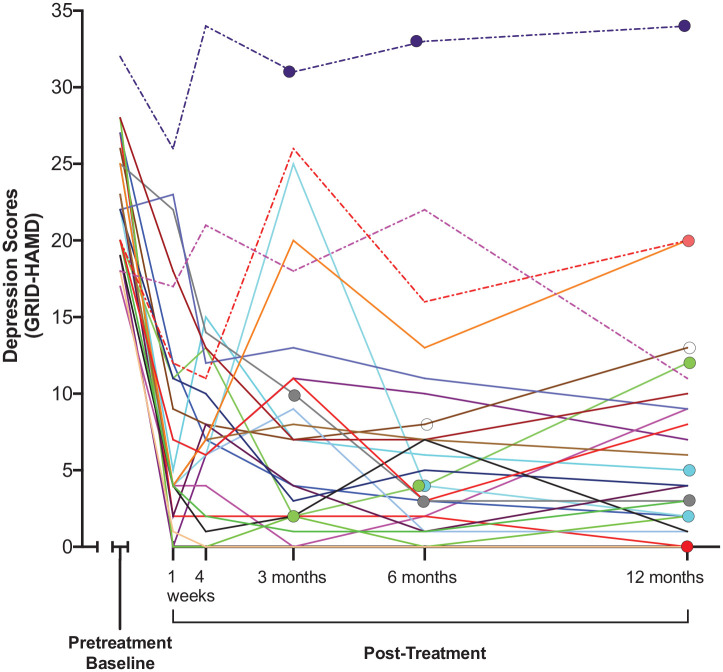
Results: All 24 participants attended all follow-up visits through the 12-month timepoint. Large decreases from baseline in GRID-HAMD scores were observed at 1-, 3-, 6-, and 12-month follow-up (Cohen d = 2.3, 2.0, 2.6, and 2.4, respectively). Treatment response (⩾50% reduction in GRID-HAMD score from baseline) and remission were 75% and 58%, respectively, at 12 months. There were no serious adverse events judged to be related to psilocybin in the long-term follow-up period, and no participants reported psilocybin use outside of the context of the study. Participant ratings of personal meaning, spiritual experience, and mystical experience after sessions predicted increased well-being at 12 months, but did not predict improvement in depression.
Conclusions: These findings demonstrate that the substantial antidepressant effects of psilocybin-assisted therapy may be durable at least through 12 months following acute intervention in some patients.
Keywords: Insight; long-term effects; major depressive disorder; mystical experience; psilocybin.
Conflict of interest statement
Figures
References
-
- Agin-Liebes GI, Malone T, Yalch MM, et al.. (2020) Long-term follow-up of psilocybin-assisted psychotherapy for psychiatric and existential distress in patients with life-threatening cancer. Journal of Psychopharmacology 34(2): 155–166. - PubMed
-
- Beck AT, Steer RA, Ball R, et al.. (1996) Comparison of Beck Depression Inventories-IA and -II in psychiatric outpatients. Journal of Personality Assessment 67(3): 588–597. - PubMed
-
- Bogenschutz MP, Forcehimes AA, Pommy JA, et al.. (2015) Psilocybin-assisted treatment for alcohol dependence: A proof-of-concept study. Journal of Psychopharmacology 29(3): 289–299. - PubMed
Publication types
MeSH terms
Substances
Grants and funding
LinkOut - more resources
Full Text Sources
Medical
