


Inferiority complex: why do sensory ion channels multimerize?
- PMID: 35166323
- PMCID: PMC9022975
- DOI: 10.1042/BST20211002
Inferiority complex: why do sensory ion channels multimerize?
Abstract
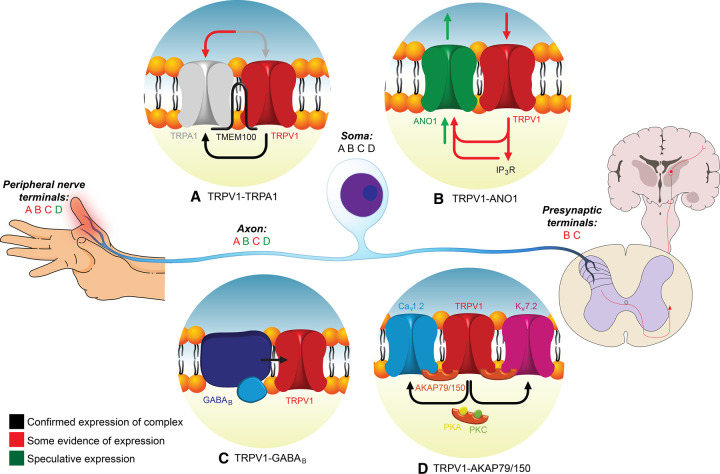
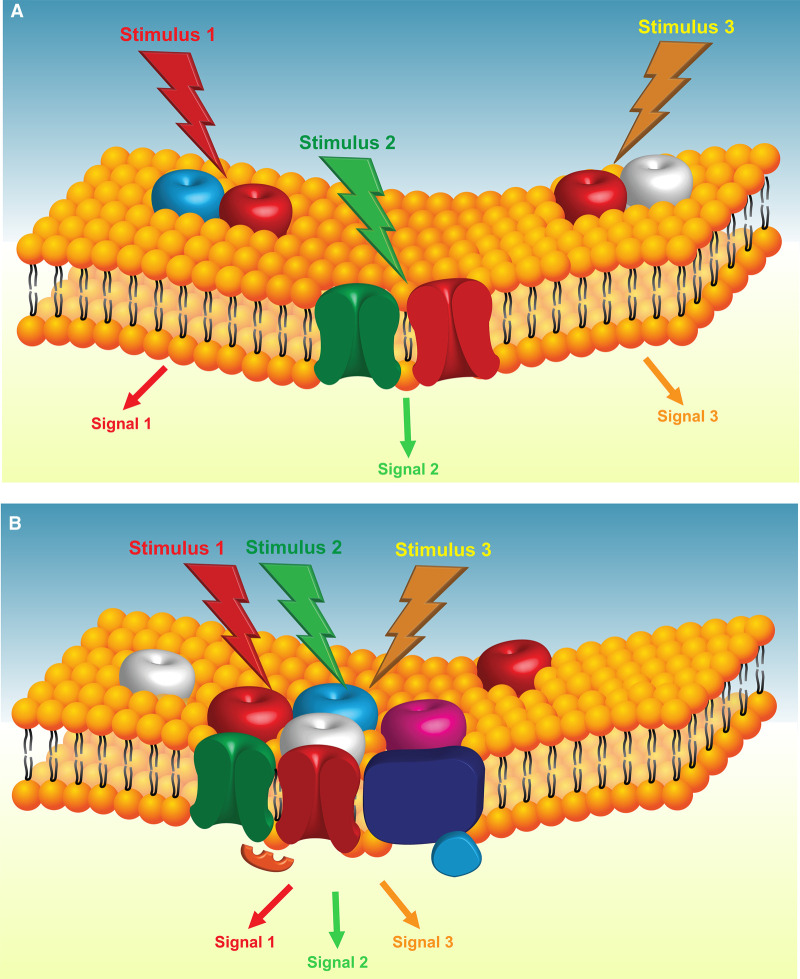
Peripheral somatosensory nerves are equipped with versatile molecular sensors which respond to acute changes in the physical environment. Most of these sensors are ion channels that, when activated, depolarize the sensory nerve terminal causing it to generate action potentials, which is the first step in generation of most somatic sensations, including pain. The activation and inactivation of sensory ion channels is tightly regulated and modulated by a variety of mechanisms. Amongst such mechanisms is the regulation of sensory ion channel activity via direct molecular interactions with other proteins in multi-protein complexes at the plasma membrane of sensory nerve terminals. In this brief review, we will consider several examples of such complexes formed around a prototypic sensory receptor, transient receptor potential vanilloid type 1 (TRPV1). We will also discuss some inherent conceptual difficulties arising from the multitude of reported complexes.
Keywords: G-protein-coupled receptors; TRPV1; nociception; pain; sensory neurons.
© 2022 The Author(s).
Conflict of interest statement
The authors declare that there are no competing interests associated with the manuscript.
Figures
Similar articles
-
Evidence for the role of lipid rafts and sphingomyelin in Ca2+-gating of Transient Receptor Potential channels in trigeminal sensory neurons and peripheral nerve terminals.Pharmacol Res. 2015 Oct;100:101-16. doi: 10.1016/j.phrs.2015.07.028. Epub 2015 Jul 31. Pharmacol Res. 2015. PMID: 26238178
-
Sensory nerve terminal mitochondrial dysfunction activates airway sensory nerves via transient receptor potential (TRP) channels.Mol Pharmacol. 2013 May;83(5):1007-19. doi: 10.1124/mol.112.084319. Epub 2013 Feb 26. Mol Pharmacol. 2013. PMID: 23444014 Free PMC article.
-
Antimycin A-induced mitochondrial dysfunction activates vagal sensory neurons via ROS-dependent activation of TRPA1 and ROS-independent activation of TRPV1.Brain Res. 2019 Jul 15;1715:94-105. doi: 10.1016/j.brainres.2019.03.029. Epub 2019 Mar 23. Brain Res. 2019. PMID: 30914247 Free PMC article.
-
Emerging Perspectives on Pain Management by Modulation of TRP Channels and ANO1.Int J Mol Sci. 2019 Jul 11;20(14):3411. doi: 10.3390/ijms20143411. Int J Mol Sci. 2019. PMID: 31336748 Free PMC article. Review.
-
Painful channels in sensory neurons.Mol Cells. 2005 Dec 31;20(3):315-24. Mol Cells. 2005. PMID: 16404144 Review.
Cited by
-
Human Transient Receptor Potential Ankyrin 1 Channel: Structure, Function, and Physiology.Subcell Biochem. 2024;104:207-244. doi: 10.1007/978-3-031-58843-3_10. Subcell Biochem. 2024. PMID: 38963489 Review.
References
Publication types
MeSH terms
Substances
Grants and funding
- 212302/Z/18/Z/WT_/Wellcome Trust/United Kingdom
- MR/V012738/1/MRC_/Medical Research Council/United Kingdom
- BB/V010344/1/BB_/Biotechnology and Biological Sciences Research Council/United Kingdom
- BB/R003068/1/BB_/Biotechnology and Biological Sciences Research Council/United Kingdom
- BB/R02104X/1/BB_/Biotechnology and Biological Sciences Research Council/United Kingdom
