


hEPCR.hTBM.hCD47.hHO-1 with donor clodronate and DDAVP treatment improves perfusion and function of GalTKO.hCD46 porcine livers perfused with human blood
- PMID: 35166407
- PMCID: PMC10249003
- DOI: 10.1111/xen.12731
hEPCR.hTBM.hCD47.hHO-1 with donor clodronate and DDAVP treatment improves perfusion and function of GalTKO.hCD46 porcine livers perfused with human blood
Abstract
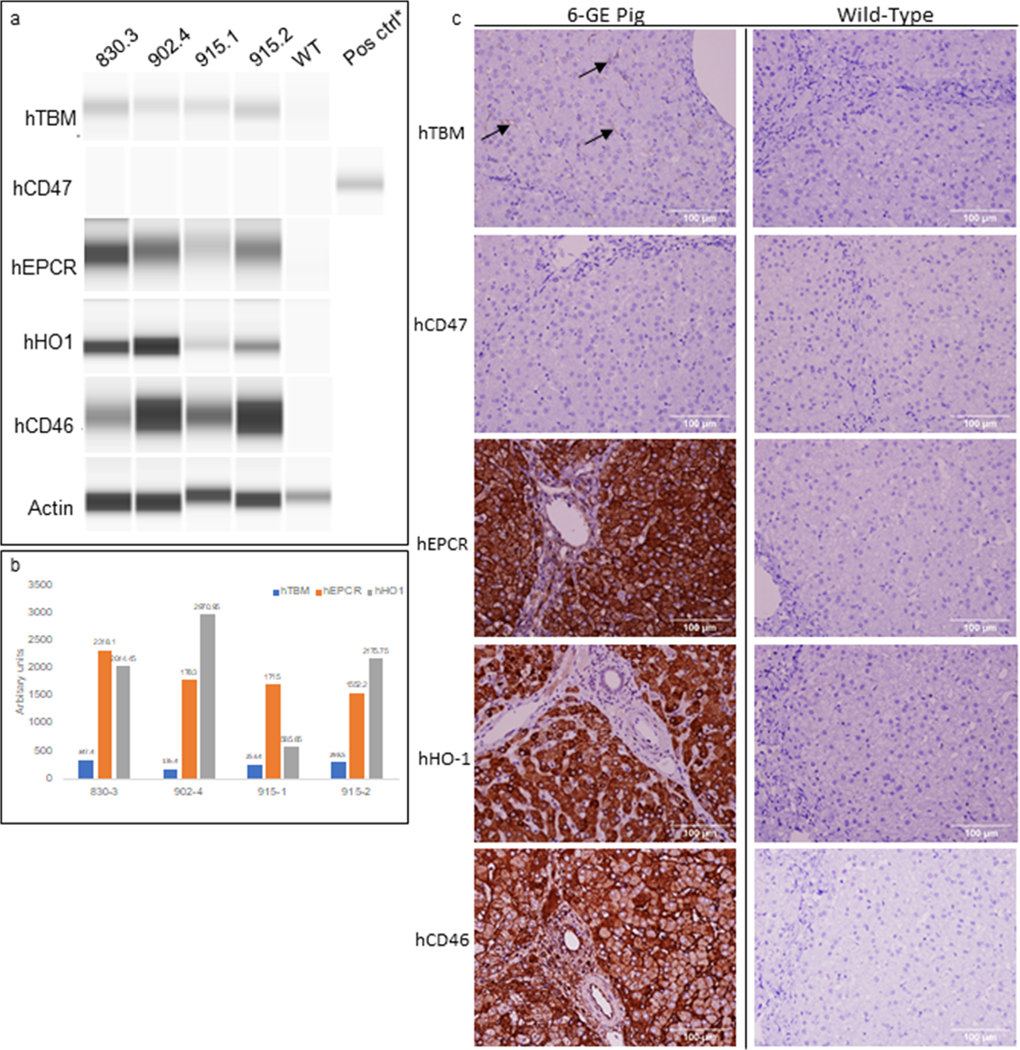
Introduction: Platelet sequestration, inflammation, and inappropriate coagulation cascade activation are prominent in liver xenotransplant models and are associated with poor outcomes. Here, we evaluate a cassette of six additional genetic modifications to reduce anti-pig antibody binding (α-1,3-galactosyl transferase knockout [GalTKO]) and target coagulation dysregulation (human endothelial protein C receptor [hEPRC] and thrombomodulin [hTBM]), complement pathway regulation (human membrane cofactor protein, hCD46), inflammation heme oxygenase 1 [hHO-1]), and a self-recognition receptor (integrin-associated protein [hCD47]), as well as donor pharmacologic treatments designed to blunt these phenomena.
Methods: Livers from GaltKO.hCD46 pigs ("2-gene," n = 3) and GalTKO.hCD46 pigs also transgenic for hEPRC, hTBM, hCD47, and hHO-1 ("6-gene," n = 4) were perfused ex vivo with whole human blood. Six-gene pigs were additionally pretreated with desmopressin (DDAVP) and clodronate liposomes to deplete vWF and kupffer cells, respectively.
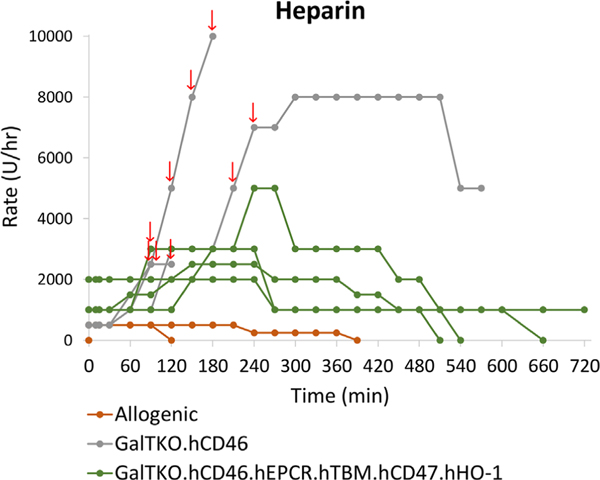
Results: The average perfusion times increased from 304 (±148) min in the 2-gene group to 856 (±61) min in the 6-gene group (p = .010). The average heparin administration was decreased from 8837 U/h in the 2-gene to 1354 U/h in the 6-gene group (p = .047). Platelet sequestration tended to be delayed in the 6-gene group (p = .070), while thromboxane B2 (TXB2, a platelet activation marker) levels were lower over the first hour (p = .044) (401 ± 124 vs. 2048 ± 712 at 60 min). Thrombin production as measured by F1+2 levels tended to be lower in the 6-gene group (p = .058).
Conclusions: The combination of the hEPCR.hTBM.hCD47.hHO-1 cassette along with donor pig DDAVP and clodronate liposome pretreatment was associated with prolonged function of xenoperfused livers, reduced coagulation pathway perturbations, and decreased TXB2 elaboration, and reflects significant progress to modulate liver xenograft injury in a pig to human model.
Keywords: ex-vivo perfusion; liver xenotransplantation; transgenic pigs.
© 2022 John Wiley & Sons A/S. Published by John Wiley & Sons Ltd.
Conflict of interest statement
CONFLICT OF INTEREST
RNP has served without compensation on Revivicor’s Scientific Advisory Board. DLA is Executive VP and CSO of Revivicor, Inc. KK, LS, AD, WE, and CP are employees of Revivicor, Inc. Revivicor, Inc. is a wholly owned subsidiary of United Therapeutics Corporation.
Figures




References
-
- Rees MA, Butler AJ, Chavez-Cartaya G, et al. Prolonged function of extracorporeal hDAF transgenic pig livers perfused with human blood.Transplantation. 2002;73:1194–1202. - PubMed
-
- Powelson J, Cosimi AB, Austen W, et al. Porcine-to-primate orthotopic liver transplantation. Transplant Proc. 1994;26:1353–1354. - PubMed
-
- Ekser B, Long C, Echeverri GJ, et al. Impact of thrombocytopenia on survival of baboons with genetically modified pig liver transplants: clinical relevance. Am J Transplant. 2010;10:273–285. - PubMed
-
- Shah JA, Navarro-Alvarez N, DeFazio M, et al. A bridge to some-where: 25-day survival after pig-to-baboon liver xenotransplantation. Ann Surg. 2016;263:1069–1071. - PubMed
Publication types
MeSH terms
Substances
Grants and funding
LinkOut - more resources
Full Text Sources
Other Literature Sources
Research Materials
Miscellaneous
