


Reciprocal Associations Between Maternal Smoking Cessation and Breastfeeding
- PMID: 35166565
- PMCID: PMC8971983
- DOI: 10.1089/bfm.2021.0199
Reciprocal Associations Between Maternal Smoking Cessation and Breastfeeding
Abstract
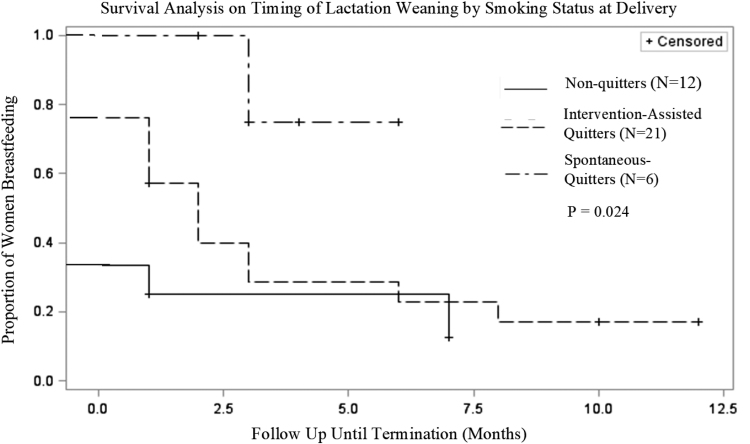
Background: Pregnancy is a motivating factor to quit smoking, but many women relapse postpartum. The underlying mechanisms and the necessary duration of breastfeeding that provide long-term protection against postpartum smoking relapse are unknown. Aims: We aimed to examine (1) associations of smoking cessation with breastfeeding initiation and duration; (2) necessary breastfeeding duration to reduce or prevent risk of postpartum smoking relapse. Methods: In this cohort study, we recruited 55 mothers, either smoking or have quit smoking, who recently delivered their baby from the Greater Buffalo area, NY, USA. Results: Quitters had a higher breastfeeding initiation rate (73.7% versus 30.8%; p = 0.029) and breastfed longer (p < 0.024) than nonquitters. Mothers who never breastfed relapsed quicker than mothers who did (p = 0.039). There was a 28% reduction in smoking relapse at 12 months postpartum for every month longer of breastfeeding duration (confounder-adjusted hazard ratio, 0.72 [95% confidence interval, 0.55-0.94]; p = 0.014). The estimated smoking relapse risk was 60.0% for nonbreastfeeding, 22.4% for 3 months of breastfeeding, 8.4% for 6 months of breastfeeding, and 1.2% for 12 months of breastfeeding. Conclusion: Smoking cessation was associated with increased breastfeeding initiation and duration. Smoking relapse risk decreased with longer breastfeeding duration, and 12 months of breastfeeding may help to prevent smoking relapse. An integrated intervention of maternal smoking cessation and breastfeeding promotion is promising to enhance both behaviors.
Keywords: breastfeeding; maternal and child health; public health; smoking cessation; smoking relapse.
Conflict of interest statement
A.I., M.H., L.S., J.I., and M.G.K. completed the student research and X.W. was the advisor. The authors declare that they have nothing to disclose and no conflict of interest.
Figures


References
-
- Orton S, Coleman T, Coleman-Haynes T, et al. . Predictors of postpartum return to smoking: A systematic review. Nicotine Tob Res 2018;20:665–673. - PubMed
-
- Logan CA, Rothenbacher D, Genuneit J. Postpartum smoking relapse and breast feeding: Defining the window of opportunity for intervention. Nicotine Tob Res 2017;19:367–372. - PubMed
Publication types
MeSH terms
Grants and funding
LinkOut - more resources
Full Text Sources
Medical
