. 2022 Feb;8(2):000742.
doi: 10.1099/mgen.0.000742.

Identification of novel, cryptic Clostridioides species isolates from environmental samples collected from diverse geographical locations

Affiliations

Identification of novel, cryptic Clostridioides species isolates from environmental samples collected from diverse geographical locations

Charles Hall Davis Williamson et al. Microb Genom. 2022 Feb.

Abstract

Clostridioides difficile is a pathogen often associated with hospital-acquired infection or antimicrobial-induced disease; however, increasing evidence indicates infections can result from community or environmental sources. Most genomic sequencing of C. difficile has focused on clinical strains, although evidence is growing that C. difficile spores are widespread in soil and water in the environment. In this study, we sequenced 38 genomes collected from soil and water isolates in Flagstaff (AZ, USA) and Slovenia in an effort targeted towards environmental surveillance of C. difficile. At the average nucleotide identity (ANI) level, the genomes were divergent to C. difficile at a threshold consistent with different species. A phylogenetic analysis of these divergent genomes together with Clostridioides genomes available in public repositories confirmed the presence of three previously described, cryptic Clostridioides species and added two additional clades. One of the cryptic species (C-III) was almost entirely composed of Arizona and Slovenia genomes, and contained distinct sub-groups from each region (evidenced by SNP and gene-content differences). A comparative genomics analysis identified multiple unique coding sequences per clade, which can serve as markers for subsequent environmental surveys of these cryptic species. Homologues to the C. difficile toxin genes, tcdA and tcdB, were found in cryptic species genomes, although they were not part of the typical pathogenicity locus observed in C. difficile, and in silico PCR suggested that some would not amplify with widely used PCR diagnostic tests. We also identified gene homologues in the binary toxin cluster, including some present on phage and, for what is believed to be the first time, on a plasmid. All isolates were obtained from environmental samples, so the function and disease potential of these toxin homologues is currently unknown. Enzymatic profiles of a subset of cryptic isolates (n=5) demonstrated differences, suggesting that these isolates contain substantial metabolic diversity. Antimicrobial resistance (AMR) was observed across a subset of isolates (n=4), suggesting that AMR mechanisms are intrinsic to the genus, perhaps originating from a shared environmental origin. This study greatly expands our understanding of the genomic diversity of Clostridioides. These results have implications for C. difficile One Health research, for more sensitive C. difficile diagnostics, as well as for understanding the evolutionary history of C. difficile and the development of pathogenesis.

Keywords: Clostridioides difficile; cryptic species; genomics; toxin.


Conflict of interest statement

The authors declare that there are no conflicts of interest.

Figures
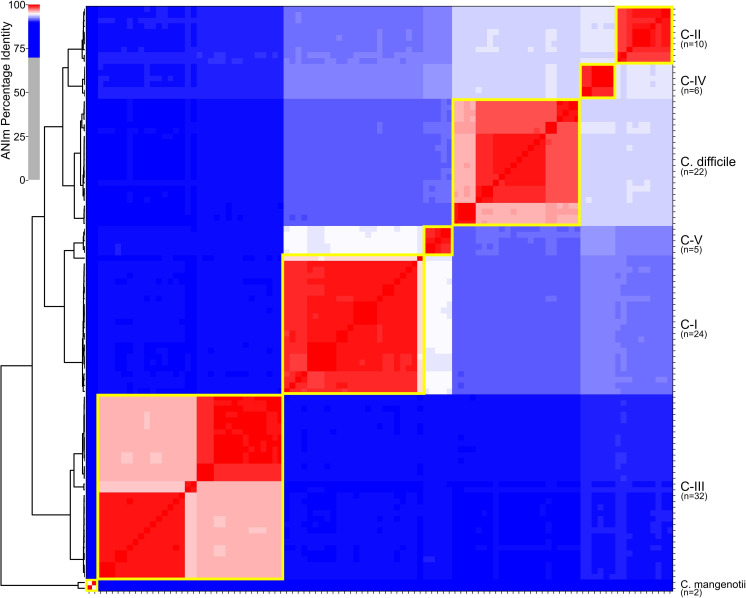
Fig. 1.
Fig. 1.
Heat map and clustering of genomes based upon pairwise ANI values (ANIm value computed with pyani [37]). Yellow boxes indicate species/lineage boundaries of 95 % ANI.
Fig. 2.
Fig. 2.
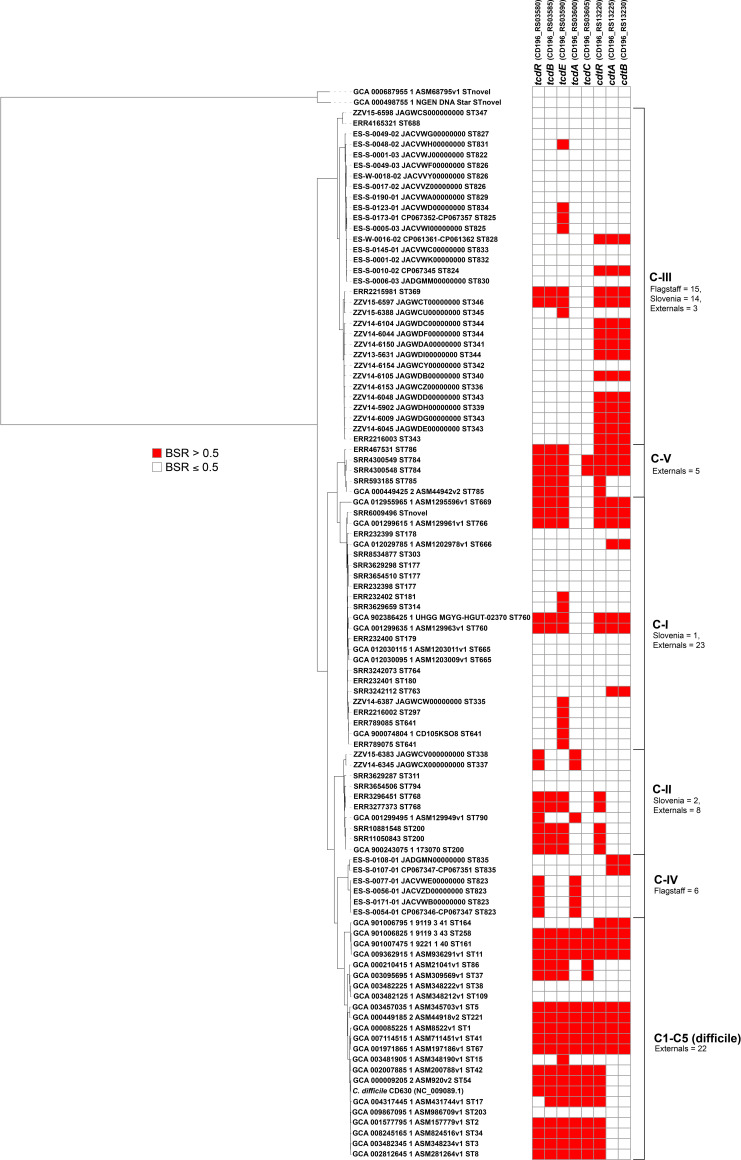
A core-genome, maximum-likelihood SNP phylogeny of 101 reference genomes rooted with C. mangenotii (top of phylogeny) demonstrating a similar topology to the clustering of genomes with ANI values. The presence or absence of C. difficile toxins (tcdR, tcdB, tcdE, tcdA, tcdC, cdtR, cdtA, cdtB) is displayed in the heat map to the right of the phylogeny. Toxin presence or absence was determined with a BSR cut-off value of 0.5 (see Methods). The numbers of genomes from Flagstaff (this study), Slovenia (this study) or downloaded from the NCBI (labelled as external) in each species/lineage are listed next to the heat map.
Fig. 3.
Fig. 3.
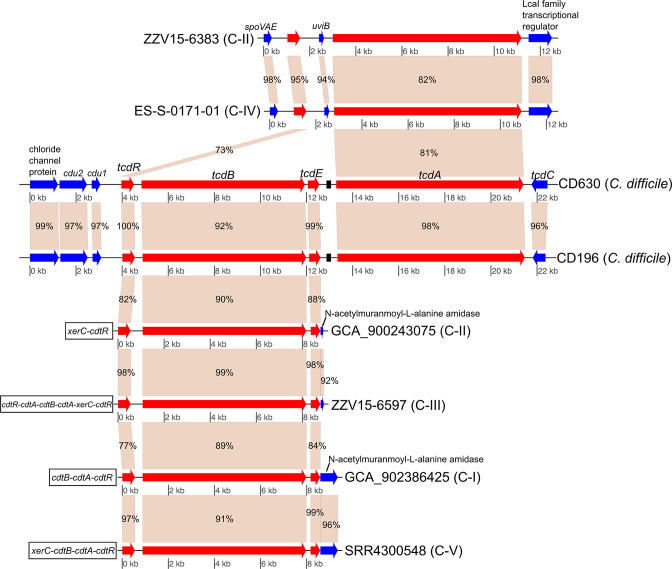
Gene map of tcdB and tcdA regions in genomes from various species/lineages containing C. difficile toxin homologues. Toxin gene homologues (tcdR, tcdB, tcdE, tcdA) are displayed in red, and flanking genes are displayed in blue. tcdB homologues were observed in genomes in groups C-I, C-II, C-III and C-V, and tcdA homologues were observed in genomes in groups C-II and C-IV. No cryptic lineage genomes contained both tcdB and tcdA homologues. The figure was generated with genoPlotR [54]. Numbers on genes indicate pairwise blast identities.
Fig. 4.
Fig. 4.
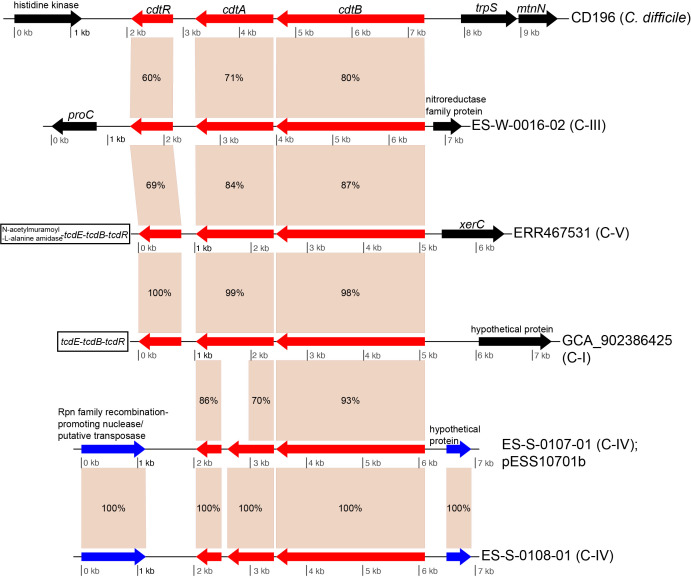
Gene map of binary toxin gene regions in genomes from various species. Binary toxin homologues are displayed in red. Binary toxin gene homologues were observed in isolates from clades C-I, C-III, C-IV and C-V. The figure was generated with genoPlotR [54]. Numbers on genes indicate pairwise blast identities. Blue arrows indicate homologous genes outside of the toxin cluster while black boxes indicate genes with no homolog in other gene clusters.
Fig. 5.
Fig. 5.
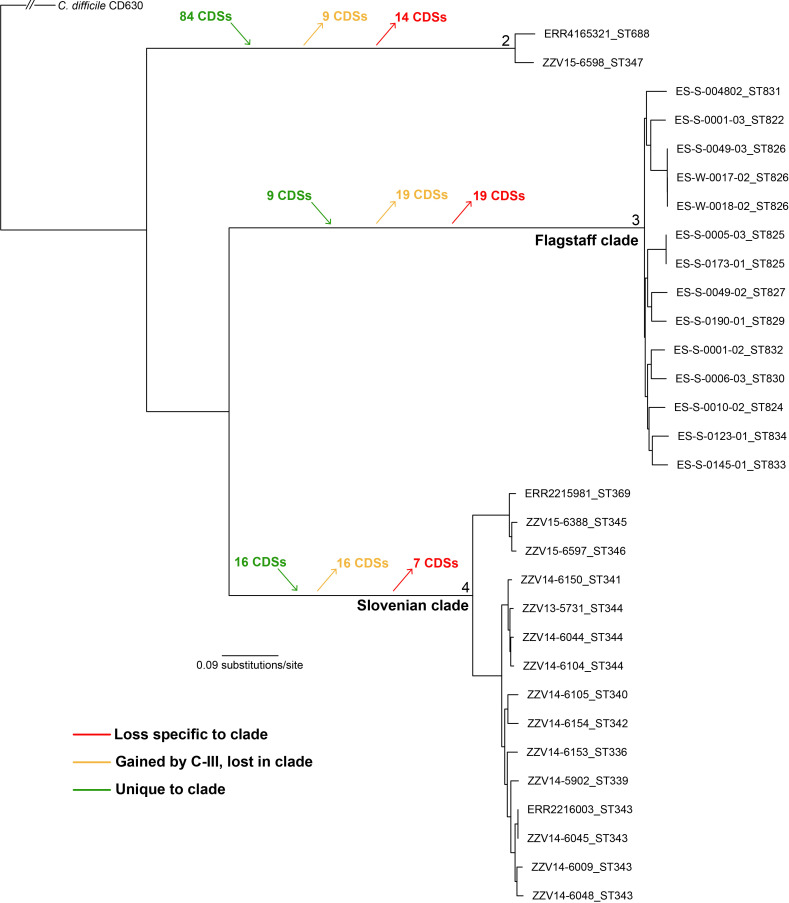
A core-genome, maximum-likelihood SNP phylogeny of C-III genomes displaying coding regions conserved or lost among lineages. Unique coding regions are present in all three major lineages of C-III, based on an analysis with ls-bsr (see Methods). The phylogeny was rooted by querying SNPs in C. difficile CD630.

References

    1. Janezic S, Smrke J, Rupnik M. Isolation of Clostridioides difficile from different outdoor sites in the domestic environment. Anaerobe. 2020;62:102183. doi: 10.1016/j.anaerobe.2020.102183. - DOI - PubMed
    1. Lim SC, Knight DR, Riley TV. Clostridium difficile and one health. Clin Microbiol Infect. 2020;26:857–863. doi: 10.1016/j.cmi.2019.10.023. - DOI - PubMed
    1. Rodriguez Diaz C, Seyboldt C, Rupnik M. Non-human C. difficile reservoirs and sources: animals, food, environment. Adv Exp Med Biol. 2018;1050:227–243. doi: 10.1007/978-3-319-72799-8_13. - DOI - PubMed
    1. Janezic S, Potocnik M, Zidaric V, Rupnik M. Highly divergent Clostridium difficile strains isolated from the environment. PLoS One. 2016;11:e0167101. doi: 10.1371/journal.pone.0167101. - DOI - PMC - PubMed
    1. Dingle KE, Elliott B, Robinson E, Griffiths D, Eyre DW, et al. Evolutionary history of the Clostridium difficile pathogenicity locus. Genome Biol Evol. 2014;6:36–52. doi: 10.1093/gbe/evt204. - DOI - PMC - PubMed

Publication types

MeSH terms

LinkOut - more resources