


Determinants of willingness to pay for health services: a systematic review of contingent valuation studies
- PMID: 35166973
- PMCID: PMC8853086
- DOI: 10.1007/s10198-022-01437-x
Determinants of willingness to pay for health services: a systematic review of contingent valuation studies
Abstract
Introduction: Stated preference studies are a valuable tool to elicit respondents' willingness to pay (WTP) for goods or services, especially in situations where no market valuation exists. Contingent valuation (CV) is a widely used approach among stated-preference techniques for eliciting WTP if prices do not exist or do not reflect actual costs, for example, when services are covered by insurance. This review aimed to provide an overview of relevant factors determining WTP for health services to support variable selection.
Methods: A comprehensive systematic literature search and review of CV studies assessing determinants of WTP for health services was conducted, including 11 electronic databases. Two of the authors made independent decisions on the eligibility of studies. We extracted all determinants used and related p values for the effect sizes (e.g. reported in regression models with WTP for a health service as outcome variable). Determinants were summarised in systematic evidence tables and structured by thematic domains.
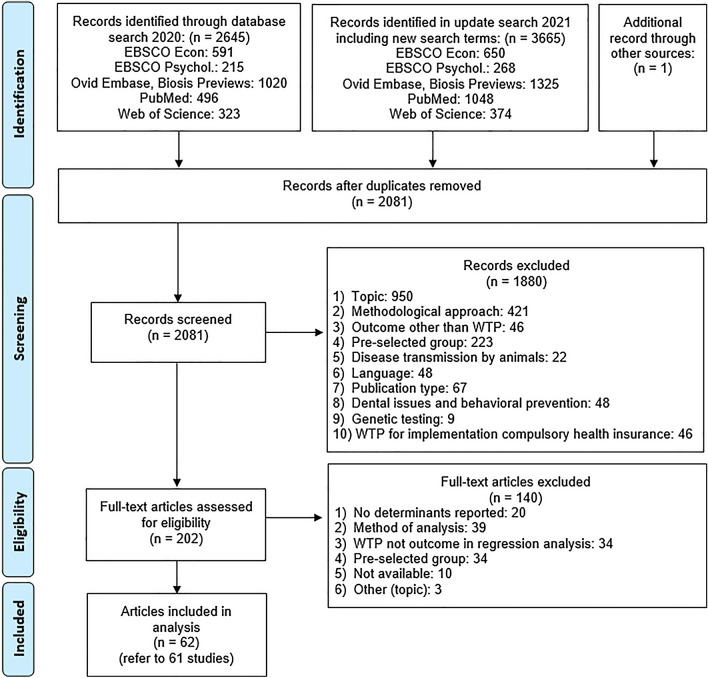
Results: We identified 2082 publications, of which 202 full texts were checked for eligibility. We included 62 publications on 61 studies in the review. Across all studies, we identified 22 WTP determinants and other factors from 5 thematic domains: sociodemographic characteristics, perceived threat, perceived benefit, perceived barriers, and other information.
Conclusion: Our review provides evidence on 22 relevant determinants of WTP for health services, which may be used for variable selection and as guidance for planning CV surveys. Endogeneity should be carefully considered before interpreting these determinants as causal factors and potential intervention targets.
Keywords: Contingent valuation; Economic valuation; Literature review; Public health; Sociodemographic determinants; Willingness to pay.
© 2022. The Author(s), under exclusive licence to Springer-Verlag GmbH Germany, part of Springer Nature.
Conflict of interest statement
The authors have no conflicts of interest to declare that are relevant to the content of this article. All the authors certify that they have no affiliations with or involvement in any organisation or entity with any financial interest or non-financial interest in the subject matter or materials discussed in this manuscript. The authors have no financial or proprietary interests in any material discussed in this article.
Figures
References
-
- Drummond M, Sculpher M, Torrance G, O’Brien B, Stoddart G. Methods for the economic evaluation of health care programmes. 3. New York: Oxford University Press; 2005. Chapter 7: cost-benefit analysis; pp. 211–245.
-
- Carson RT. Contingent valuation: a practical alternative when prices aren't available. J. Econ. Perspect. 2012;26(4):27–42. doi: 10.1257/jep.26.4.27. - DOI
-
- Cambridge University Press: Definition of health service Cambridge University Press. https://dictionary.cambridge.org/de/worterbuch/englisch/health-service (2020). Accessed 10 Nov 2020
Publication types
MeSH terms
LinkOut - more resources
Full Text Sources
