


Hot red pepper powder as a safe alternative to antibiotics in organic poultry feed: an updated review
- PMID: 35168162
- PMCID: PMC8850793
- DOI: 10.1016/j.psj.2021.101684
Hot red pepper powder as a safe alternative to antibiotics in organic poultry feed: an updated review
Abstract
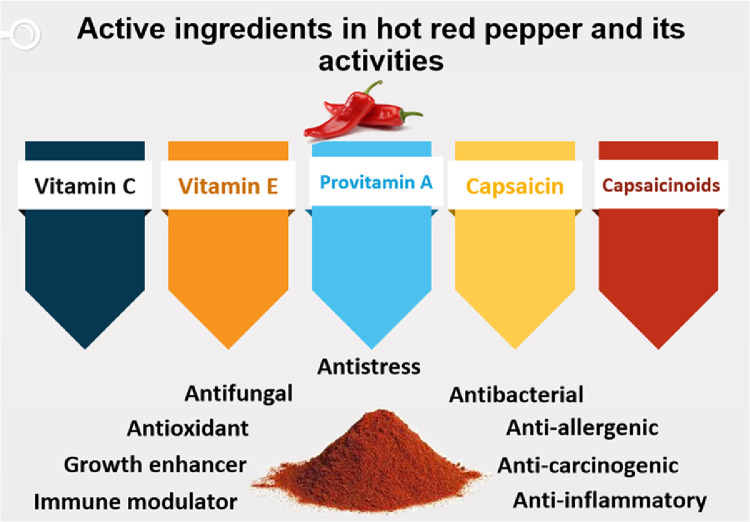
Globally, several studies have investigated the utilization and efficacy of promising medicinal herbal plants to enhance livestock and poultry production. The most commonly investigated phytobiotics in broiler ration were oregano, garlic, thyme, rosemary, black pepper, hot red pepper (HRP), and sage. Phytobiotics are classified on the basis of the medicinal properties of plants, their essential oil extracts, and their bioactive compounds. The majority of bioactive compounds in plants are secondary metabolites, such as terpenoids, phenolic, glycosides, and alkaloids. The composition and concentrations of these bioactive constitutes vary according to their biological factors and manufacturing and storage conditions. Furthermore, HRP is one of the most important and widely used spices in the human diet. Capsicum annum, that is, HRP, is a species of the plant genus Capsicum (pepper), which is a species native to southern North America and northern South America and is widely grown and utilized for its fresh or cooked fruits. Moreover, these fruits may be used as dried powders or processed forms of oleoresins. Researches have proven that C. annuum is the only plant that produces the alkaloid capsaicinoids. Approximately 48% of its active substances are capsaicin (8-methyl-N-vanillyl-6-nonemide), the main active compound responsible for the intense effects of HRP varieties and the main component inducing the hot flavor. This review aimed to highlight the effects of HRP as a phytobiotic in broiler nutrition and its mode of action as a possible alternative to antibiotics and clarify its impact on broiler and layer productivity.
Keywords: antibiotic alternatives; hot red pepper; organic poultry; phytobiotic; poultry diet.
Copyright © 2021 The Authors. Published by Elsevier Inc. All rights reserved.
Figures
References
-
- Abd El-Ghany W.A., Shaalan M., Salem H.M. Nanoparticles applications in poultry production: an updated review. Worlds Poult. Sci. J. 2021;77:1–25.
-
- Abd El-Hack M.E., Alagawany M., Abdelnour S. Responses of growing rabbits to supplementing diet with a mixture of black and red pepper oils as a natural growth promoter. J. Anim. Physiol. Anim. Nutr. 2018;103:509–517. - PubMed
-
- Abd El-Hack M.E., El-Saadony M.T., Shafi M.E., Alshahrani O.A., Saghir S.A., Al-Wajeeh A.S., Al-Shargi O.Y., Taha A.E., Mesalam N.M., Abdel-Moneim A.-M.E. Prebiotics can restrict Salmonella populations in poultry: a review. Anim. Biotechnol. 2022 doi: 10.1080/10495398.2021.1883637. In Press. - DOI - PubMed
-
- Abd El-Hack M.E., El-Saadony M.T., Shafi M.E., Qattan S.Y., Batiha G.E., Khafaga A.F., Abdel-Moneim A.M.E., Alagawany M. Probiotics in poultry feed: a comprehensive review. J. Anim. Physiol. Anim. Nutr. 2020;104:1835–1850. - PubMed
-
- Abd El-Hack M.E., El-Saadony M.T., Shafi M.E., Zabermawi N.M., Arif M., Batiha G.E.-S., Khafaga A.F., Abd El-Hakim Y.M., Al-Sagheer A.A. Antimicrobial and antioxidant properties of chitosan and its derivatives and their applications: a review. Int. J. Biol. Macromol. 2020;164:2726–2744. - PubMed
Publication types
MeSH terms
Substances
LinkOut - more resources
Full Text Sources
