. 2022 Aug 10;71(5):1147-1158.
doi: 10.1093/sysbio/syac011.

Ghost Lineages Highly Influence the Interpretation of Introgression Tests

Affiliations

Ghost Lineages Highly Influence the Interpretation of Introgression Tests

Théo Tricou et al. Syst Biol. .

Abstract

Most species are extinct, those that are not are often unknown. Sequenced and sampled species are often a minority of known ones. Past evolutionary events involving horizontal gene flow, such as horizontal gene transfer, hybridization, introgression, and admixture, are therefore likely to involve "ghosts," that is extinct, unknown, or unsampled lineages. The existence of these ghost lineages is widely acknowledged, but their possible impact on the detection of gene flow and on the identification of the species involved is largely overlooked. It is generally considered as a possible source of error that, with reasonable approximation, can be ignored. We explore the possible influence of absent species on an evolutionary study by quantifying the effect of ghost lineages on introgression as detected by the popular D-statistic method. We show from simulated data that under certain frequently encountered conditions, the donors and recipients of horizontal gene flow can be wrongly identified if ghost lineages are not taken into account. In particular, having a distant outgroup, which is usually recommended, leads to an increase in the error probability and to false interpretations in most cases. We conclude that introgression from ghost lineages should be systematically considered as an alternative possible, even probable, scenario. [ABBA-BABA; D-statistic; gene flow; ghost lineage; introgression; simulation.].


Figures

<sc>Figure</sc> 1.
Figure 1.
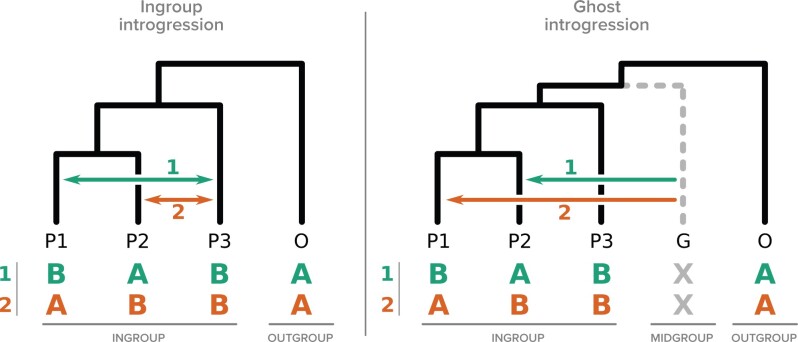
Introgression events that can result in a significant excess of ABBA or BABA patterns according to the D-statistic. The usual interpretation of this excess is the hypothesis of “ingroup” introgression (left panel). However, “ghost” (or “midgroup”) introgression (right panel) from ghost lineages (G) can produce similar patterns.
<sc>Figure</sc> 2.
Figure 2.
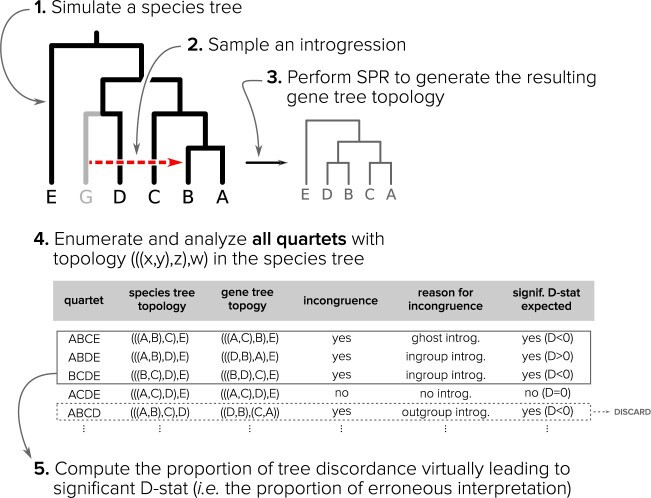
Species tree/Gene tree simulation: (1) a species tree is generated under a birth death model and 20 taxa are sampled from it; (2) an introgression event is picked from a random donor and recipient; (3) an introgressed gene tree is constructed from the species tree by SPR; (4) for each quartet with a ladder-like topology ([formula image,z],w) in the species tree, species tree and gene tree topologies are compared to determine if there is an incongruence caused by the introgression; (5) the proportion of erroneous interpretation of the D-statistic across the species tree is computed by the sum of all introgressions with a midgroup ghost donor over all introgressions detected, outgroup introgressions excluded.
<sc>Figure</sc> 3.
Figure 3.
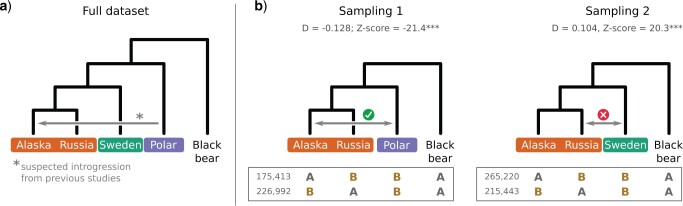
The effect of sampling on the interpretation of the D-statistic, using bear genomic data as an example. a) Phylogenetic relationship of the five bear taxa sampled. The gray arrow shows the introgression inferred from previous studies. b) D-statistic calculated from two 4-taxon subsets. The number of ABBA and BABA patterns is given below the trees. In subset 1, the Slovenian bear, a lineage that is not thought to be involved in introgression, is removed. In subset 2, the donor of the introgression shown in 3A (i.e., the polar bear) is removed. Introgressions were inferred from the D-statistic (grey arrows), and their congruence with other studies (tick-mark formula image congruent, cross-mark formula image not congruent) is indicated above the arrow.
<sc>Figure</sc> 4.
Figure 4.
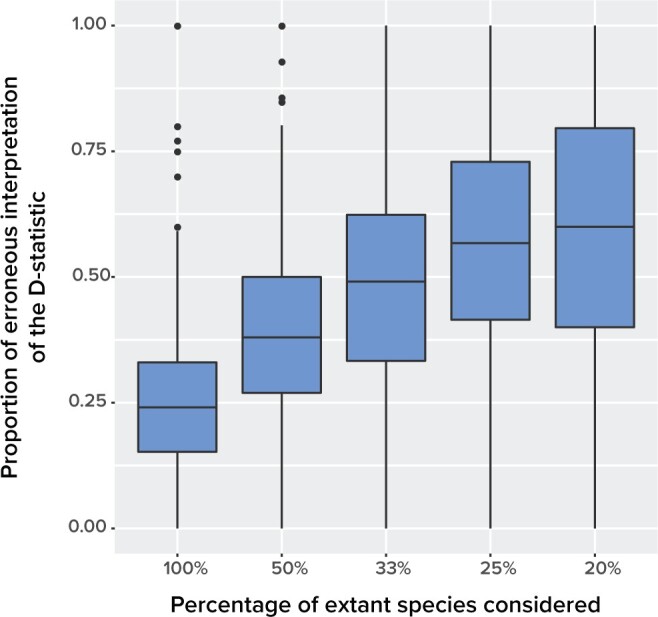
The effect of taxonomic sampling (formula image-axis) on the proportion of erroneous interpretations of the D-statistic (formula image-axis). The error rate is increasing with the amount of unknown.
<sc>Figure</sc> 5.
Figure 5.
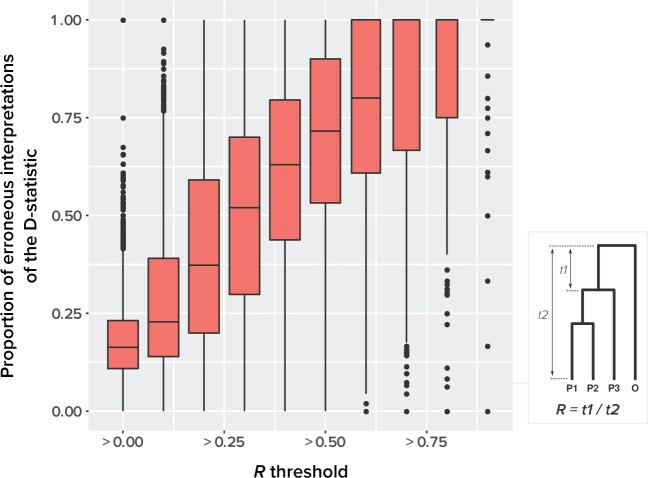
The relationship between outgroup distance (formula image) and the proportion of erroneous interpretations of the D-statistic for different thresholds of formula image (formula image-axis). The distances formula image1 and formula image2 used to calculate the relative distance to the outgroup (formula image) are described on the right box.
<sc>Figure</sc> 6.
Figure 6.
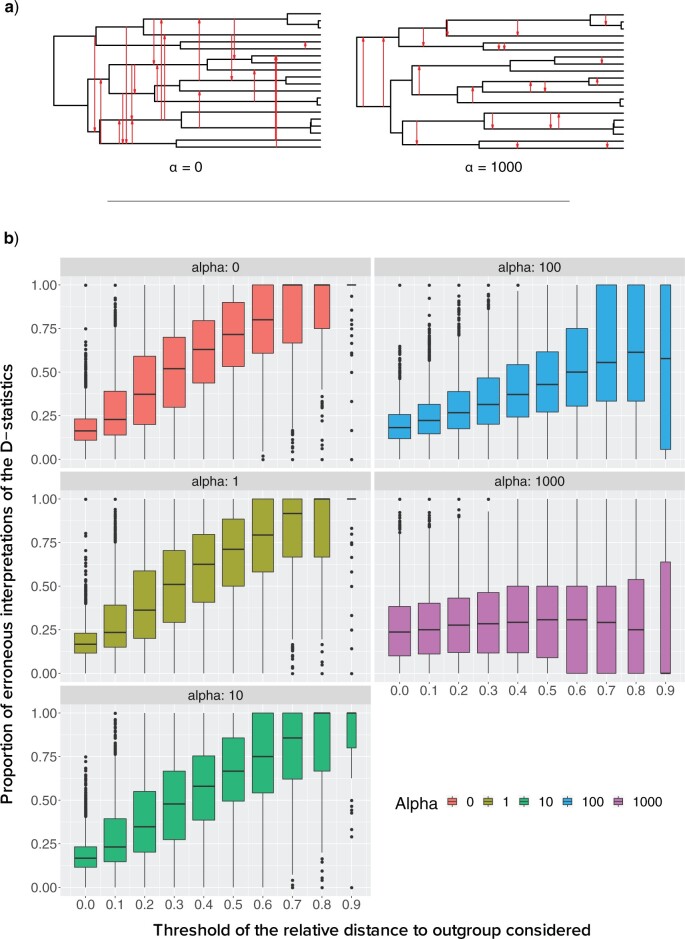
The effect of the probability of introgression on the proportion of erroneous interpretations of the D-statistic. a) Illustration of the effect of the formula image parameter, which imposes constraints on introgression in relation to phylogenetic distance. b) Relationship between relative outgroup distance (formula image-axis) and the proportion of erroneous interpretations (formula image-axis) for different levels of constraint on introgression related to phylogenetic distance, determined by formula image (0, 1, 10, 100, 1000).

References

    1. Barlow A., Cahill J.A., Hartmann S., Theunert C., Xenikoudakis G., Fortes G.G., Paijmans J.L.A., Rabeder G., Frischauf C., Grandal-d’Anglade A., García-Vázquez A., Murtskhvaladze M., Saarma U., Anijalg P., Skrbinšek T., Bertorelle G., Gasparian B., Bar-Oz G., Pinhasi R., Slatkin M., Dalén L., Shapiro B., Hofreiter M.. 2018. Partial genomic survival of cave bears in living brown bears. Nat. Ecol. Evol. 2:1563–1570. - PMC - PubMed
    1. Bordewich M., Semple C.. 2005. On the computational complexity of the rooted subtree prune and regraft distance. Ann. Comb. 8:409–423.
    1. Cahill J.A., Green R.E., Fulton T.L., Stiller M., Jay F., Ovsyanikov N., Salamzade R., John J.S., Stirling I., Slatkin M., Shapiro B.. 2013. Genomic evidence for island population conversion resolves conflicting theories of polar bear evolution. PLoS Genet. 9:e1003345. - PMC - PubMed
    1. Chapman M.A., Burke J.M.. 2007. Genetic divergence and hybrid speciation. Evol. Int. J. Org. Evol. 61:1773–1780. - PubMed
    1. Dannemann M., Racimo F.. 2018. Something old, something borrowed: admixture and adaptation in human evolution. Curr. Opin. Genet. Dev. 53:1–8. - PubMed

Publication types