Review
. 2022 Apr 1;322(4):G405-G420.
doi: 10.1152/ajpgi.00316.2021. Epub 2022 Feb 16.

Intestinal secretory mechanisms and diarrhea

Affiliations
Review

Intestinal secretory mechanisms and diarrhea

Stephen J Keely et al. Am J Physiol Gastrointest Liver Physiol. .

Abstract

One of the primary functions of the intestinal epithelium is to transport fluid and electrolytes to and from the luminal contents. Under normal circumstances, absorptive and secretory processes are tightly regulated such that absorption predominates, thereby enabling conservation of the large volumes of water that pass through the intestine each day. However, in conditions of secretory diarrhea, this balance becomes dysregulated, so that fluid secretion, driven primarily by Cl- secretion, overwhelms absorptive capacity, leading to increased loss of water in the stool. Secretory diarrheas are common and include those induced by pathogenic bacteria and viruses, allergens, and disruptions to bile acid homeostasis, or as a side effect of many drugs. Here, we review the cellular and molecular mechanisms by which Cl- and fluid secretion in the intestine are regulated, how these mechanisms become dysregulated in conditions of secretory diarrhea, currently available and emerging therapeutic approaches, and how new strategies to exploit intestinal secretory mechanisms are successfully being used in the treatment of constipation.

Keywords: chloride secretion; diarrhea; epithelial transport.


Conflict of interest statement

No conflicts of interest, financial or otherwise, are declared by the authors.

Figures
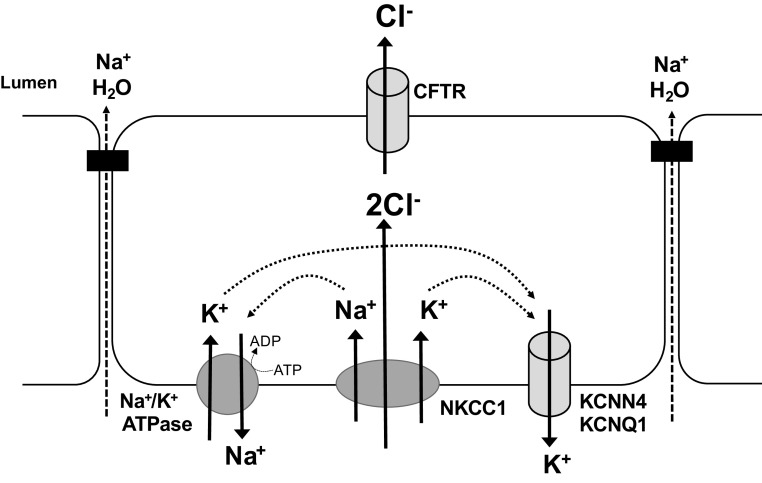
Figure 1.
Figure 1.
Intestinal epithelial Cl secretory mechanism. Chloride secretion is the primary driving force for water secretion across the intestinal epithelium. The energy for this process is derived from the activity of Na+-K+-ATPase pumps in the basolateral membrane. This transporter exudes 3 Na+ from the cell in exchange for 2 K+ into the cell with each molecule of ATP consumed. K+ is recycled across the basolateral membrane through the cAMP and Ca2+-regulated K+ channels, KCNQ1 and KCNN4, respectively. Through the activity of the Na+-K+-ATPase pump, intracellular Na+ is maintained at low levels creating a gradient for its entry via the Na+-K+-2Cl cotransporter, NKCC1. Since Na+ and K+ entering the cell via this transporter are recycled across the basolateral membrane, a net increase in chloride concentration inside the cell results, with the result that when the apical Cl channel, cystic fibrosis transmembrane conductance regulator (CFTR), opens (or other Cl channels, not shown), there is an electrochemical gradient for chloride secretion into the lumen. Cations, most notably Na+, follow passively through the paracellular pathway, with the net accumulation of NaCl in the lumen creating an osmotic gradient that drives water secretion.
Figure 2.
Figure 2.
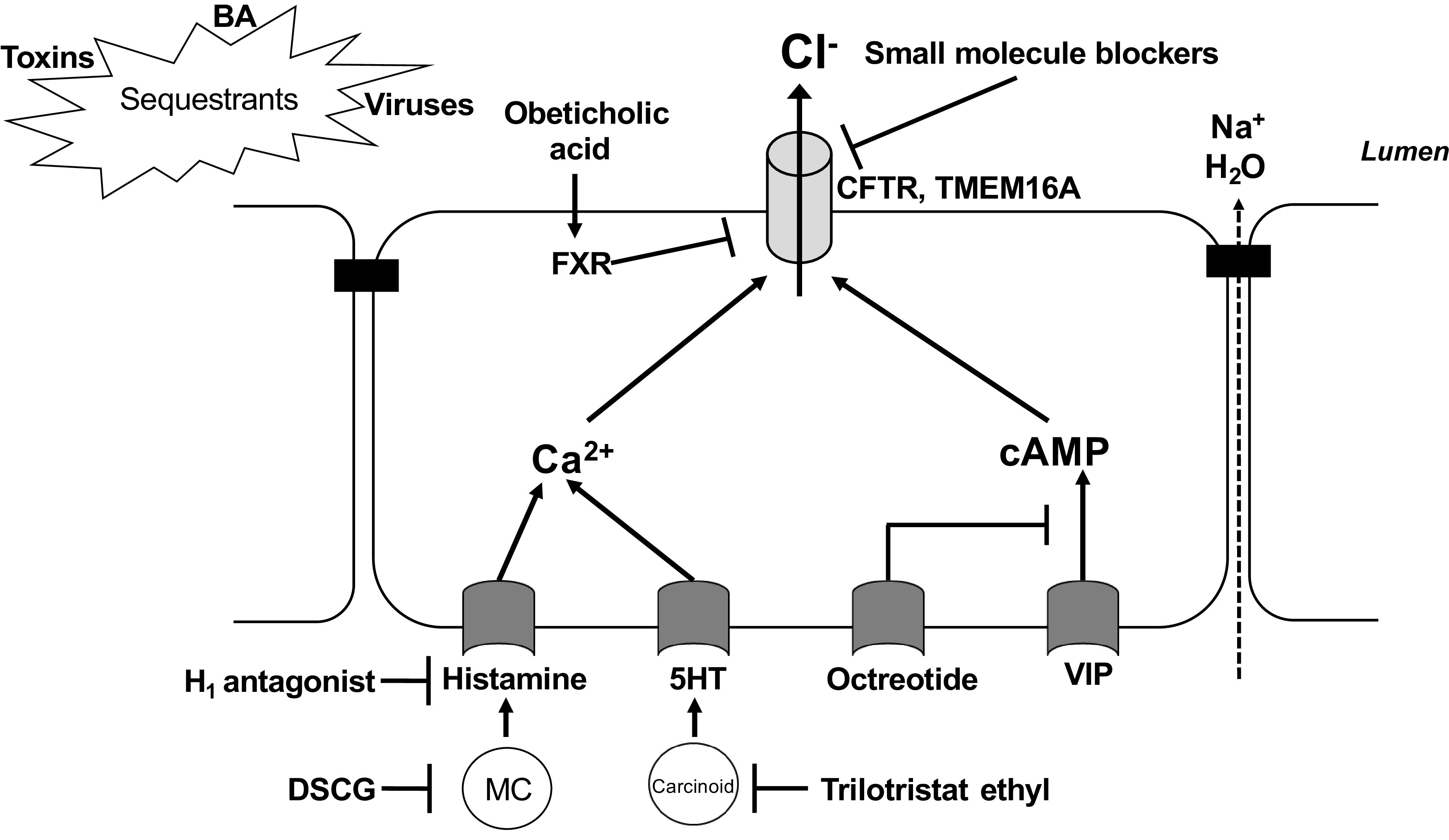
Modulation of intestinal secretory mechanisms as a modality to treat diarrhea. Selected agents discussed in the text are illustrated. In allergic diarrhea, histamine released from mast cells (MC) may evoke calcium-dependent Cl secretion, which can be blocked by the mast cell stabilizer disodium cromoglycate (DSCG) or antagonists of the histamine H1 receptor. Excessive release of serotonin (5HT) in patients suffering from carcinoid syndrome also evokes calcium-dependent Cl secretion; production of 5HT can be inhibited by trilotristat ethyl. Release of excess amounts of vasoactive intestinal polypeptide (VIP) in the setting of VIPoma triggers profound cAMP-dependent Cl secretion; this action (and release of VIP from the tumor) can be antagonized by somatostatin analogs such as octreotide. Small molecule inhibitors of CFTR or TMEM16A can block Cl secretion directly, whereas the farnesoid X receptor (FXR) agonist, obeticholic acid, reduces CFTR expression levels. Finally, various resins can sequester prosecretory agents such as bile acids (BA), viruses, and toxins in the intestinal lumen, preventing their interaction with the epithelium. For further details, see text.
Figure 3.
Figure 3.
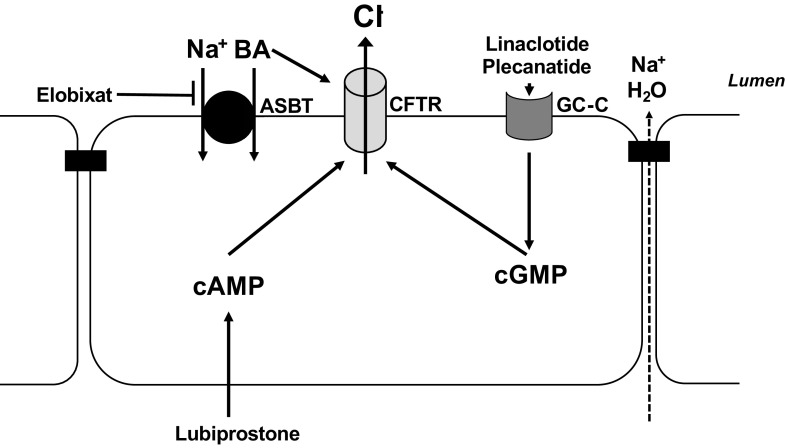
Stimulation of intestinal secretory mechanisms as an emerging modality to treat constipation. Lubiprostone elicits activation of the cystic fibrosis transmembrane conductance regulator (CFTR) Cl channel (and perhaps other channels) via an increase in cAMP. Linaclotide and plecanatide also activate CFTR and thus Cl secretion, but by binding to apical guanylyl cyclase-C (GC-C) receptors and thus triggering an increase in cGMP. Elobixat is an inhibitor of the ileal apical Na+-coupled bile acid transporter, ASBT. In the presence of this agent, bile acids (BA) accumulate luminally and stimulate Cl secretion, in part via CFTR. For further details, see text.

References

    1. Clausen MV, Hilbers F, Poulsen H. The structure and function of the Na,K-ATPase isoforms in health and disease. Front Physiol 8: 371, 2017. doi:10.3389/fphys.2017.00371. - DOI - PMC - PubMed
    1. Fuller PJ, Verity K. Colonic sodium-potassium adenosine triphosphate subunit gene expression: ontogeny and regulation by adrenocortical steroids. Endocrinology 127: 32–38, 1990. doi:10.1210/endo-127-1-32. - DOI - PubMed
    1. Vagin O, Dada LA, Tokhtaeva E, Sachs G. The Na-K-ATPase α1β1 heterodimer as a cell adhesion molecule in epithelia. Am J Physiol Cell Physiol 302: C1271–C1281, 2012. doi:10.1152/ajpcell.00456.2011. - DOI - PMC - PubMed
    1. Geering K. Function of FXYD proteins, regulators of Na, K-ATPase. J Bioenerg Biomembr 37: 387–392, 2005. doi:10.1007/s10863-005-9476-x. - DOI - PubMed
    1. Garty H, Karlish SJ. Role of FXYD proteins in ion transport. Annu Rev Physiol 68: 431–459, 2006. doi:10.1146/annurev.physiol.68.040104.131852. - DOI - PubMed

Publication types