


The Interplay of Environmental Exposures and Mental Health: Setting an Agenda
- PMID: 35171017
- PMCID: PMC8848757
- DOI: 10.1289/EHP9889
The Interplay of Environmental Exposures and Mental Health: Setting an Agenda
Abstract
Background: To date, health-effects research on environmental stressors has rarely focused on behavioral and mental health outcomes. That lack of research is beginning to change. Science and policy experts in the environmental and behavioral health sciences are coming together to explore converging evidence on the relationship-harmful or beneficial-between environmental factors and mental health.
Objectives: To organize evidence and catalyze new findings, the National Academy of Sciences, Engineering, and Medicine (NASEM) hosted a workshop 2-3 February 2021 on the interplay of environmental exposures and mental health outcomes.
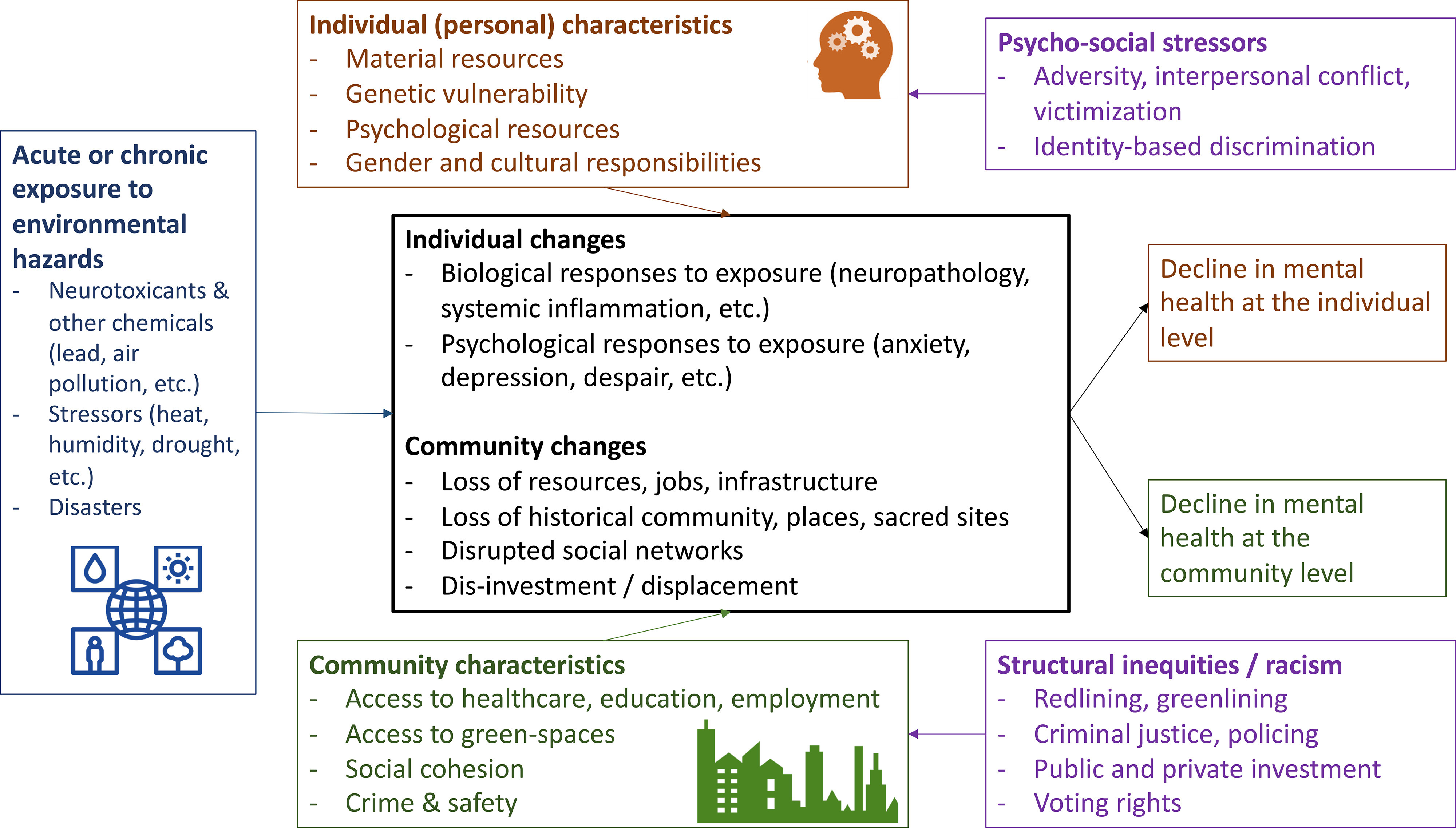
Methods: This commentary provides a nonsystematic, expert-guided conceptual review and interdisciplinary perspective on the convergence of environmental and mental health, drawing from hypotheses, findings, and research gaps presented and discussed at the workshop. Featured is an overview of what is known about the intersection of the environment and mental health, focusing on the effects of neurotoxic pollutants, threats related to climate change, and the importance of health promoting environments, such as urban green spaces.
Discussion: We describe what can be gained by bridging environmental and psychological research disciplines and present a synthesis of what is needed to advance interdisciplinary investigations. We also consider the implications of the current evidence for a) foundational knowledge of the etiology of mental health and illness, b) toxicant policy and regulation, c) definitions of climate adaptation and community resilience, d) interventions targeting marginalized communities, and e) the future of research training and funding. We include a call to action for environmental and mental health researchers, focusing on the environmental contributions to mental health to unlock primary prevention strategies at the population level and open equitable paths for preventing mental disorders and achieving optimal mental health for all. https://doi.org/10.1289/EHP9889.
Figures
References
-
- American Psychiatric Association. 2013. Diagnostic and Statistical Manual of Mental Disorders. 5th ed. Washington, DC: American Psychiatric Publications. 10.1176/appi.books.9780890425596. - DOI
-
- Aschengrau A, Weinberg JM, Janulewicz PA, Romano ME, Gallagher LG, Winter MR, et al. . 2012. Occurrence of mental illness following prenatal and early childhood exposure to tetrachloroethylene (PCE)-contaminated drinking water: a retrospective cohort study. Environ Health Glob Access Sci Source 11:2, PMID: , 10.1186/1476-069X-11-2. - DOI - PMC - PubMed
Publication types
MeSH terms
Grants and funding
LinkOut - more resources
Full Text Sources
Medical
Miscellaneous