


Treatment standards for direct oral anticoagulants in patients with acute ischemic stroke and non-valvular atrial fibrillation: A survey among German stroke units
- PMID: 35176109
- PMCID: PMC8853580
- DOI: 10.1371/journal.pone.0264122
Treatment standards for direct oral anticoagulants in patients with acute ischemic stroke and non-valvular atrial fibrillation: A survey among German stroke units
Abstract
Background: Acute ischemic stroke (AIS) in patients with non-valvular atrial fibrillation (AF) despite oral anticoagulation (OAC) is a complex and insufficiently investigated setting. Potential strategies range from maintaining the current OAC to changing the substance class. We have queried the specific treatment standards on German stroke units (SUs).
Methods: By means of a standardized online questionnaire via SurveyMonkey™ (San Mateo, CA, USA), all clinical heads of German SUs were asked about their treatment standards in the following clinical situations: first AIS of an OAC-naïve AF patient, AF patient with AIS despite administration of a vitamin K antagonist (VKA), AF patient with AIS despite administration of direct OAC (DOAC). In addition, the performance of specific coagulation tests in AF patients with AIS despite OAC was queried.
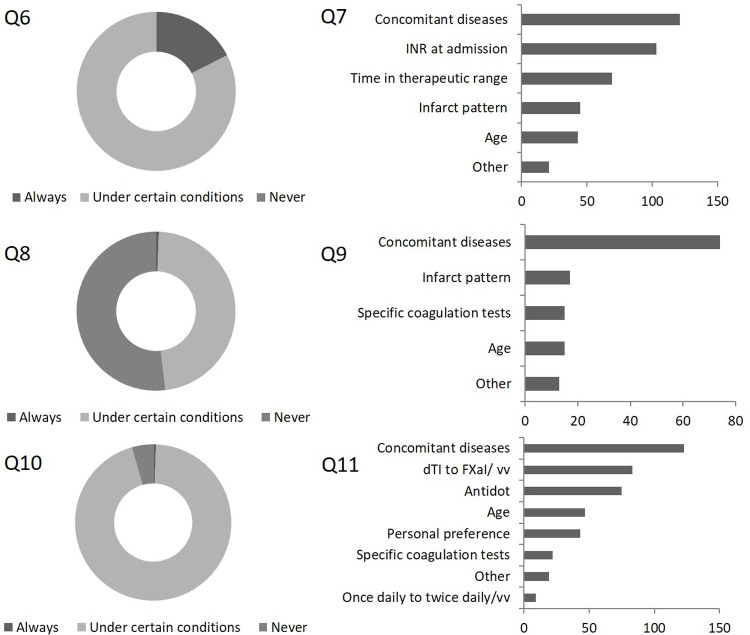
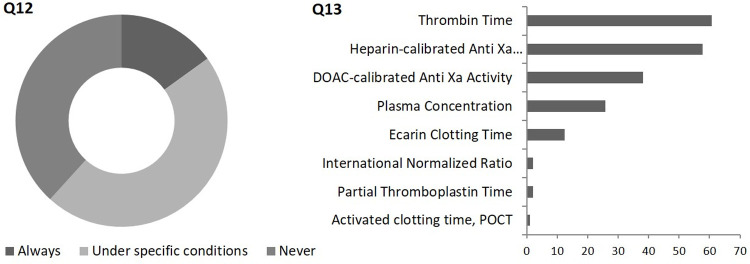
Results: 160 (48%) clinical heads of German SU responded. Data from pivotal trials (84%), own experience with substances (71%), and side-effect profiles (66%) determine the initial DOAC prescription. In case of an AIS despite OAC, 83 and 18% would switch from VKA to DOAC under certain conditions and always, respectively. Half of respondents would switch from DOAC to VKA under certain conditions, while the other half would decline. 96% would switch to an alternative DOAC. The vast majority of those who made preconditions considered concomitant diseases (92, 90, and 81%, respectively). Few would consider infarct pattern (<35%). 61% perform initial coagulation tests (only one-third substance-specific assessments); however, the majority do not use these to make further decisions.
Conclusions: In the setting of an OAC-naïve AF patient with AIS, established pivotal data are most respected. In the unclear setting of an AIS despite OAC, most respondents consider concomitant diseases and give preference to switching to a (different) DOAC.
Conflict of interest statement
NO authors have competing interests.
Figures
References
-
- Klijn CJ, Paciaroni M, Berge E, Korompoki E, Kõrv J, Lal A, et al.. Antithrombotic treatment for secondary prevention of stroke and other thromboembolic events in patients with stroke or transient ischemic attack and non-valvular atrial fibrillation: A European Stroke Organisation guideline. Eur Stroke J. 2019;4(3):198–223. Epub 2020/01/28. doi: 10.1177/2396987319841187 ; PubMed Central PMCID: PMC6960695. - DOI - PMC - PubMed
-
- Hindricks G, Potpara T, Dagres N, Arbelo E, Bax JJ, Blomström-Lundqvist C, et al.. 2020 ESC Guidelines for the diagnosis and management of atrial fibrillation developed in collaboration with the European Association of Cardio-Thoracic Surgery (EACTS). Eur Heart J. 2021;42(5):373–498. doi: 10.1093/eurheartj/ehaa612 . - DOI - PubMed
-
- Ruff CT, Giugliano RP, Braunwald E, Hoffman EB, Deenadayalu N, Ezekowitz MD, et al.. Comparison of the efficacy and safety of new oral anticoagulants with warfarin in patients with atrial fibrillation: a meta-analysis of randomised trials. Lancet. 2014;383(9921):955–62. Epub 2013/12/10. doi: 10.1016/S0140-6736(13)62343-0 . - DOI - PubMed
MeSH terms
Substances
LinkOut - more resources
Full Text Sources
Medical
