


Tuberculosis drug resistance profiling based on machine learning: A literature review
- PMID: 35176257
- PMCID: PMC9387475
- DOI: 10.1016/j.bjid.2022.102332
Tuberculosis drug resistance profiling based on machine learning: A literature review
Abstract
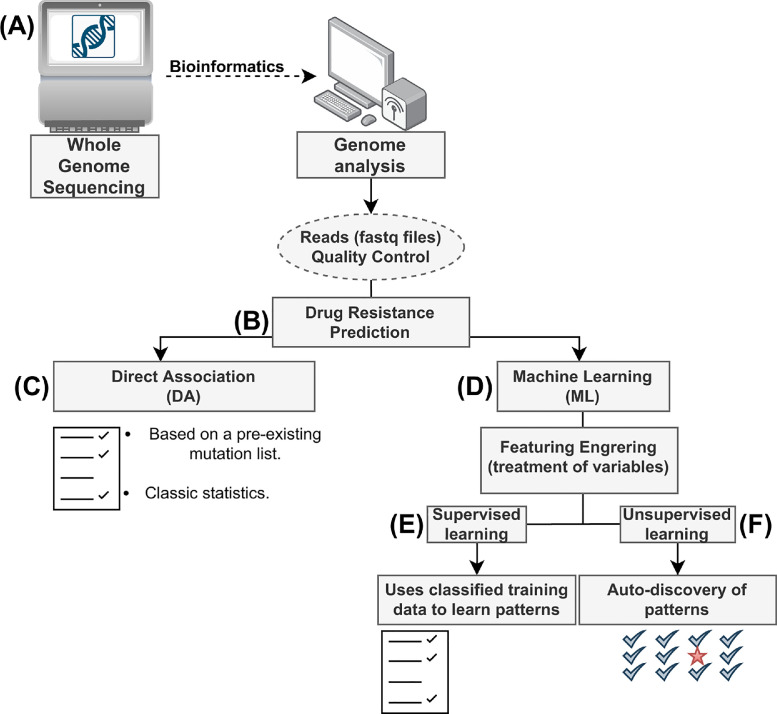
Tuberculosis (TB), caused by Mycobacterium tuberculosis (MTB), is one of the top 10 causes of death worldwide. Drug-resistant tuberculosis (DR-TB) poses a major threat to the World Health Organization's "End TB" strategy which has defined its target as the year 2035. In 2019, there were close to 0.5 million cases of DRTB, of which 78% were resistant to multiple TB drugs. The traditional culture-based drug susceptibility test (DST - the current gold standard) often takes multiple weeks and the necessary laboratory facilities are not readily available in low-income countries. Whole genome sequencing (WGS) technology is rapidly becoming an important tool in clinical and research applications including transmission detection or prediction of DR-TB. For the latter, many tools have recently been developed using curated database(s) of known resistance conferring mutations. However, documenting all the mutations and their effect is a time-taking and a continuous process and therefore Machine Learning (ML) techniques can be useful for predicting the presence of DR-TB based on WGS data. This can pave the way to an earlier detection of drug resistance and consequently more efficient treatment when compared to the traditional DST.
Keywords: Drug resistance prediction; Machine Learning; Mycobacterium tuberculosis; Whole genome sequencing.
Copyright © 2022 Sociedade Brasileira de Infectologia. Published by Elsevier España, S.L.U. All rights reserved.
Conflict of interest statement
Conflicts of interest The authors declare no conflict of interest.
Figures
References
-
- WHO . World Health Organization; 2020. WHO | Global Tuberculosis Report.https://www.who.int/teams/global-tuberculosis-programme/tb-reports/globa... Available at: [accessed June 24, 2021]
Publication types
MeSH terms
Substances
LinkOut - more resources
Full Text Sources
Medical
