Review
. 2022 May 4;30(5):1869-1884.
doi: 10.1016/j.ymthe.2022.02.014. Epub 2022 Feb 14.

The battle between host and SARS-CoV-2: Innate immunity and viral evasion strategies

Affiliations
Review

The battle between host and SARS-CoV-2: Innate immunity and viral evasion strategies

Shilei Zhang et al. Mol Ther. .

Abstract

The SARS-CoV-2 virus, the pathogen causing COVID-19, has caused more than 200 million confirmed cases, resulting in more than 4.5 million deaths worldwide by the end of August, 2021. Upon detection of SARS-CoV-2 infection by pattern recognition receptors (PRRs), multiple signaling cascades are activated, which ultimately leads to innate immune response such as induction of type I and III interferons, as well as other antiviral genes that together restrict viral spread by suppressing different steps of the viral life cycle. Our understanding of the contribution of the innate immune system in recognizing and subsequently initiating a host response to an invasion of SARS-CoV-2 has been rapidly expanding from 2020. Simultaneously, SARS-CoV-2 has evolved multiple immune evasion strategies to escape from host immune surveillance for successful replication. In this review, we will address the current knowledge of innate immunity in the context of SARS-CoV-2 infection and highlight recent advances in the understanding of the mechanisms by which SARS-CoV-2 evades a host's innate defense system.

Keywords: SARS-CoV-2; antiviral targets; inflammation; innate immune response; interferon; signaling transduction.


Conflict of interest statement

Declaration of interests The authors declare no conflict of interest.

Figures
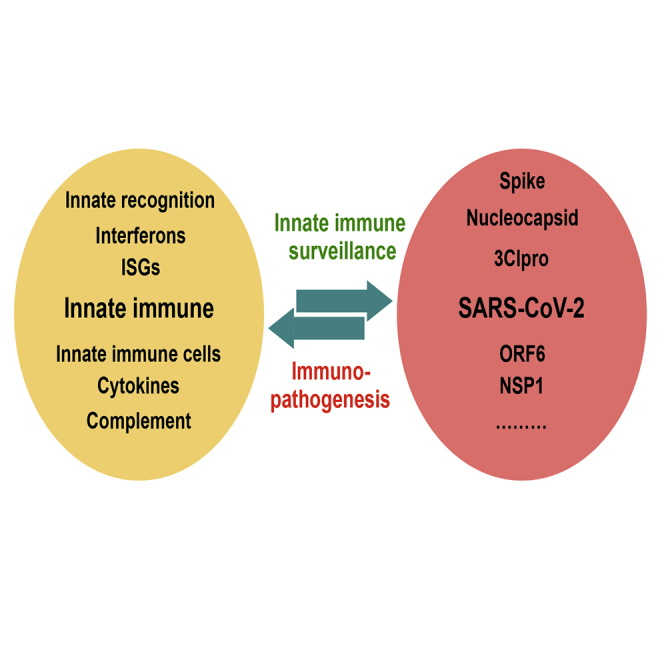
None
Graphical abstract
Figure 1
Figure 1
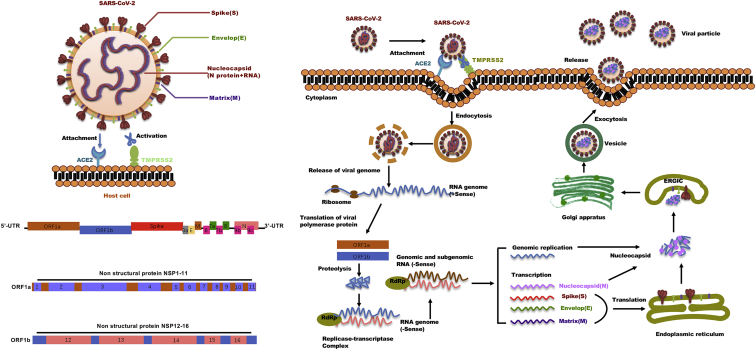
The life cycle of SARS-CoV-2 in host cells SARS-CoV-2 enters into the host cell through the binding of the Spike protein to the receptor ACE2, together with TMPRSS2, followed by multiple steps including release of the viral genome RNA, translation of the viral RNA, proteolytic cleavage of polyproteins (pp1ab and pp1a) by nsp3 (papain-like protease; PLpro) and nsp5 (main protease, Mpro), replication and translation by the RTC, packaging and assembly of new virions, and virion release from the cell through exocytosis. RdRP: RNA-dependent RNA polymerase; RTC: replication and transcription complex; ERGIC: ER-to-Golgi intermediate compartment. ACE2: angiotensin-converting enzyme 2; TMPRSS2: transmembrane serine protease 2. (Right) 5′ UTR: 5′ untranslated region; 3′ UTR: 3′ untranslated region; ORF1a: open reading frame 1a; ORF1b: open reading frame 1b; 3a: ORF3a; E: envelop; M: membrane protein; 6: ORF6; 7a: ORF7a; 7b: ORF7b; 8: ORF8; 9b: ORF9b; 9c: ORF9c; N: nucleocapsid protein.
Figure 2
Figure 2
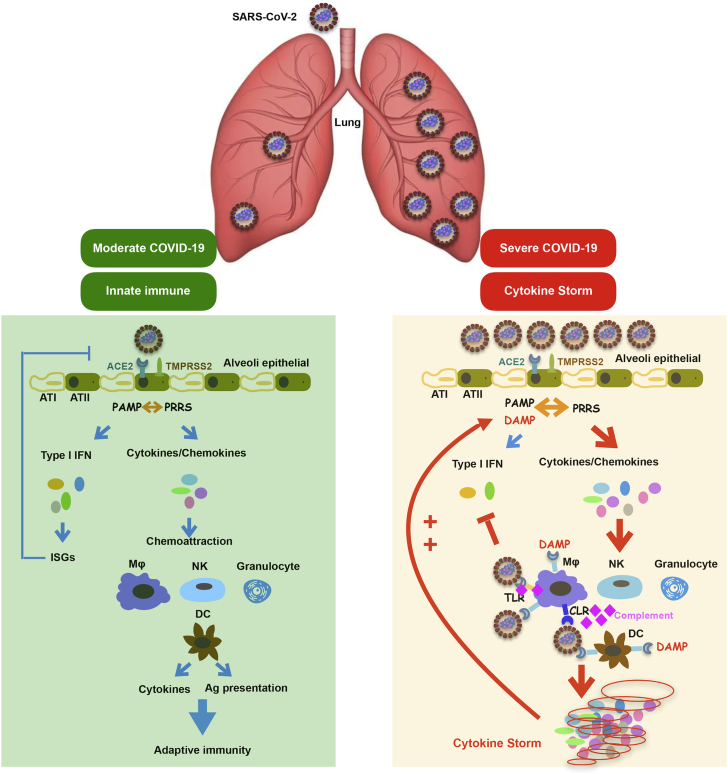
The innate immune responses to SARS-CoV-2 infection Infection with SARS-CoV-2 in airway epithelial cells triggers innate and adaptive immune responses. In severe COVID-19, a high virus load hyperactivates the innate immune system results in the production of high levels of inflammatory cytokines called a “cytokine storm.” AT I, alveolar type I cells; AT II: alveolar type II cells; MΦ, macrophage; DC, dendritic cells; NK, NK cells; Ag presentation, antigen presentation; DAMP, damage-associated molecular pattern; PAMP, pathogen-associated molecular pattern; PRRS, pattern recognition receptors; TLR, Toll-like receptors; CLR, C-type lectin receptors; ISG, interferon-stimulated gene.
Figure 3
Figure 3
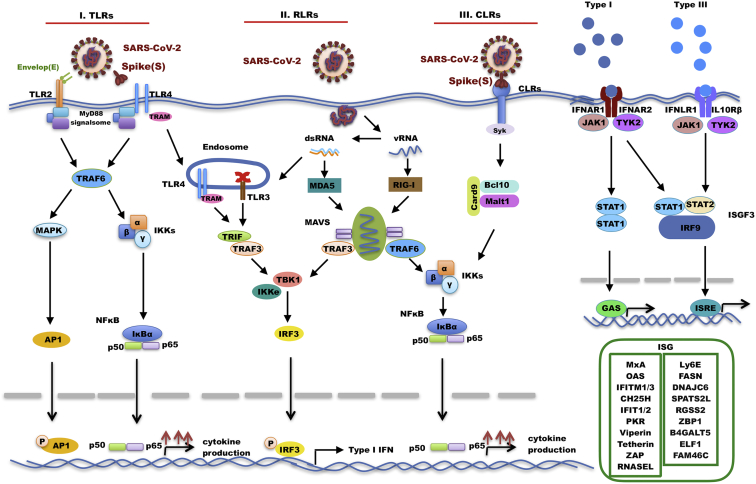
PRRs-mediated recognition of SARS-CoV-2 SARS-CoV-2 is recognized by the innate immune system by members of distinct classes of PRRs (with their respective ligands indicated): Toll-like receptors (TLRs), retinoic acid-inducible gene-I (RIG-I) receptors, and C-type lectin receptors (CLRs). Upon recognition, signal transduction occurs through downstream transcription regulators called interferon regulatory factors (IRFs) to elicit interferons production. The secreted interferons interact with their receptors, which results in activation of JAK-Stat signaling pathway that governs the expression of various IFN-stimulated genes. TRAM, Toll receptor–associated molecule; TRAF6, TNF receptor associated factor 6; MAPK, mitogen-activated protein kinase; AP1, activator protein 1; IKKs, IκB kinase; NF-κB, nuclear factor kappa-light-chain-enhancer of activated B cells; TRIF, TIR domain-containing adaptor-inducing interferon-β; TRAF3, TNF receptor associated factor 3; IKKe, IkappaB kinase-epsilon; TBK1, TANK binding kinase 1; IRF3, interferon regulatory factor 3; Syk, spleen tyrosine kinase; Card9, caspase recruitment domain family member 9; Bcl10, B-cell lymphoma/leukemia 10; Malt1, mucosa-associated lymphoid tissue lymphoma translocation protein 1; IFNAR, interferon alpha/beta receptor; JAK1, tyrosine-protein kinase JAK1; Tyk2, non-receptor tyrosine-protein kinase 2; IFNLR1, interferon lambda receptor 1; IL10Rβ, interleukin 10 receptor subunit beta; Stat1, signal transducer and activator of transcription 1; Stat2, signal transducer and activator of transcription 2, IRF9: interferon regulatory factor 9; ISGF3, interferon-stimulated gene factor 3; GAS, gamma interferon activation site; ISRE, interferon-sensitive response element.
Figure 4
Figure 4
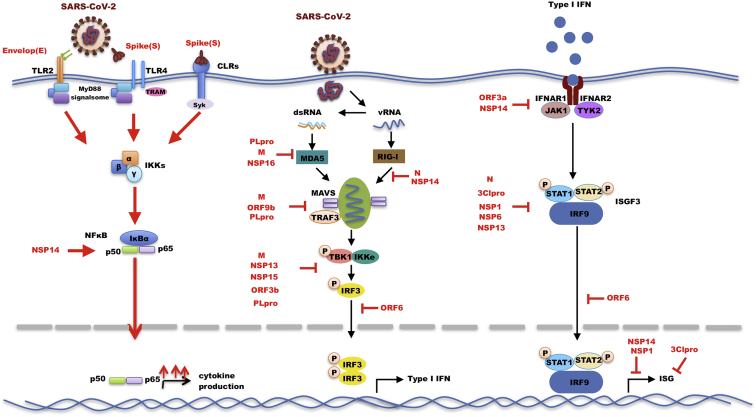
Innate immune evasion by SARS-CoV-2 Recognition by PRRs triggers a signaling cascade that culminates in the transcription and subsequent generation of interferons. SARS-CoV-2 has evolved to antagonize these pathways at virtually all stages, indicated by red blunt end arrows. Red solid arrows indicate hyperactivated signal cascade by SARS-CoV-2. Black solid arrows indicated pathway connection.

References

    1. Totura A.L., Bavari S. Broad-spectrum coronavirus antiviral drug discovery. Expert Opin. Drug Discov. 2019;14:397–412. - PMC - PubMed
    1. Cui J., Li F., Shi Z.L. Origin and evolution of pathogenic coronaviruses. Nat. Rev. Microbiol. 2019;17:181–192. - PMC - PubMed
    1. Woo P.C., Lau S.K., Lam C.S., Lau C.C., Tsang A.K., Lau J.H., Bai R., Teng J.L., Tsang C.C., Wang M., et al. Discovery of seven novel Mammalian and avian coronaviruses in the genus deltacoronavirus supports bat coronaviruses as the gene source of alphacoronavirus and betacoronavirus and avian coronaviruses as the gene source of gammacoronavirus and deltacoronavirus. J. Virol. 2012;86:3995–4008. - PMC - PubMed
    1. Su S., Wong G., Shi W., Liu J., Lai A.C.K., Zhou J., Liu W., Bi Y., Gao G.F. Epidemiology, genetic recombination, and pathogenesis of coronaviruses. Trends Microbiol. 2016;24:490–502. - PMC - PubMed
    1. Drosten C., Günther S., Preiser W., van der Werf S., Brodt H.R., Becker S., Rabenau H., Panning M., Kolesnikova L., Fouchier R.A., et al. Identification of a novel coronavirus in patients with severe acute respiratory syndrome. N. Engl. J. Med. 2003;348:1967–1976. - PubMed

Publication types