


Settling moths are the vital component of pollination in Himalayan ecosystem of North-East India, pollen transfer network approach revealed
- PMID: 35177694
- PMCID: PMC8854426
- DOI: 10.1038/s41598-022-06635-4
Settling moths are the vital component of pollination in Himalayan ecosystem of North-East India, pollen transfer network approach revealed
Abstract
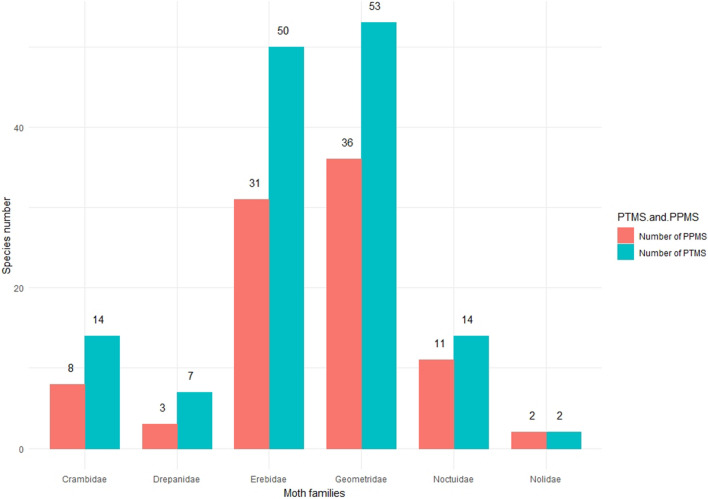
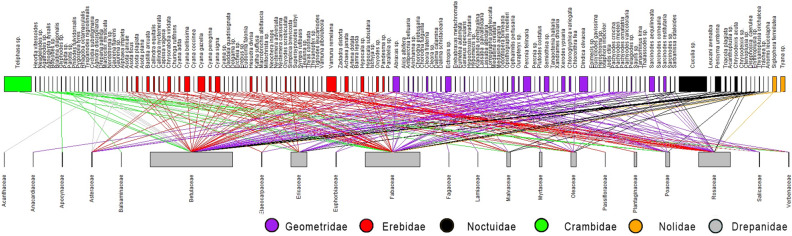
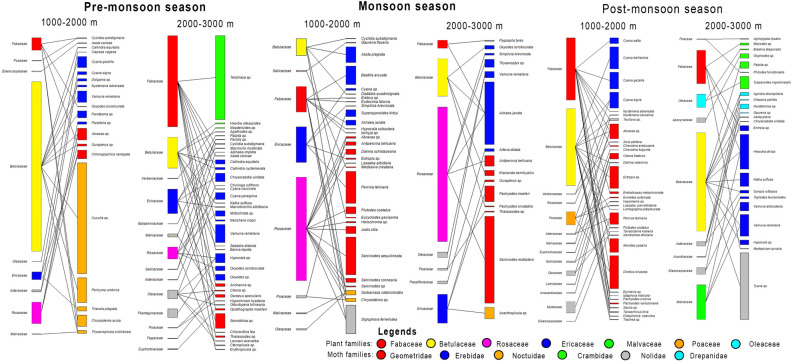
Majority of the pollination related studies are based on the diurnal pollinators, and the nocturnal pollinators received less scientific attention. We reveal the significance of settling moths in pollination of angiosperm families in Himalayan ecosystem of North-East India. The refined and novel method of pollen extraction from the proboscides provides a more robust assessment of the pollen carrying capacity. The study is based on one of the largest data sets (140 pollen transporter moth species (PTMS)), with interpretation based on seasonal as well as altitudinal data. In the present study about 65% moths (91 species) carried sufficient quantities of pollen grains to be considered as potential pollinators (PPMS). Teliphasa sp. (Crambidae) and Cuculia sp. (Noctuidae) are found to carry the highest quantity of pollen. We found pollen grains of 21 plant families and the abundant pollen are from Betulaceae, Fabaceae, Rosaceae and Ericaceae. Species composition of PTMS and PPMS in pre-monsoon, monsoon, and post-monsoon revealed the dominance of Geometridae. Maximum diversity of PTMS and PPMS is found from 2000 to 2500 m altitude. The nocturnal pollen transfer network matrices exhibited high degree of selectivity (H2' = 0.86).
© 2022. The Author(s).
Conflict of interest statement
The authors declare no competing interests.
Figures



References
-
- Potts SG, et al. Global pollinator declines: Trends, impacts and drivers. Trends Ecol. Evol. 2010;25:345–353. - PubMed
-
- Kearns CA, Inouye DW, Waser NM. ENDANGERED MUTUALISMS: The conservation of plant-pollinator interactions. Annu. Rev. Ecol. Syst. 1998;29:83–112.
-
- Ollerton J, Winfree R, Tarrant S. How many flowering plants are pollinated by animals? Oikos. 2011;120:321–326.
-
- Labandeira CC. A paleobiologic perspective on plant–insect interactions. Curr. Opin. Plant Biol. 2013;16:414–421. - PubMed
-
- Faegri, K. & Van Der Pijl, L. Principles of Pollination Ecology. (Elsevier Science, 2014).
Publication types
MeSH terms
LinkOut - more resources
Full Text Sources
Miscellaneous
