


Comparison of Hematopoietic Stem Cell Transplantation Outcomes Using Matched Sibling Donors, Haploidentical Donors, and Immunosuppressive Therapy for Patients With Acquired Aplastic Anemia
- PMID: 35178053
- PMCID: PMC8843935
- DOI: 10.3389/fimmu.2022.837335
Comparison of Hematopoietic Stem Cell Transplantation Outcomes Using Matched Sibling Donors, Haploidentical Donors, and Immunosuppressive Therapy for Patients With Acquired Aplastic Anemia
Abstract
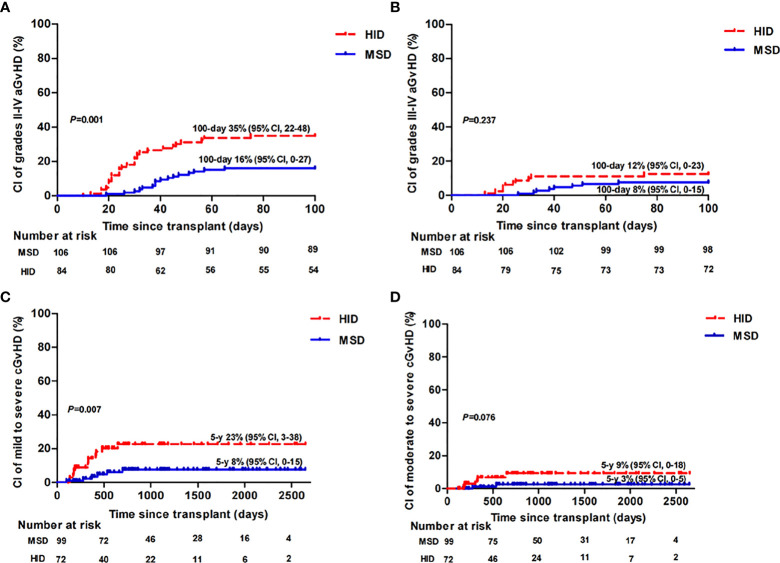
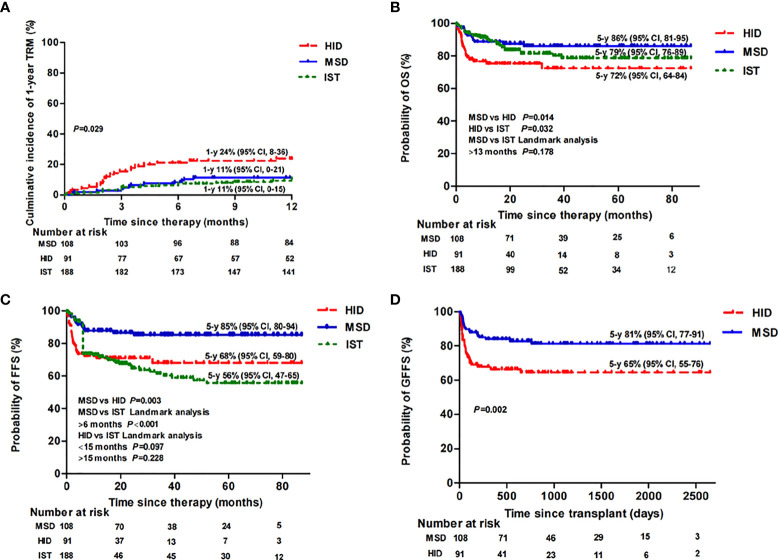
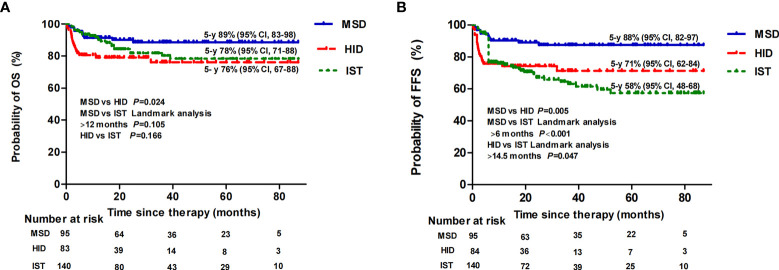
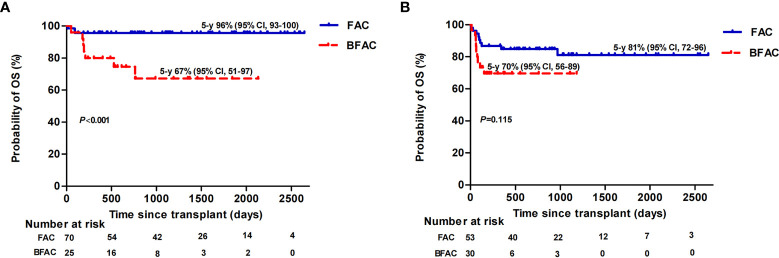
We retrospectively compared the outcomes of 387 consecutive patients with acquired aplastic anemia (AA) who underwent hematopoietic stem cell transplantation (HSCT) with a fludarabine-based conditioning regimen from matched sibling donors (MSD) (n = 108) or haploidentical donors (HID) (n = 91) and immunosuppressive therapy (IST) (n = 188) from 2014 to 2020 at our hospital. Compared with HID-HSCT, MSD-HSCT had a lower incidence of graft failure (1% vs. 7%, p = 0.062), grade II-IV acute graft versus host disease (aGvHD) (16% vs. 35%, p = 0.001), and mild to severe chronic GvHD (cGvHD) (8% vs. 23%, p = 0.007), but an equivalent incidence of grade III-IV aGvHD (8% vs. 12%, p = 0.237) and moderate to severe cGvHD (3% vs. 9%, p = 0.076). HSCT had superior blood count recovery at 3, 6, and 12 months compared with IST (p < 0.001). The estimated 5-year overall survival (OS) of the MSD, HID, and IST groups were 86%, 72%, and 79% (p = 0.02), respectively; accordingly, the failure-free survival (FFS) rates were 85%, 68%, and 56%, respectively (p < 0.001). For patients aged ≤40 years, the OS rate was still significantly superior for MSD-HSCT receipients compared to HID-HSCT receipients (89% vs. 76%, p = 0.024) while the HID-HSCT recipients showed similar OS (76% vs. 78%, p = 0.166) but superior FFS (p = 0.047) when follow-up was longer than 14.5 months in contrast to IST. In a multivariate analysis, HID-HSCT and a conditioning regimen that included busulfan were adversely related to OS among patients who received allografts. In conclusion, MSD-HSCT was the frontline choice for patients with severe AA aged ≤40 years, while HID-HSCT was as effective as IST for patients without an MSD.
Keywords: aplastic anemia; haploidentical donor; immunosuppressive therapy; matched sibling donor; transplantation.
Copyright © 2022 Zhang, Huo, Liu, Shen, Chen, Zhang, Chen, Pang, Yang, Zhang, Ma, Zhai, He, Wei, Jiang, Han, Zheng and Feng.
Conflict of interest statement
The authors declare that the research was conducted in the absence of any commercial or financial relationships that could be construed as a potential conflict of interest.
Figures
References
-
- Liu L, Zhang Y, Jiao W, Zhou H, Wang Q, Jin S, et al. Comparison of Efficacy and Health-Related Quality of Life of First-Line Haploidentical Hematopoietic Stem Cell Transplantation With Unrelated Cord Blood Infusion and First-Line Immunosuppressive Therapy for Acquired Severe Aplastic Anemia. Leukemia (2020) 34(12):3359–69. doi: 10.1038/s41375-020-0933-7 - DOI - PubMed
Publication types
MeSH terms
LinkOut - more resources
Full Text Sources
Medical
