


Lifetime risk of autosomal recessive neurodegeneration with brain iron accumulation (NBIA) disorders calculated from genetic databases
- PMID: 35180557
- PMCID: PMC8856992
- DOI: 10.1016/j.ebiom.2022.103869
Lifetime risk of autosomal recessive neurodegeneration with brain iron accumulation (NBIA) disorders calculated from genetic databases
Abstract
Background: Neurodegeneration with brain iron accumulation (NBIA) are a group of clinically and genetically heterogeneous diseases characterized by iron overload in basal ganglia and progressive neurodegeneration. Little is known about the epidemiology of NBIA disorders. In the absence of large-scale population-based studies, obtaining reliable epidemiological data requires innovative approaches.
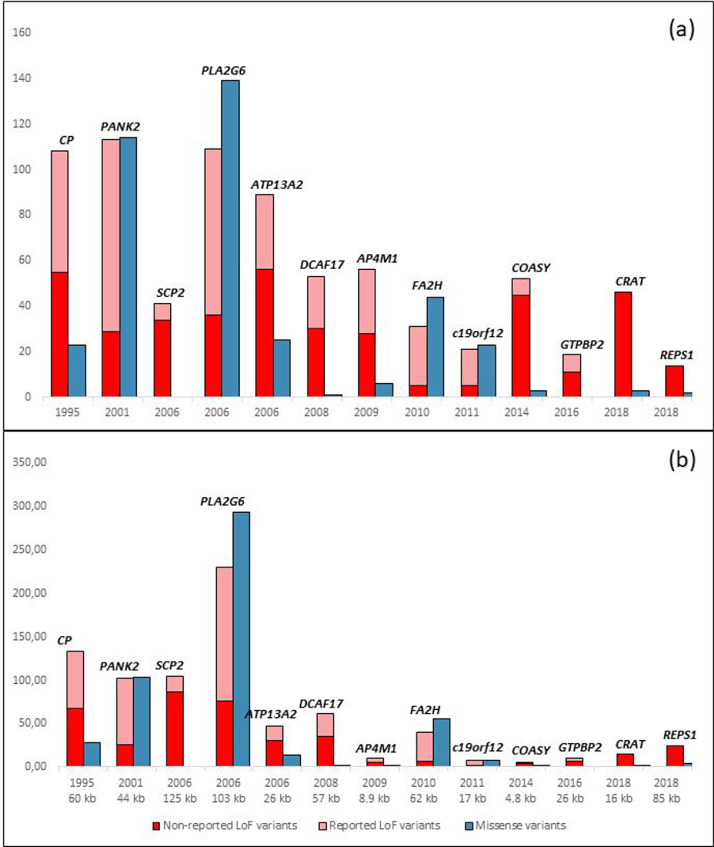
Methods: All pathogenic variants were collected from the 13 genes associated with autosomal recessive NBIA (PLA2G6, PANK2, COASY, ATP13A2, CP, AP4M1, FA2H, CRAT, SCP2, C19orf12, DCAF17, GTPBP2, REPS1). The allele frequencies of these disease-causing variants were assessed in exome/genome collections: the Genome Aggregation Database (gnomAD) and our in-house database. Lifetime risks were calculated from the sum of allele frequencies in the respective genes under assumption of Hardy-Weinberg equilibrium.
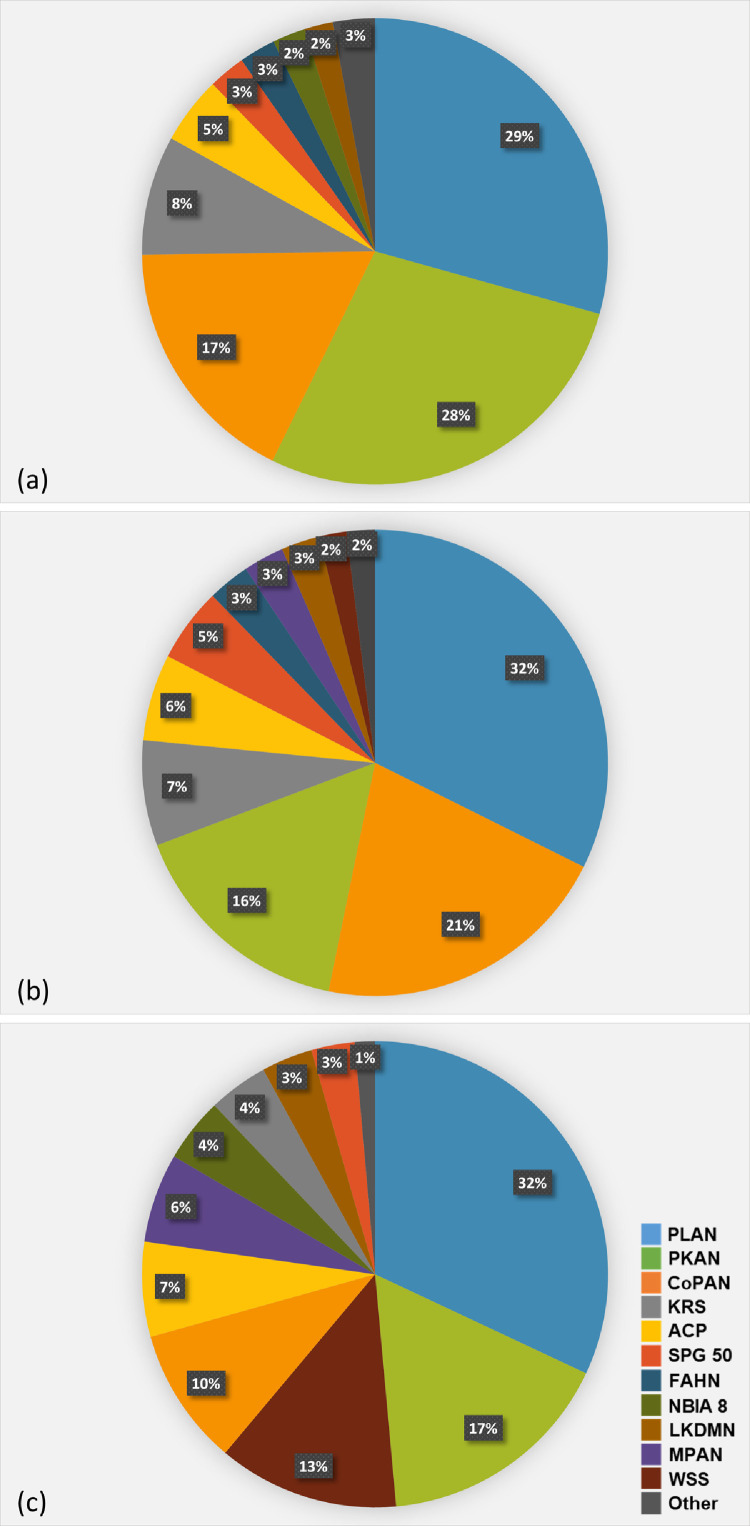
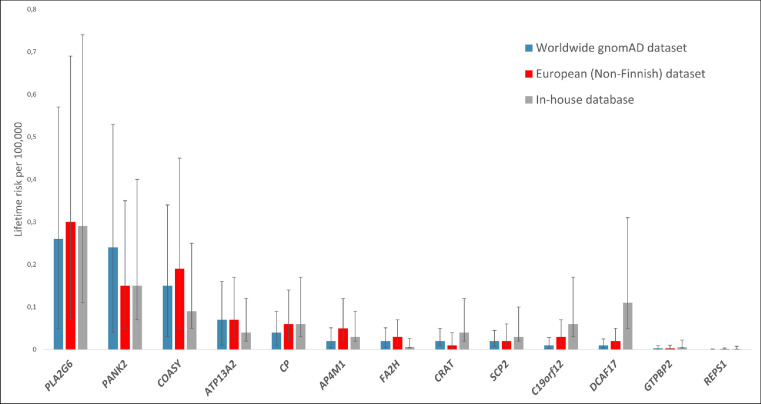
Findings: The combined estimated lifetime risk of all 13 investigated NBIA disorders is 0.88 (95% confidence interval 0.70-1.10) per 100,000 based on the global gnomAD dataset (n = 282,912 alleles), 0.92 (0.65-1.29) per 100,000 in the European gnomAD dataset (n = 129,206), and 0.90 (0.48-1.62) per 100,000 in our in-house database (n = 44,324). Individually, the highest lifetime risks (>0.15 per 100,000) are found for disorders caused by variants in PLA2G6, PANK2 and COASY.
Interpretation: This population-genetic estimation on lifetime risks of recessive NBIA disorders reveals frequencies far exceeding previous population-based numbers. Importantly, our approach represents lifetime risks from conception, thus including prenatal deaths. Understanding the true lifetime risk of NBIA disorders is important in estimating disease burden, allocating resources and targeting specific interventions.
Funding: This work was carried out in the framework of TIRCON ("Treat Iron-Related Childhood-Onset Neurodegeneration").
Keywords: Autosomal recessive NBIA disorders; CoPAN; Lifetime risk; Neurodegeneration; PKAN; PLAN.
Copyright © 2022 The Authors. Published by Elsevier B.V. All rights reserved.
Conflict of interest statement
Declaration of interests HK received a research scholarship from Alzheimer Foundation Czech Republic. TK served as coordinating investigator of the FORT trial and received research funding from Retrophin, Inc.; served as coordinating investigator of the deferiprone in PKAN randomized and extension trial and received research funding from ApoPharma Inc.; received support from the European Commission 7th Framework Programme (FP7/2007-2013, HEALTHF2-2011; Grant Agreement No. 277984, TIRCON) and from the European Reference Network for Rare Neurological Diseases (ERN-RND), co-funded by the European Commission (ERN-RND: 3HP 767231); provided consulting services to CoA Therapeutics, Comet Therapeutics, and Retrophin, Inc.; received travel support from ApoPharma Inc. All other authors do not report any conflicts of interest.
Figures
References
-
- Di Meo I., Tiranti V. Classification and molecular pathogenesis of NBIA syndromes. Eur J Paediatr Neurol. 2018;22(2):272–284. EJPN: official journal of the European Paediatric Neurology Society. - PubMed
-
- Hayflick S.J., Westaway S.K., Levinson B., et al. Genetic, clinical, and radiographic delineation of Hallervorden-Spatz syndrome. N Engl J Med. 2003;348(1):33–40. - PubMed
MeSH terms
Substances
Supplementary concepts
LinkOut - more resources
Full Text Sources
Medical
Miscellaneous
