. 2022 May 3;10(5):597-611.
doi: 10.1158/2326-6066.CIR-21-0129.

BHLHE40 Regulates the T-Cell Effector Function Required for Tumor Microenvironment Remodeling and Immune Checkpoint Therapy Efficacy

Affiliations

BHLHE40 Regulates the T-Cell Effector Function Required for Tumor Microenvironment Remodeling and Immune Checkpoint Therapy Efficacy

Avery J Salmon et al. Cancer Immunol Res. .

Abstract

Immune checkpoint therapy (ICT) using antibody blockade of programmed cell death protein 1 (PD-1) or cytotoxic T-lymphocyte-associated protein 4 (CTLA-4) can provoke T cell-dependent antitumor activity that generates durable clinical responses in some patients. The epigenetic and transcriptional features that T cells require for efficacious ICT remain to be fully elucidated. Herein, we report that anti-PD-1 and anti-CTLA-4 ICT induce upregulation of the transcription factor BHLHE40 in tumor antigen-specific CD8+ and CD4+ T cells and that T cells require BHLHE40 for effective ICT in mice bearing immune-edited tumors. Single-cell RNA sequencing of intratumoral immune cells in BHLHE40-deficient mice revealed differential ICT-induced immune cell remodeling. The BHLHE40-dependent gene expression changes indicated dysregulated metabolism, NF-κB signaling, and IFNγ response within certain subpopulations of CD4+ and CD8+ T cells. Intratumoral CD4+ and CD8+ T cells from BHLHE40-deficient mice exhibited higher expression of the inhibitory receptor gene Tigit and displayed alterations in expression of genes encoding chemokines/chemokine receptors and granzyme family members. Mice lacking BHLHE40 had reduced ICT-driven IFNγ production by CD4+ and CD8+ T cells and defects in ICT-induced remodeling of macrophages from a CX3CR1+CD206+ subpopulation to an iNOS+ subpopulation that is typically observed during effective ICT. Although both anti-PD-1 and anti-CTLA-4 ICT in BHLHE40-deficient mice led to the same outcome-tumor outgrowth-several BHLHE40-dependent alterations were specific to the ICT that was used. Our results reveal a crucial role for BHLHE40 in effective ICT and suggest that BHLHE40 may be a predictive or prognostic biomarker for ICT efficacy and a potential therapeutic target.


Figures

Figure 1. Subsets of intratumoral myeloid and lymphoid cells express Bhlhe40. A, Bhlhe40 mRNA expression in intratumoral mLama4-specific CD8+ T cells sorted from T3 sarcoma–bearing WT mice treated with anti–CTLA-4, anti–PD-1, or both anti–CTLA-4 and anti–PD-1. B, tSNE plot from merged treatment data of exclusively intratumoral lymphocytes showing Bhlhe40 expression within indicated lymphoid subpopulations identified by scRNAseq in the T3 MCA sarcoma. C, Violin plots showing Bhlhe40 expression in T3 intratumoral lymphoid cells by cluster and treatment. D, Heatmap displaying normalized expression of select genes in T3 intratumoral lymphoid cells by cluster and treatment. E, Tumor growth in Bhlhe40–/– or Bhlhe40+/+ mice transplanted with 1956 sarcoma cells and subsequently treated with control, anti–CTLA-4, anti–PD-1, or both anti–CTLA-4 and anti–PD-1 on days 3, 6, and 9 post-transplant. F, Cumulative Kaplan–Meier survival curves for the 1956 tumor–bearing Bhlhe40–/– or Bhlhe40+/+ mice treated as in E. For A, each dot represents 5 pooled mice harvested on day 11 posttransplant and assessed independently (N = 3; *, P < 0.05, unpaired t test). B–D, scRNAseq data generated in Gubin et al (39) were reanalyzed for Bhlhe40 expression. Data in E are presented as average tumor diameter ± SEM of 5 mice per group and are representative of at least four independent experiments. Data in (F) are cumulative survival curves from 4 independent experiments of 3–5 mice per group [***, P < 0.001 (log-rank (Mantel–Cox) test)].
Figure 1.
Subsets of intratumoral myeloid and lymphoid cells express Bhlhe40. A,Bhlhe40 mRNA expression in intratumoral mLama4-specific CD8+ T cells sorted from T3 sarcoma–bearing WT mice treated with anti–CTLA-4, anti–PD-1, or both anti–CTLA-4 and anti–PD-1. B, tSNE plot from merged treatment data of exclusively intratumoral lymphocytes showing Bhlhe40 expression within indicated lymphoid subpopulations identified by scRNAseq in the T3 MCA sarcoma. C, Violin plots showing Bhlhe40 expression in T3 intratumoral lymphoid cells by cluster and treatment. D, Heatmap displaying normalized expression of select genes in T3 intratumoral lymphoid cells by cluster and treatment. E, Tumor growth in Bhlhe40–/– or Bhlhe40+/+ mice transplanted with 1956 sarcoma cells and subsequently treated with control, anti–CTLA-4, anti–PD-1, or both anti–CTLA-4 and anti–PD-1. F, Cumulative Kaplan–Meier survival curves for the 1956 tumor–bearing Bhlhe40–/– or Bhlhe40+/+ mice treated as in E. For A, each dot represents 5 pooled mice harvested on day 11 posttransplant and assessed independently (N = 3; *, P < 0.05, unpaired t test). BD, scRNAseq data generated in Gubin et al (39) were reanalyzed for Bhlhe40 expression. Data in E are presented as average tumor diameter ± SEM of 5 mice per group and are representative of at least four independent experiments. Data in (F) are cumulative survival curves from 4 independent experiments of 3–5 mice per group [***, P < 0.001 (log-rank (Mantel–Cox) test)].
Figure 2. Bhlhe40 is selectively required in T cells for anti–PD-1 or anti–CTLA-4 ICT-mediated tumor rejection. A, Tumor growth in Bhlhe40ΔT or Bhlhe40f/f mice transplanted with 1956 sarcoma cells and subsequently treated with control mAb, anti–CTLA-4, or anti–PD-1 on days 3, 6, and 9 posttransplant. B, Cumulative Kaplan–Meier survival curves of 1956 tumor–bearing Bhlhe40ΔT or Bhlhe40f/f mice treated as in A. Bhlhe40 mRNA expression in intratumoral PD-1+LAG-3+CD8+ T cells (C) and PD-1+LAG-3+CD4+ T cells (D) sorted on day 11 posttransplant from 1956 sarcoma–bearing WT mice treated with control mAb, anti–CTLA-4, or anti–PD-1. Bhlhe40 mRNA expression in CD8+ OT-I T cells (E) stimulated with 1 μmol/L OVA-I peptide and CD4+ OT-II T cells (F) stimulated with 1 μmol/L OVA-II peptide for the indicated time. Data in A are presented as average tumor diameter ± SEM of 5–6 mice per group and are representative of 3 independent experiments. Data in B are cumulative survival curves from 3 independent experiments of 4–6 mice per group [***, P < 0.001; NS, not significant, (log-rank (Mantel–Cox) test)]. For C and D, each dot represents mice harvested and assessed independently (N = 5; *, P < 0.05; **, P < 0.01, unpaired t test). Data in E, and F are presented as mean mRNA fold change. Bar indicates mean ± SEM (*, P < 0.05; **, P < 0.01, unpaired t test) and are representative of 3 independent experiments.
Figure 2.
Bhlhe40 is selectively required in T cells for anti–PD-1 or anti–CTLA-4 ICT-mediated tumor rejection. A, Tumor growth in Bhlhe40ΔT or Bhlhe40f/f mice transplanted with 1956 sarcoma cells and subsequently treated with control mAb, anti–CTLA-4, or anti–PD-1. B, Cumulative Kaplan–Meier survival curves of 1956 tumor–bearing Bhlhe40ΔT or Bhlhe40f/f mice treated as in A. Bhlhe40 mRNA expression in intratumoral PD-1+LAG-3+CD8+ T cells (C) and PD-1+LAG-3+CD4+ T cells (D) sorted on day 11 posttransplant from 1956 sarcoma–bearing WT mice treated with control mAb, anti–CTLA-4, or anti–PD-1. Bhlhe40 mRNA expression in CD8+ OT-I T cells (E) stimulated with 1 μmol/L OVA-I peptide and CD4+ OT-II T cells (F) stimulated with 1 μmol/L OVA-II peptide for the indicated time. Data in A are presented as average tumor diameter ± SEM of 5–6 mice per group and are representative of 3 independent experiments. Data in B are cumulative survival curves from 3 independent experiments of 5–6 mice per group [***, P < 0.001; NS, not significant, (log-rank (Mantel–Cox) test)]. For C and D, each dot represents mice harvested and assessed independently (N = 5; *, P < 0.05; **, P < 0.01, unpaired t test). Data in E, and F are presented as mean mRNA fold change. Bar indicates mean ± SEM (*, P < 0.05; **, P < 0.01, unpaired t test) and are representative of 3 independent experiments.
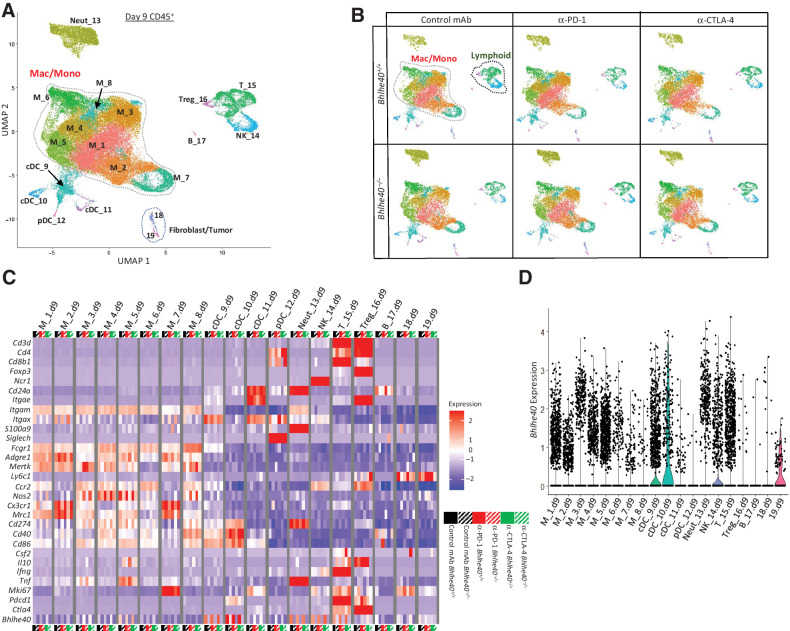
Figure 3. Bhlhe40 is required for ICT-induced remodeling of the intratumoral immune cells. A, UMAP plot from scRNAseq of intratumoral CD45+ cells harvested on day 9 posttumor transplant from 1956 tumor–bearing Bhlhe40+/+ or Bhlhe40–/– mice treated with control mAb, anti–CTLA-4, or anti–PD-1. Cluster cell types identified via known cellular subset marker expression and comparison with Immgen database. B, UMAP plots from scRNAseq of CD45+ intratumoral cells. C, Heatmap displaying normalized expression of select genes in each cell cluster by group. D, Violin plot showing Bhlhe40 expression by cluster.
Figure 3.
Bhlhe40 is required for ICT-induced remodeling of intratumoral immune cells. A, UMAP plot from scRNAseq of intratumoral CD45+ cells harvested on day 9 posttumor transplant from 1956 tumor–bearing Bhlhe40+/+ or Bhlhe40–/– mice treated with control mAb, anti–CTLA-4, or anti–PD-1. Cluster cell types identified via known cellular subset marker expression and comparison with Immgen database. B, UMAP plots from scRNAseq of CD45+ intratumoral cells. C, Heatmap displaying normalized expression of select genes in each cell cluster by group. D, Violin plot showing Bhlhe40 expression by cluster.
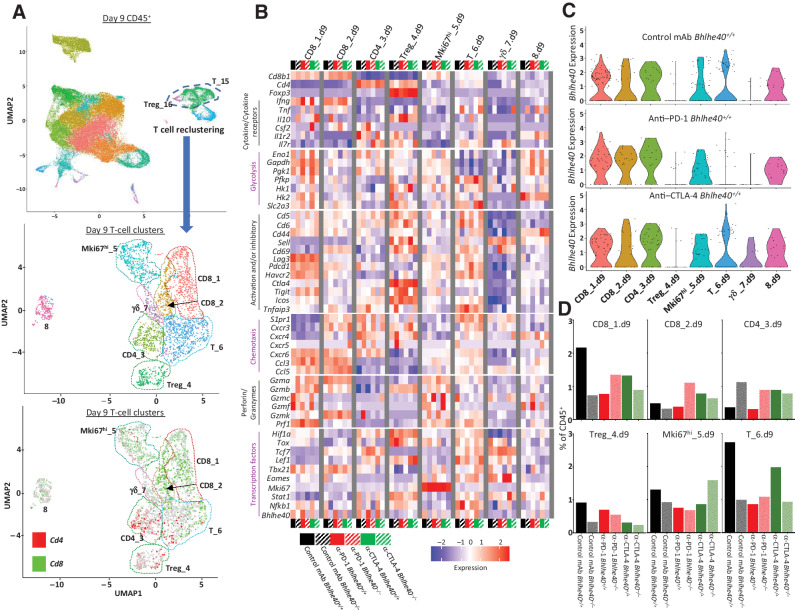
Figure 4. Bhlhe40 regulates CD4+ and CD8+ T-cell function. Intratumoral CD45+ cells were harvested on day 9 posttumor transplant from 1956 tumor–bearing Bhlhe40+/+ or Bhlhe40–/– mice treated with control mAb, anti–CTLA-4, or anti–PD-1, and analyzed by scRNAseq. A, UMAP displaying reclustering of T cell–containing clusters (middle plot) and Cd4 and Cd8 expression (bottom plot) of all experimental conditions computationally combined. B, Heatmap displaying normalized expression of select genes in each T-cell cluster. C, Violin plot showing Bhlhe40 expression in Bhlhe40+/+ mice by cluster and treatment. D, Percentage of cells in individual T-cell clusters by condition and treatment represented as percent of CD45+ cells.
Figure 4.
Bhlhe40 regulates CD4+ and CD8+ T-cell function. Intratumoral CD45+ cells were harvested on day 9 posttumor transplant from 1956 tumor–bearing Bhlhe40+/+ or Bhlhe40–/– mice treated with control mAb, anti–CTLA-4, or anti–PD-1, and analyzed by scRNAseq. A, UMAP displaying reclustering of T cell–containing clusters (middle plot) and Cd4 and Cd8 expression (bottom plot) of all experimental conditions computationally combined. B, Heatmap displaying normalized expression of select genes in each T-cell cluster. C, Violin plot showing Bhlhe40 expression in Bhlhe40+/+ mice by cluster and treatment. D, Percentage of cells in individual T-cell clusters by condition and treatment represented as percent of CD45+ cells.
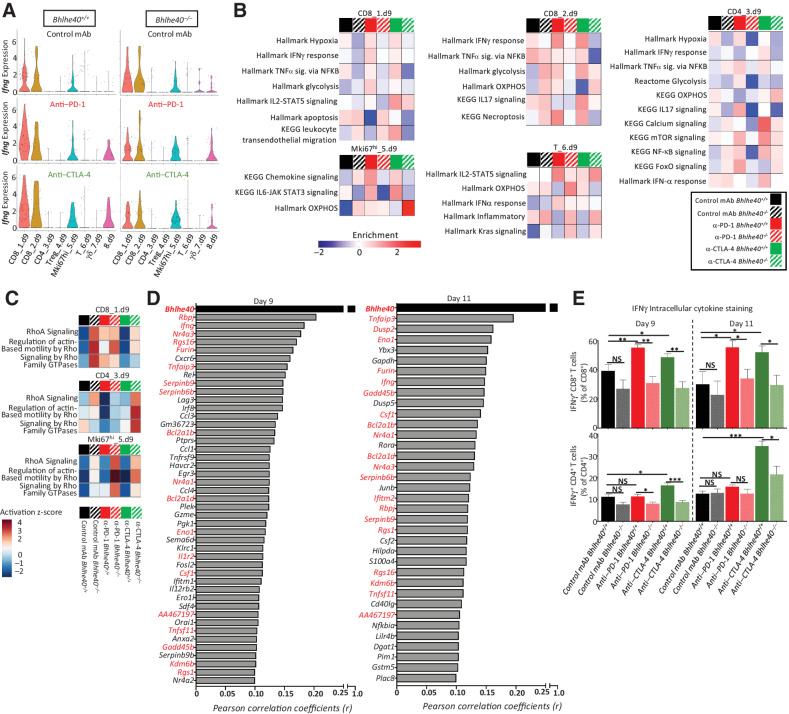
Figure 5. Bhlhe40 deficiency alters effector phenotype of intratumoral T cells during ICT. A, Violin plot showing Ifng expression by T-cell cluster and treatment determined using scRNAseq data from intratumoral CD45+ cells harvested on day 9 posttumor transplant from 1956 tumor–bearing Bhlhe40+/+ (left) or Bhlhe40–/- (right) mice treated with control mAb, anti–CTLA-4, or anti–PD-1. B, Heatmap of select enriched gene sets by T-cell cluster and condition as determined by GSEA enrichment. C, Heatmap of select IPA pathways by T-cell cluster and condition. D, Correlation between gene expression and Bhlhe40 expression. Genes displayed are those with a Pearson correlation coefficient (r) greater than or equal to 0.1 from day 9 (left) or day 11 (right). Genes in red indicate overlap between day 9 and day 11 scRNAseq (P ≤ 1.5e-7 for all genes listed). E, Percent of intratumoral IFNγ+CD8+ cells and IFNγ+CD4+ cells as assessed by intracellular cytokine staining. Data in E are representative of 5 individual mice per condition and represent 3 independent experiments. Bar indicates mean percent ± SEM as assessed by flow cytometry (*, P < 0.05; **, P < 0.01; ***, P < 0.005; NS, not significant, unpaired t test).
Figure 5.
Bhlhe40 deficiency alters effector phenotype of intratumoral T cells during ICT. A, Violin plot showing Ifng expression by T-cell cluster and treatment determined using scRNAseq data from intratumoral CD45+ cells harvested on day 9 posttumor transplant from 1956 tumor–bearing Bhlhe40+/+ (left) or Bhlhe40−/− (right) mice treated with control mAb, anti–CTLA-4, or anti–PD-1. B, Heatmap of select enriched gene sets by T-cell cluster and condition as determined by GSEA. C, Heatmap of select IPA pathways by T-cell cluster and condition. D, Correlation between gene expression and Bhlhe40 expression. Genes displayed are those with a Pearson correlation coefficient (r) greater than or equal to 0.1 from day 9 (left) or day 11 (right). Genes in red indicate overlap between day 9 and day 11 scRNAseq (P ≤ 1.5e-7 for all genes listed). E, Percent of intratumoral IFNγ+CD8+ cells and IFNγ+CD4+ cells as assessed by intracellular cytokine staining. Data in E are representative of 5 individual mice per condition and represent 3 independent experiments. Bar indicates mean percent ± SEM as assessed by flow cytometry (*, P < 0.05; **, P < 0.01; ***, P < 0.005; NS, not significant, unpaired t test).
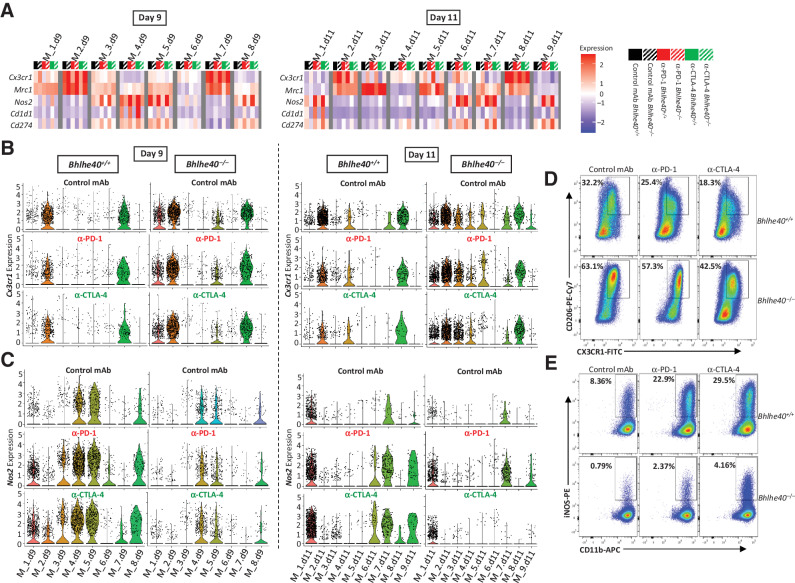
Figure 6. ICT-induced remodeling of intratumoral monocyte/macrophages requires Bhlhe40. A, Heatmap displaying normalized expression of select genes in each monocyte/macrophage cluster by group determined using scRNAseq data from 1956 intratumoral CD45+ cells harvested on day 9 (left) or day 11 (right) posttumor transplant from 1956 tumor–bearing Bhlhe40+/+ or Bhlhe40–/– mice treated with control mAb, anti–CTLA-4, or anti–PD-1. B, Violin plots showing Cx3cr1 expression in intratumoral monocytes/macrophages on day 9 (left) and day 11 (right) by cluster and treatment. C, Violin plots showing Nos2 expression in intratumoral monocytes/macrophages on day 9 (left) and day 11 (right) by cluster and treatment. Flow cytometry plots of 1956 intratumoral macrophages from day 11 posttransplant showing percent of CX3CR1+CD206+ macrophages (D) and iNOS+macrophages (E) in Bhlhe40–/– or Bhlhe40+/+ mice treated with control mAb, anti–CTLA-4, or anti–PD-1. Flow cytometry plots in D and E are gated on macrophages as described in the study by Noguchi and colleagues (39).
Figure 6.
ICT-induced remodeling of intratumoral monocyte/macrophages requires Bhlhe40. A, Heatmap displaying normalized expression of select genes in each monocyte/macrophage cluster by group determined using scRNAseq data from 1956 intratumoral CD45+ cells harvested on day 9 (left) or day 11 (right) posttumor transplant from 1956 tumor–bearing Bhlhe40+/+ or Bhlhe40–/– mice treated with control mAb, anti–CTLA-4, or anti–PD-1. B, Violin plots showing Cx3cr1 expression in intratumoral monocytes/macrophages on day 9 (left) and day 11 (right) by cluster and treatment. C, Violin plots showing Nos2 expression in intratumoral monocytes/macrophages on day 9 (left) and day 11 (right) by cluster and treatment. Flow cytometry plots of 1956 intratumoral macrophages from day 11 posttransplant showing percent of CX3CR1+CD206+ macrophages (D) and iNOS+macrophages (E) in Bhlhe40–/– or Bhlhe40+/+ mice treated with control mAb, anti–PD-1, or anti–CTLA-4. Flow cytometry plots in D and E are gated on macrophages as described in the study by Noguchi and colleagues (39).
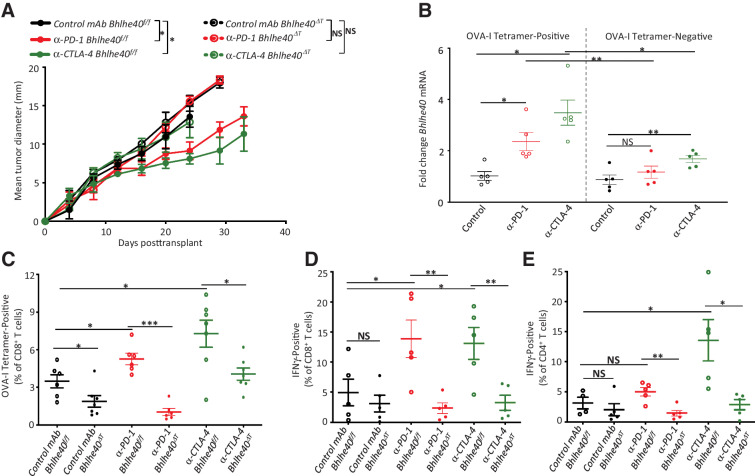
Figure 7. Bhlhe40 is required for generation of functional tumor antigen–specific T cells and ICT efficacy against B16-OVA melanoma. A, B16-OVA tumor growth in Bhlhe40ΔT and Bhlhe40f/f mice treated with control mAb, anti–CTLA-4, or anti–PD-1 on days 3, 6, and 9 posttransplant. B, Bhlhe40 mRNA expression in intratumoral OVA-I tetramer–positive or –negative CD8+ T cells sorted from B16-OVA melanoma–bearing WT mice treated with control mAb, anti–CTLA-4, or anti–PD-1. C, Percent of intratumoral OVA tetramer–positive CD8+ T cells in B16-OVA melanoma–bearing Bhlhe40ΔT and Bhlhe40f/f mice treated as in B. Percent of intratumoral IFNγ-positive CD8+ T cells (stimulated ex vivo with OVA-I peptide; D) or CD4+ T cells (E; stimulated ex vivo with OVA-II peptide) in B16-OVA melanoma–bearing Bhlhe40ΔT or Bhlhe40f/f mice treated as in B. Data in A are presented as average tumor diameter ± SEM of 4–5 mice per group and are representative of at least 3 independent experiments (*, P < 0.05; **, P < 0.01, two-way ANOVA). Data in B are presented as mean ± SEM Bhlhe40 mRNA fold change. Each dot represents a Bhlhe40 mRNA data point from sorted OVA-I tetramer–positive and –negative CD8+ T cells isolated from 4–5 individual mice per group and are representative of at least 3 independent experiments. Data in D and E are presented as mean ± SEM of IFNγ+ cells expressed as a percent of CD8+ T cells or CD4+ T cells as assessed by flow cytometry. For C–E, cells were gated on live CD45+Thy1.2+ and CD8+ or CD4+ T cells. For B–E, cells were isolated from 4–5 individual mice per group on day 15 posttransplant (*, P < 0.05; **, P < 0.01; NS, not significant, unpaired t test).
Figure 7.
Bhlhe40 is required for generation of functional tumor antigen–specific T cells and ICT efficacy against B16-OVA melanoma. A, B16-OVA tumor growth in Bhlhe40ΔT and Bhlhe40f/f mice treated with control mAb, anti–CTLA-4, or anti–PD-1. B,Bhlhe40 mRNA expression in intratumoral OVA-I tetramer–positive or –negative CD8+ T cells sorted from B16-OVA melanoma–bearing WT mice treated with control mAb, anti–CTLA-4, or anti–PD-1. C, Percent of intratumoral OVA tetramer–positive CD8+ T cells in B16-OVA melanoma–bearing Bhlhe40ΔT and Bhlhe40f/f mice treated as in B. Percent of intratumoral IFNγ-positive CD8+ T cells (stimulated ex vivo with OVA-I peptide; D) or CD4+ T cells (E; stimulated ex vivo with OVA-II peptide) in B16-OVA melanoma–bearing Bhlhe40ΔTor Bhlhe40f/f mice treated as in B. Data in A are presented as average tumor diameter ± SEM of 4–5 mice per group and are representative of at least 3 independent experiments (*, P < 0.05; **, P < 0.01, two-way ANOVA). Data in B are presented as mean ± SEM Bhlhe40 mRNA fold change. Each dot represents a Bhlhe40 mRNA data point from sorted OVA-I tetramer–positive and –negative CD8+ T cells isolated from 4–5 individual mice per group and are representative of at least 3 independent experiments. Data in D and E are presented as mean ± SEM of IFNγ+ cells expressed as a percent of CD8+ T cells or CD4+ T cells as assessed by flow cytometry. For CE, cells were gated on live CD45+Thy1.2+ and CD8+ or CD4+ T cells. For BE, cells were isolated from 4–5 individual mice per group on day 15 posttransplant (*, P < 0.05; **, P < 0.01; NS, not significant, unpaired t test).

References

    1. Gubin MM, Zhang X, Schuster H, Caron E, Ward JP, Noguchi T, et al. Checkpoint blockade cancer immunotherapy targets tumour-specific mutant antigens. Nature 2014;515:577–81. - PMC - PubMed
    1. Alspach E, Lussier DM, Miceli AP, Kizhvatov I, DuPage M, Luoma AM, et al. MHC-II neoantigens shape tumour immunity and response to immunotherapy. Nature 2019;574:696–701. - PMC - PubMed
    1. Gubin MM, Artyomov MN, Mardis ER, Schreiber RD. Tumor neoantigens: building a framework for personalized cancer immunotherapy. J Clin Invest 2015;125:3413–21. - PMC - PubMed
    1. van Rooij N, van Buuren MM, Philips D, Velds A, Toebes M, Heemskerk B, et al. Tumor exome analysis reveals neoantigen-specific T-cell reactivity in an ipilimumab-responsive melanoma. J Clin Oncol 2013;31:e439–42. - PMC - PubMed
    1. Coulie PG, Van den Eynde BJ, van der Bruggen P, Boon T. Tumour antigens recognized by T lymphocytes: at the core of cancer immunotherapy. Nat Rev Cancer 2014;14:135–46. - PubMed

Publication types