Randomized Controlled Trial
. 2022 Jan-Dec;14(1):2038855.
doi: 10.1080/19490976.2022.2038855.

Timing of antimicrobial prophylaxis for cesarean section is critical for gut microbiome development in term born infants

Affiliations
Randomized Controlled Trial

Timing of antimicrobial prophylaxis for cesarean section is critical for gut microbiome development in term born infants

Verena Bossung et al. Gut Microbes. 2022 Jan-Dec.

Abstract

Animal models imply that the perinatal exposure to antibiotics has a substantial impact on microbiome establishment of the offspring. We aimed to evaluate the effect of timing of antimicrobial prophylaxis for cesarean section before versus after cord clamping on gut microbiome composition of term born infants. We performed an exploratory, single center randomized controlled clinical trial. We included forty pregnant women with elective cesarean section at term. The intervention group received single dose intravenous cefuroxime after cord clamping (n = 19), the control group single dose intravenous cefuroxime 30 minutes before skin incision (n = 21). The primary endpoint was microbiome signature of infants and metabolic prediction in the first days of life as determined in meconium samples by 16S rRNA gene sequencing. Secondary endpoints were microbiome composition at one month and 1 year of life. In meconium samples of the intervention group, the genus Staphylococcus pre-dominated. In the control group, the placental cross-over of cefuroxime was confirmed in cord blood. A higher amino acid and nitrogen metabolism as well as increased abundance of the genera Cutibacterium, Corynebacterium and Streptophyta were noted (indicator families: Cytophagaceae, Lactobacilaceae, Oxalobacteraceae). Predictive models of metabolic function revealed higher 2'fucosyllactose utilization in control group samples. In the follow-up visits, a higher abundance of the genus Clostridium was evident in the intervention group. Our exploratory randomized controlled trial suggests that timing of antimicrobial prophylaxis is critical for early microbiome engraftment but not antimicrobial resistance emergence in term born infants.

Keywords: Microbiome; antibiotic resistome; antibiotics; cesarean section; diversity; surgical antimicrobial prophylaxis; term infant.


Conflict of interest statement

No potential conflict of interest was reported by the author(s).

Figures

Figure 1.
Figure 1.
Flowchart of study inclusion.
Figure 2.
Figure 2.
Microbiome differences in meconium samples stratified to timing of antibiotic prophylaxis. Relative abundance of the most abundant genera (a) as well as detected indicator species via linear discriminant analysis effect size (P< .05) (b), principal coordinates analysis of beta diversity (permutational multivariate analysis of variance using distance matrices P = .026) (c) and Shannon’s diversity index (pairwise Wilcoxon rank sum test * P = .035) (d) indicated significant impact of intrapartum antibiotic prophylaxis on neonatal microbiome.
Figure 3.
Figure 3.
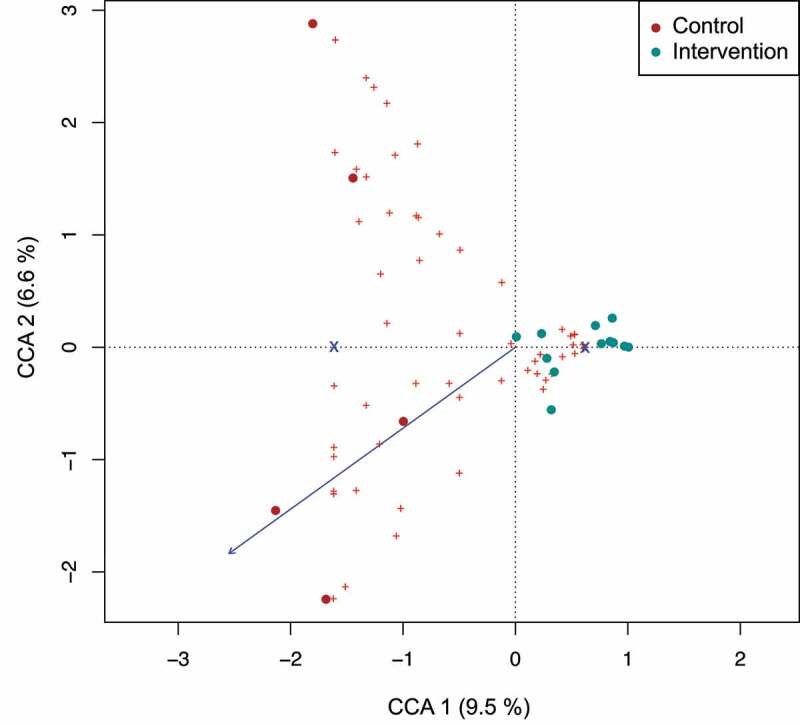
Interdependence of concentration of antibiotics in cord blood with diversity of infant’s gut microbiome in meconium samples. Constrained correspondence analysis with administration of intrapartum antimicrobial prophylaxis set as constrain 1 and concentration of antibiotic in blood as constrain 2 revealed that 6.6% of variation was explained by the concentration of antibiotic in the cord blood suggesting the dependence of changes in microbiome of meconium on the identified concentration of antibiotic.
Figure 4.
Figure 4.
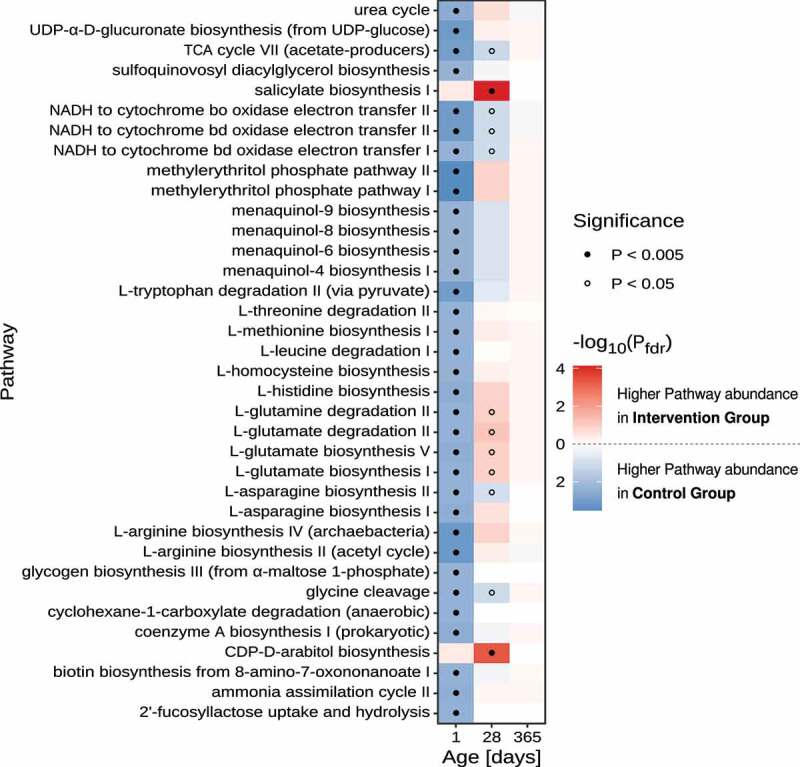
Differential pathway abundance analyses between control- and intervention group stool samples. Heatmap of FDR-adjusted P-values refer to the significance levels obtained by comparing the sum of OTU-counts between samples from the control- and intervention group for OTUs that were predicted to harbor the focal metabolic pathway. Only pathways with an FDR-adjusted P-value < 0.005 in at least one of the age groups are displayed. Dots indicate pathways with P-values below 0.005 (filled circle) and 0.05 (open circles), respectively. Statistical comparison of pathway abundance is based on a zero-inflated beta-binomial (ZIBB) model to account for excessive zeroes and over-dispersion in the sequence count data.
Figure 5.
Figure 5.
Impact of intrapartum antimicrobial prophylaxis on the gut microbiome at later stages of microbiome development. (a) Indicator species identified via linear discriminant analysis effect size (P < .05) for intervention and control group infants at the age of 1 month. (b) Relative abundance of the genus Clostridium from the family Peptostreptococcaceae (found to be associated with the intervention group at 1 month) is still increased at the time point of 1 year without reaching statistical significance (Wilcoxon rank-sum test).
Figure 6.
Figure 6.
Heatmap and hierarchical clustering according to the abundance of antibiotic resistance genes on the first days of life, at one month and at one year after birth. Timing of antibiotic prophylaxis was selected as covariate for the analysis. Clustering was performed based on the Euclidean distance; dark green represents abundance of the resistance genes and aquamarine the absence.

References

    1. Boerma T, Ronsmans C, Melesse DY, Barros AJD, Barros FC, Juan L, Moller AB, Say L, Hosseinpoor AR, Yi M, et al. Global epidemiology of use of and disparities in caesarean sections. Lancet. 2018;392(10155):1341–16. doi:10.1016/S0140-6736(18)31928-7. - DOI - PubMed
    1. Institut für Qualitätssicherung und Transparenz im Gesundheitswesen . Bundesauswertung zum Erfassungsjahr 2019 Geburtshilfe. 2020.
    1. Kawakita T, Landy HJ.. Surgical site infections after cesarean delivery: epidemiology, prevention and treatment. Matern Heal Neonatol Perinatol. 2017;3(1):12. doi:10.1186/s40748-017-0051-3. - DOI - PMC - PubMed
    1. Smaill FM, Grivell RM. Antibiotic prophylaxis versus no prophylaxis for preventing infection after cesarean section. Cochrane Database Syst Rev. 2014;10:CD00748. - PMC - PubMed
    1. Hopkins L, Smaill FM. Withdrawn: antibiotic prophylaxis regimens and drugs for cesarean section. Cochrane Database Syst Rev. 2012;1:CD001136. doi:10.1002/14651858.CD001136.pub2. - DOI - PMC - PubMed

Publication types

LinkOut - more resources