


No axillary surgical treatment for lymph node-negative patients after ultra-sonography [NAUTILUS]: protocol of a prospective randomized clinical trial
- PMID: 35184724
- PMCID: PMC8859876
- DOI: 10.1186/s12885-022-09273-1
No axillary surgical treatment for lymph node-negative patients after ultra-sonography [NAUTILUS]: protocol of a prospective randomized clinical trial
Abstract
Background: Following sentinel lymph node biopsy (SLNB), the axillary recurrence rate is very low although SLNB has a false-negative rate of 5-10%. In the ACOSOG Z0011 trial, non-sentinel positive-lymph nodes were found in more than 20% of the axillary dissection group; the SLNB only group did not have a higher axillary recurrence rate. These findings raised questions about the direct therapeutic effect of the SLNB. SLNB has post-surgical complications including lymphedema. Considering advances in imaging modalities and adjuvant therapies, the role of SLNB in early breast cancer needs to be re-evaluated.
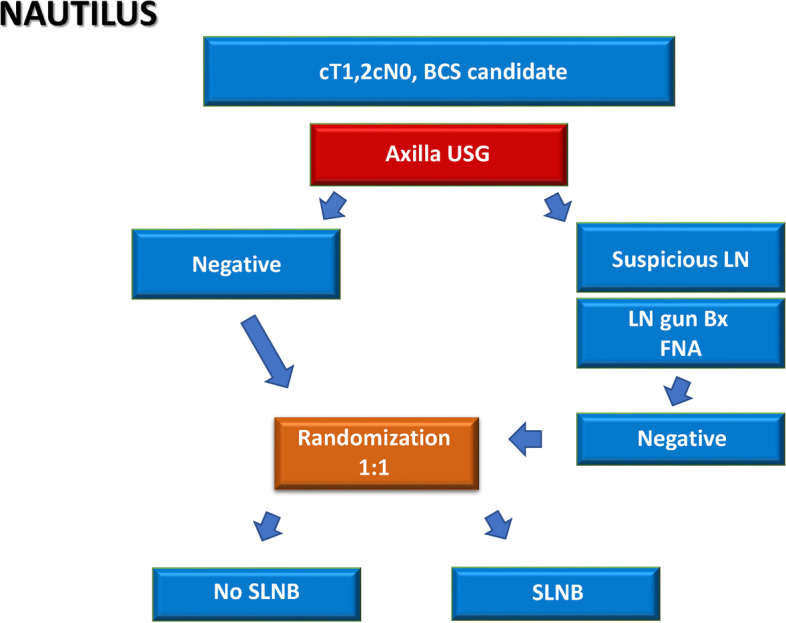
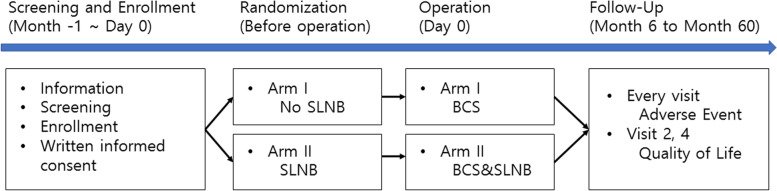
Methods: The NAUTILUS trial is a prospective multicenter randomized controlled trial involving clinical stage T1-2 and N0 breast cancer patients receiving breast-conserving surgery. Axillary ultrasound is mandatory before surgery with predefined imaging criteria for inclusion. Ultrasound-guided core needle biopsy or needle aspiration of a suspicious node is allowed. Patients will be randomized (1:1) into the no-SLNB (test) and SLNB (control) groups. A total of 1734 patients are needed, considering a 5% non-inferiority margin, 5% significance level, 80% statistical power, and 10% dropout rate. All patients in the two groups will receive ipsilateral whole-breast radiation according to a predefined protocol. The primary endpoint of this trial is the 5-year invasive disease-free survival. The secondary endpoints are overall survival, distant metastasis-free survival, axillary recurrence rate, and quality of life of the patients.
Discussion: This trial will provide important evidence on the oncological safety of the omission of SLNB for early breast cancer patients undergoing breast-conserving surgery and receiving whole-breast radiation, especially when the axillary lymph node is not suspicious during preoperative axillary ultrasound.
Trial registration: ClinicalTrials.gov, NCT04303715 . Registered on March 11, 2020.
Keywords: Breast cancer; Sentinel node biopsy; Ultrasound.
© 2022. The Author(s).
Conflict of interest statement
The authors declare that they have no competing interests.
Figures
References
-
- Krag DN, Anderson SJ, Julian TB, Brown AM, Harlow SP, Costantino JP, Ashikaga T, Weaver DL, Mamounas EP, Jalovec LM, et al. Sentinel-lymph-node resection compared with conventional axillary-lymph-node dissection in clinically node-negative patients with breast cancer: overall survival findings from the NSABP B-32 randomised phase 3 trial. Lancet Oncol. 2010;11(10):927–933. doi: 10.1016/S1470-2045(10)70207-2. - DOI - PMC - PubMed
-
- Dabakuyo TS, Fraisse J, Causeret S, Gouy S, Padeano MM, Loustalot C, Cuisenier J, Sauzedde JM, Smail M, Combier JP, et al. A multicenter cohort study to compare quality of life in breast cancer patients according to sentinel lymph node biopsy or axillary lymph node dissection. Ann Oncol. 2009;20(8):1352–1361. doi: 10.1093/annonc/mdp016. - DOI - PubMed
-
- Lyman GH, Temin S, Edge SB, Newman LA, Turner RR, Weaver DL, Benson AB, 3rd, Bosserman LD, Burstein HJ, Cody H, 3rd, et al. Sentinel lymph node biopsy for patients with early-stage breast cancer: American Society of Clinical Oncology clinical practice guideline update. J Clin Oncol. 2014;32(13):1365–1383. doi: 10.1200/JCO.2013.54.1177. - DOI - PubMed
-
- Langer I, Marti WR, Guller U, Moch H, Harder F, Oertli D, Zuber M. Axillary recurrence rate in breast cancer patients with negative sentinel lymph node (SLN) or SLN micrometastases: prospective analysis of 150 patients after SLN biopsy. Ann Surg. 2005;241(1):152–158. doi: 10.1097/01.sla.0000149305.23322.3c. - DOI - PMC - PubMed
Publication types
MeSH terms
Associated data
Grants and funding
LinkOut - more resources
Full Text Sources
Medical
