


Are Bacterial Persisters Dormant Cells Only?
- PMID: 35185807
- PMCID: PMC8847742
- DOI: 10.3389/fmicb.2021.708580
Are Bacterial Persisters Dormant Cells Only?
Abstract
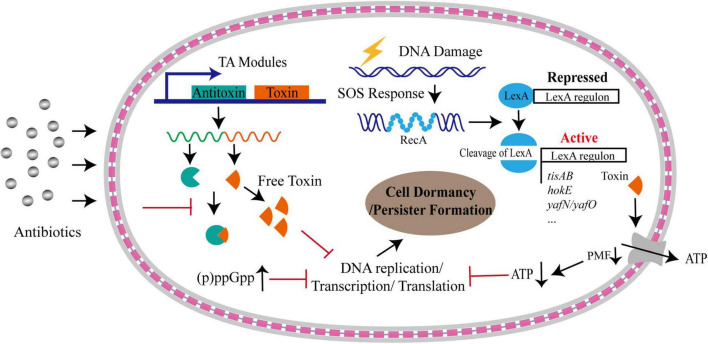
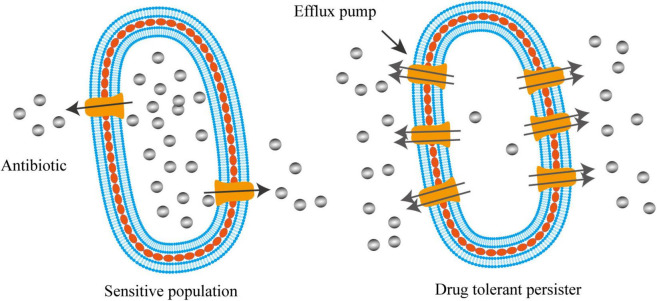
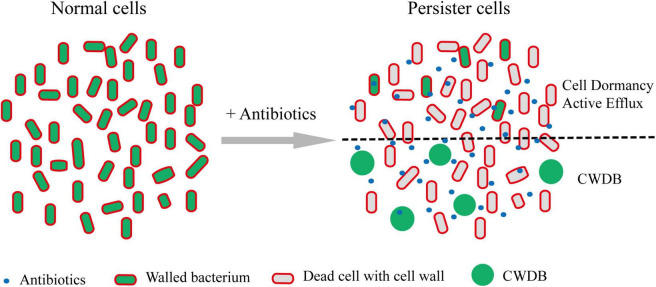
Bacterial persisters are a sub-population of phenotypic variants that tolerate high concentrations of antibiotics within the genetically homogeneous cells. They resume division upon the removal of drugs. Bacterial persistence is one of major causes of antibiotic treatment failure and recurrent infection. Cell dormancy, triggered by toxin/antitoxin pair, (p)ppGpp, SOS response and ATP levels, is known to be the mechanistic basis for persistence. However, recent studies have demonstrated that bacteria with active metabolism can maintain persistence by lowering intracellular antibiotic concentration via an efflux pump. Additionally, others and our work have showed that cell wall deficient bacteria (CWDB), including both L-form and spheroplasts that produced by β-lactam antibiotics, are associated with antibiotic persistence. They are not dormant cells as their cell walls have been completely damaged. In this review, we discuss the various types of persisters and highlight the contribution of non-walled bacteria on bacterial persistence.
Keywords: L-form; cell wall deficient bacteria; dormancy; persister; spheroplast.
Copyright © 2022 Zou, Peng, Qu and Zheng.
Conflict of interest statement
The authors declare that the research was conducted in the absence of any commercial or financial relationships that could be construed as a potential conflict of interest.
Figures
References
-
- Alexander-Jackson E. (1945). A hitherto undemonstrated zoogleal form of mycobacterium tuberculosis. Ann. N. Y. Acad. Sci. 46 127–152. 10.1111/j.1749-6632.1945.tb36166.x - DOI
Publication types
LinkOut - more resources
Full Text Sources
