


Efficacy of Acupuncture for Parkinson's Disease Anxiety: Two-Stage Protocol for a Randomized Controlled Clinical Trial
- PMID: 35186098
- PMCID: PMC8849893
- DOI: 10.1155/2022/5180193
Efficacy of Acupuncture for Parkinson's Disease Anxiety: Two-Stage Protocol for a Randomized Controlled Clinical Trial
Abstract
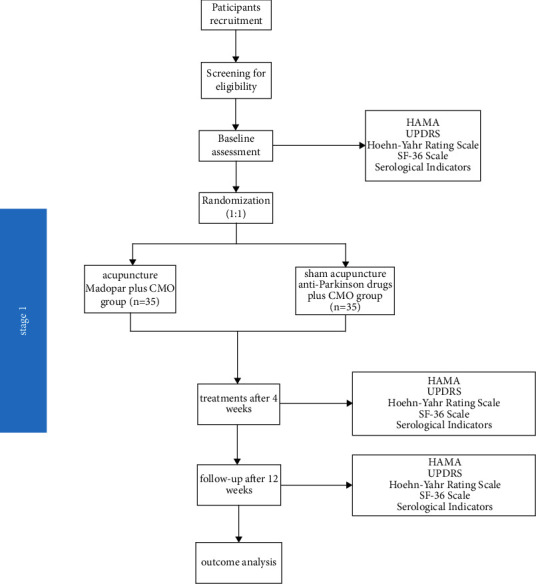
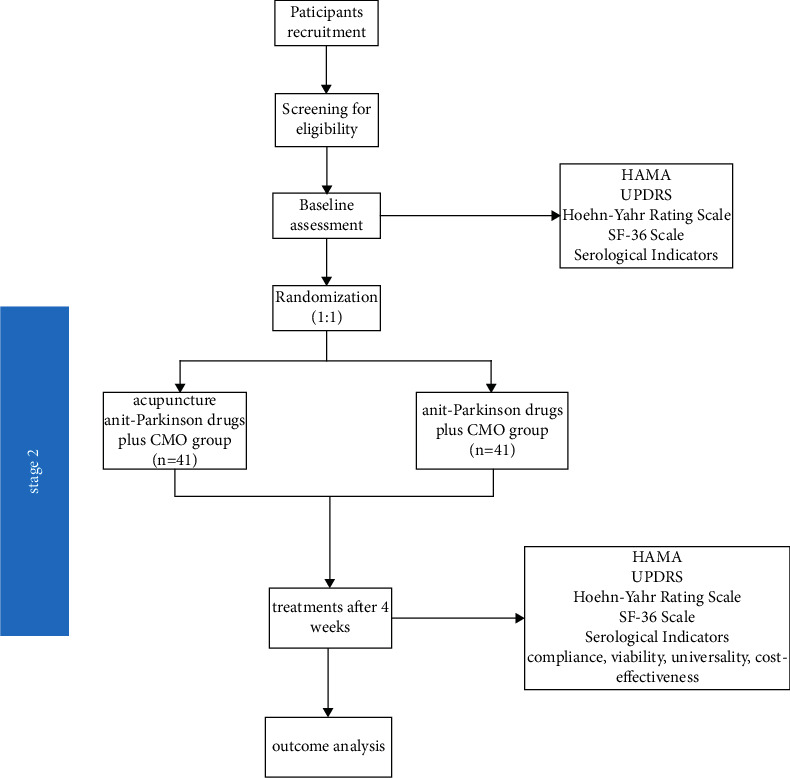
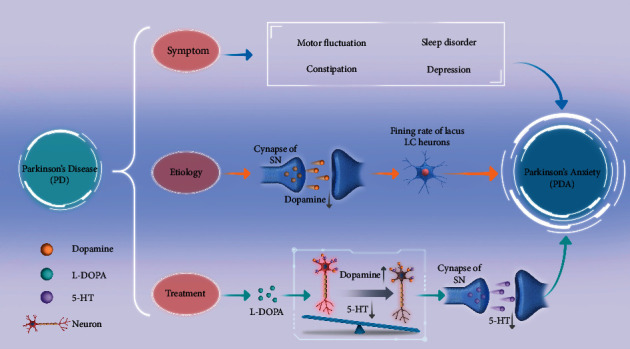
Parkinson's disease anxiety (PDA) is a nonmotor symptom of Parkinson's disease (PD) that is often neglected. PDA poses a far-reaching challenge to the treatment of PD. Acupuncture could be successful in the treatment of PDA. However, the evidence for this is still limited. We propose a two-stage clinical trial. In stage 1, a total of 70 volunteers with PDA will be randomly assigned to either acupuncture (manual acupuncture) or control group (sham acupuncture) in a 1 : 1 ratio. Treatments will be performed for four weeks. The change in the Hamilton Rating Scale for Anxiety (HAMA) score from baseline to week 4 and week 12 will be the primary outcome. The levels of adrenocorticotropic hormone (ACTH), cortisol (CORT), serotonin (5-HT), and corticotropin-releasing factor (CRH) in the patients' serum and the scores on the Hoehn-Yahr Rating Scale and the Unified Parkinson's Disease Rating Scale (UPDRS) will all be considered among the secondary outcomes. Participants will be followed up until week 12. In stage 2, a total of 82 volunteers with PDA will be randomly assigned to either an acupuncture (manual acupuncture) or a control group (anti-Parkinson drugs only) in a 1 : 1 ratio. HAMA score will be the primary outcome. Universality, feasibility and cost effectiveness, Hoehn-Yahr Rating Scale, UPDRS, and serological indicators will be secondary outcomes. Participants will be followed up until week 4. The statistical analysis will include all the allocated individuals. The First Affiliated Hospital of Guangzhou University of Traditional Chinese Medicine's Research Ethical Committee authorized this procedure, and the trial is registered with ChiCTR2100047253.
Copyright © 2022 Jing-Qi Fan et al.
Conflict of interest statement
The authors declare that there are no conflicts of interest regarding the publication of this paper.
Figures
References
LinkOut - more resources
Full Text Sources
