


Gli Phosphorylation Code in Hedgehog Signal Transduction
- PMID: 35186941
- PMCID: PMC8855225
- DOI: 10.3389/fcell.2022.846927
Gli Phosphorylation Code in Hedgehog Signal Transduction
Abstract
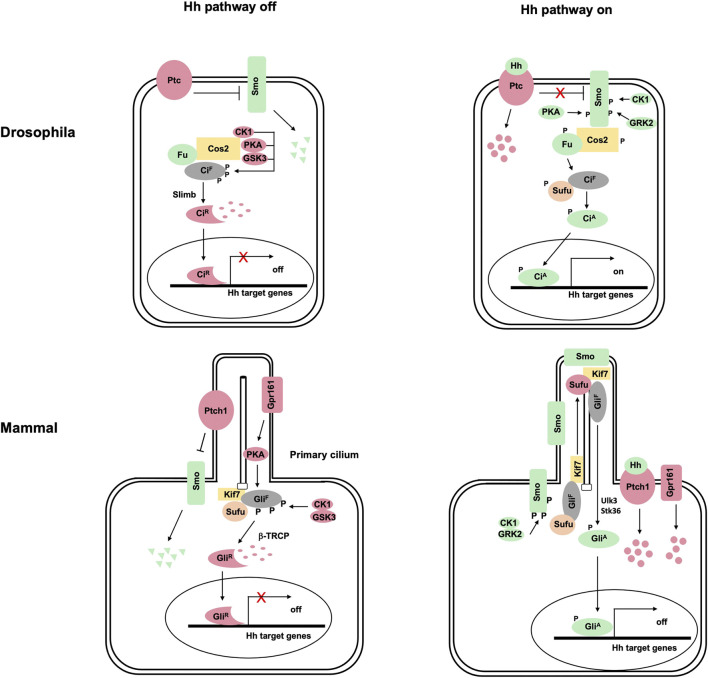
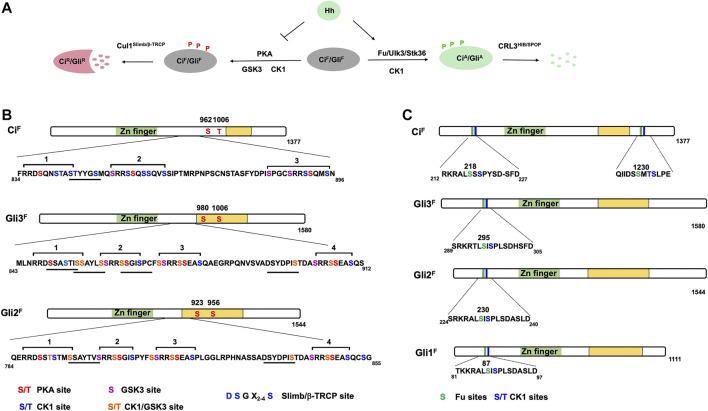
Hedgehog (Hh) family of secreted proteins governs many key processes in embryonic development and adult tissue homeostasis in species ranging from insects to human. Deregulation of Hh signaling has been implicated in a wide range of human diseases including birth defect and cancer. Hh signaling pathway culminates in the conversion of the latent transcription factor Cubitus interruptus (Ci)/Gli from a repressor form (CiR/GliR) into an activator form (CiA/GliA). Both the production of CiR/GliR in the absence of Hh and the formation of CiA/GliA in response to Hh are regulated by phosphorylation. Whereas previous studies demonstrated that sequential phosphorylation by protein kinase A (PKA), glycogen synthase kinase 3 (GSK3), and casein kinase 1 (CK1) at multiple Ser/Thr clusters in the C-terminal region of Ci/Gli targets it for proteolytic processing to generate CiR/GliR, recent studies revealed that phosphorylation of Ci/Gli by the Fused (Fu)/Unc-51 like kinase (Ulk) family kinases Fu/Ulk3/Stk36 and other kinases contributes to Ci/Gli activation. Fu/Ulk3/Stk36-mediated phosphorylation of Ci/Gli is stimulated by Hh, leading to altered interaction between Ci/Gli and the Hh pathway repressor Sufu. Here we review our current understanding of how various Ci/Gli phosphorylation events are regulated and how they influence Hh signal transduction.
Keywords: CK1; Ci; Fu; GSK3; Gli; Hedgehog; PKA; Ulk3.
Copyright © 2022 Zhou and Jiang.
Conflict of interest statement
The authors declare that the research was conducted in the absence of any commercial or financial relationships that could be construed as a potential conflict of interest.
Figures
References
Publication types
Grants and funding
LinkOut - more resources
Full Text Sources
Research Materials
Miscellaneous
