Review
. 2022 Feb 2:8:798364.
doi: 10.3389/fcvm.2021.798364. eCollection 2021.

Cerebro-Cardiovascular Risk, Target Organ Damage, and Treatment Outcomes in Primary Aldosteronism

Affiliations
Review

Cerebro-Cardiovascular Risk, Target Organ Damage, and Treatment Outcomes in Primary Aldosteronism

Xiao Lin et al. Front Cardiovasc Med. .

Abstract

Primary aldosteronism (PA) is the most common type of endocrine hypertension, and numerous experimental and clinical evidence have verified that prolonged exposure to excess aldosterone is responsible for an increased risk of cerebro-cardiovascular events and target organ damage (TOD) in patients with PA. Therefore, focusing on restoring the toxic effects of excess aldosterone on the target organs is very important to reduce cerebro-cardiovascular events. Current evidence convincingly demonstrates that both surgical and medical treatment strategies would benefit cerebro-cardiovascular outcomes and mortality in the long term. Understanding cerebro-cardiovascular risk in PA would help clinical doctors to achieve both early diagnosis and treatment. Therefore, in this review, we will summarize the cerebro-cardiovascular risk in PA, focusing on the TOD of aldosterone, including brain, heart, vascular system, renal, adipose tissues, diabetes, and obstructive sleep apnea (OSA). Furthermore, the various treatment outcomes of adrenalectomy and medical treatment for patients with PA will also be discussed. We hope this knowledge will help improve cerebro-cardiovascular prognosis and reduce the incidence and mortality of cerebro-cardiovascular events in patients with PA.

Keywords: aldosterone; cerebro-cardiovascular risk; mechanism; primary aldosteronism; target organ damage; treatment.


Conflict of interest statement

The authors declare that the research was conducted in the absence of any commercial or financial relationships that could be construed as a potential conflict of interest.

Figures
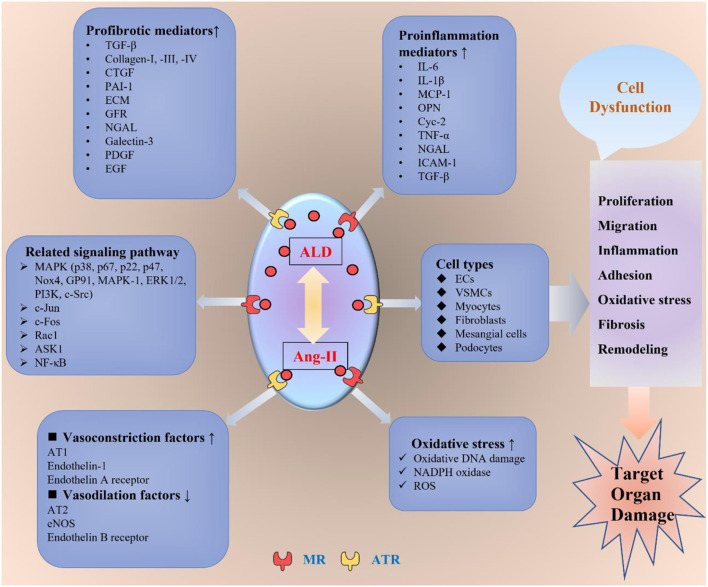
Figure 1
Figure 1
The non-genomic mechanisms of aldosterone-modulating TOD. ALD interacts with Ang-II by binding to the MR or ATR to exert its toxic effect on the target organs. ALD promotes inflammation, oxidative stress, fibrosis, migration, proliferation, adhesion, endothelial dysfunction, and vascular remodeling through different kinds of mediators and signaling pathways in various cells, including ECs, VSMCs, myocytes, fibroblasts, mesangial cells, and podocytes. ALD, aldosterone; Ang-II, angiotensin II; ATR, angiotensin receptor; MR, mineral ocorticoid receptor; AT1, angiotensin receptor 1; AT2, angiotensin receptor 2; ECs, endothelial cells; VSMCs, vascular smooth muscle cells; eNOS, endothelial nitric oxide synthase; TGF-β, transforming growth factor β; CTGF, connective tissue growth factor; PAI-1, plasminogen activator inhibitor 1; ECM, extracellular matrix; GFR, growth factor receptor; NGAL, neutrophil gelatinase-associated lipocalin; PDGF, platelet-derived growth factor; EGF, epidermal growth factor; IL-1β, interleukin 1β; IL-6, interleukin 6; MCP-1, monocyte chemoattractant protein-1; OPN, osteopontin; TNF-α, tumor necrosis factor-α; ICAM-1, intercellular adhesion molecule-1; NADPH, nicotinamide adenine dinucleotide phosphate; ROS, reactive oxygen species; ASK1, apoptosis signal-regulated kinase 1; ERK1/2, extracellular signal-regulated kinase 1/2; PI3K, phosphoinositide 3-kinase; NF-κB, NF-kappaB; TOD, target organ damage.
Figure 2
Figure 2
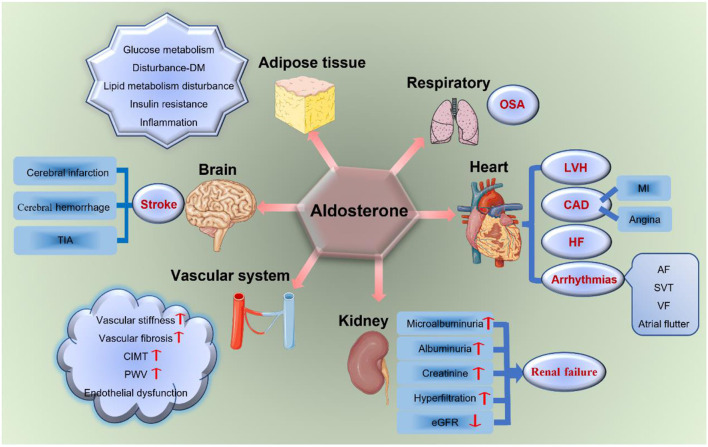
Aldosterone and TOD. Aldosterone has a toxic effect on target organs, including the brain, heart, vascular system, kidney, respiratory system, and adipose tissues. It increases the incidence of stroke, LVH, CAD, HF, arrhythmias, renal failure, vascular fibrosis and stiffness, endothelial dysfunction, glucose and lipid metabolism disturbances, insulin resistance, OSA, and so on. TIA, transient ischemic attack; DM, diabetes mellitus; LVH, left ventricular hypertrophy; CAD, coronary artery disease; MI, myocardial infarction; HF, heart failure; AF, atrial fibrillation; SVT, sustained ventricular tachycardia; VF, ventricular fibrillation; eGFR, estimated glomerular filtration rate; CIMT, carotid intima-media thickness; PWV, pulse wave velocity; OSA, obstructive sleep apnea; TOD, target organ damage.

References

    1. Parasiliti-Caprino M, Lopez C, Prencipe N, Lucatello B, Settanni F, Giraudo G, et al. Prevalence of primary aldosteronism and association with cardiovascular complications in patients with resistant and refractory hypertension. J Hypertens. (2020) 38:1841–8. 10.1097/HJH.0000000000002441 - DOI - PubMed
    1. Jaffe G, Gray Z, Krishnan G, Stedman M, Zheng Y, Han J, et al. Screening Rates for Primary Aldosteronism in Resistant Hypertension: A Cohort Study.Hypertension (Dallas, Tex.: 1979). (2020) 75:650–9. 10.1161/HYPERTENSIONAHA.119.14359 - DOI - PubMed
    1. Bernini G, Galetta F, Franzoni F, Bardini M, Taurino C, Bernardini M, et al. Arterial stiffness, intima-media thickness and carotid artery fibrosis in patients with primary aldosteronism. J Hypertens. (2008) 26:2399–405. 10.1097/HJH.0b013e32831286fd - DOI - PubMed
    1. Milliez P, Girerd X, Plouin PF, Blacher J, Safar ME, Mourad JJ. Evidence for an increased rate of cardiovascular events in patients with primary aldosteronism. J Am Coll Cardiol. (2005) 45:1243–8. 10.1016/j.jacc.2005.01.015 - DOI - PubMed
    1. Monticone S, D'Ascenzo F, Moretti C, Williams TA, Veglio F, Gaita F, et al. Cardiovascular events and target organ damage in primary aldosteronism compared with essential hypertension: a systematic review and meta-analysis. Lancet. (2018) 6, 41–50. 10.1016/S2213-8587(17)30319-4 - DOI - PubMed

LinkOut - more resources