


Review
doi: 10.1002/eji.202149632.
Epub 2022 Mar 11.
Human dendritic cell subsets: An updated view of their ontogeny and functional specialization
Affiliations
- PMID: 35187651
- PMCID: PMC9790408
- DOI: 10.1002/eji.202149632
Item in Clipboard
Review
Human dendritic cell subsets: An updated view of their ontogeny and functional specialization
Eur J Immunol.
2022 Nov.
Abstract
Human DCs have been divided into several subsets based on their phenotype and ontogeny. Recent high throughput single-cell methods have revealed additional heterogeneity within human DC subsets, and new subpopulations have been proposed. In this review, we provide an updated view of the human DC subsets and of their ontogeny supported by recent clinical studies . We also summarize their main characteristics including their functional specialization.
Keywords: Human; dendritic cell; subsets.
© 2022 The Authors. European Journal of Immunology published by Wiley-VCH GmbH.
Conflict of interest statement
The author declares no commercial or financial conflict of interest.
Figures
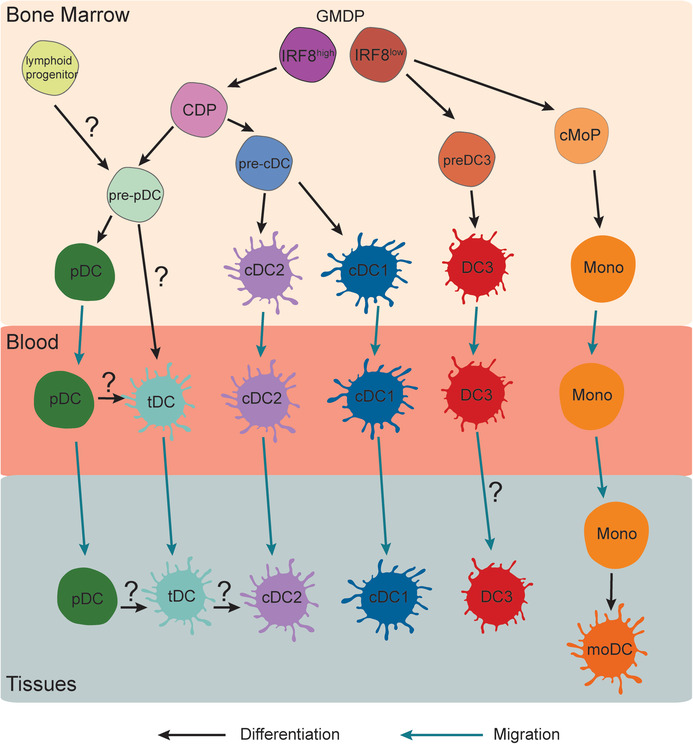
Ontogeny of human DC subsets. DC precursors originate from the bone marrow. pDC, cDC1, cDC2, and DC3 develop from precursors distinct from the other DC lineages. moDC are differentiated from monocytes in peripheral tissues. The developmental pathway of tDC remains to be better characterized. Cell differentiation is indicated in black and cell migration in blue. Questions marks indicate aspects that remain unclear. CDP, common DC progenitor; cMoP, common monocyte precursor; GMDP, granulocyte‐monocyte and DC progenitor, mono, monocyte; moDC, monocyte‐derived DC; tDC, transitional AXL+ SIGLEC6+ DC.
References
-
- Dzionek, A. , Fuchs, A. , Schmidt, P. , Cremer, S. , Zysk, M. , Miltenyi, S. , Buck, D. W. et al., BDCA‐2, BDCA‐3, and BDCA‐4: three markers for distinct subsets of dendritic cells in human peripheral blood. J. Immunol. 2000. 165: 6037–6046. - PubMed
-
- Villar, J. and Segura, E. , Decoding the heterogeneity of human dendritic cell subsets. Trends Immunol. 2020. 41: 1062–1071. - PubMed
-
- Heidkamp, G. F. , Sander, J. , Lehmann, C. H. K. , Heger, L. , Eissing, N. , Baranska, A. , Lühr, J. J. et al., Human lymphoid organ dendritic cell identity is predominantly dictated by ontogeny, not tissue microenvironment. Sci Immunol. 2016. 1. - PubMed
Publication types
MeSH terms
LinkOut - more resources
Full Text Sources
