Review
. 2022 May 4;30(5):1850-1868.
doi: 10.1016/j.ymthe.2022.02.016. Epub 2022 Feb 19.

COVID-19 mRNA vaccines: Platforms and current developments

Affiliations
Review

COVID-19 mRNA vaccines: Platforms and current developments

Gábor Tamás Szabó et al. Mol Ther. .

Abstract

Since the first successful application of messenger ribonucleic acid (mRNA) as a vaccine agent in a preclinical study nearly 30 years ago, numerous advances have been made in the field of mRNA therapeutic technologies. This research uncovered the unique favorable characteristics of mRNA vaccines, including their ability to give rise to non-toxic, potent immune responses and the potential to design and upscale them rapidly, making them excellent vaccine candidates during the coronavirus disease 2019 (COVID-19) pandemic. Indeed, the first two vaccines against COVID-19 to receive accelerated regulatory authorization were nucleoside-modified mRNA vaccines, which showed more than 90% protective efficacy against symptomatic severe acute respiratory syndrome coronavirus 2 (SARS-CoV-2) infection alongside tolerable safety profiles in the pivotal phase III clinical trials. Real-world evidence following the deployment of global vaccination campaigns utilizing mRNA vaccines has bolstered clinical trial evidence and further illustrated that this technology can be used safely and effectively to combat COVID-19. This unprecedented success also emphasized the broader potential of this new drug class, not only for other infectious diseases, but also for other indications, such as cancer and inherited diseases. This review presents a brief history and the current status of development of four mRNA vaccine platforms, nucleoside-modified and unmodified mRNA, circular RNA, and self-amplifying RNA, as well as an overview of the recent progress and status of COVID-19 mRNA vaccines. We also discuss the current and anticipated challenges of these technologies, which may be important for future research endeavors and clinical applications.

Keywords: COVID-19; first mRNA vaccine approval; mRNA vaccine platforms; mRNA vaccines; nucleoside-modified mRNA.


Conflict of interest statement

Declaration of interests G.T.S., A.J.M., and I.V. are all full-time employees at BioNTech SE, Mainz, Germany, and may hold shares from BioNTech SE.

Figures
None
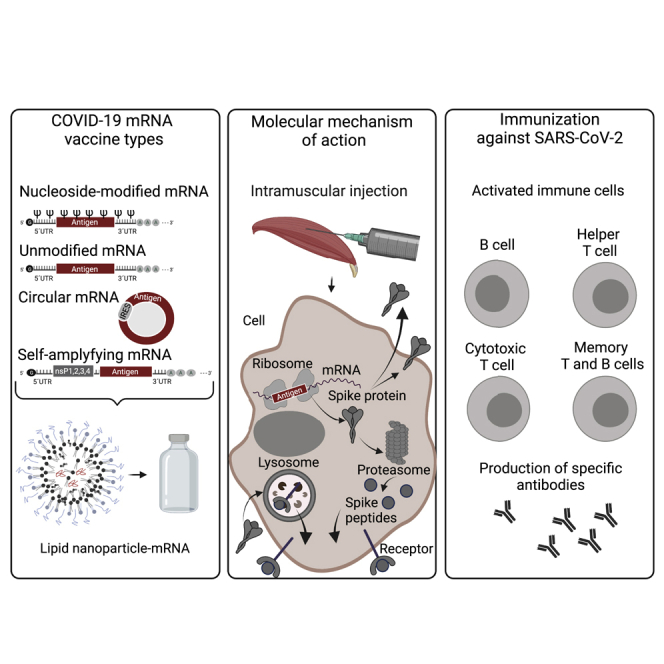
Graphical abstract
Figure 1
Figure 1
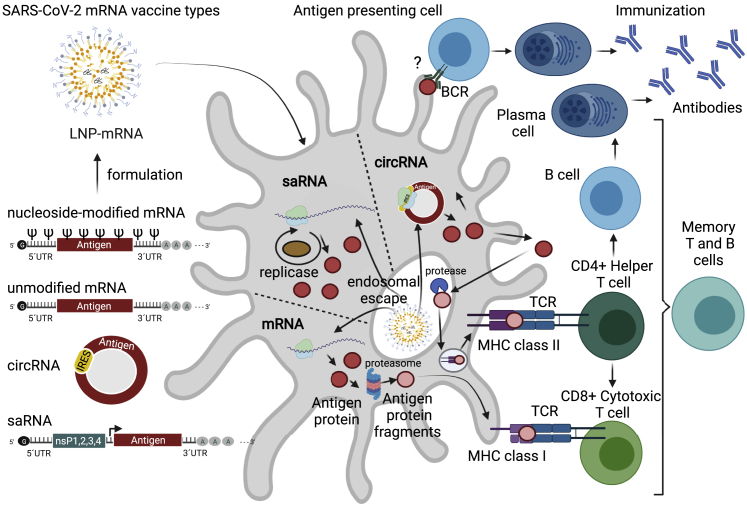
Immunization against COVID-19 with mRNA vaccines Immunization with mRNA vaccines requires an antigen-encoding mRNA transcript. The linear non-replicating mRNAs consist of a sequence encoding an antigen (e.g., the S protein for SARS-CoV-2) flanked by 5′ and 3′ UTRs, with a cap structure at the 5′ end and a poly(A) tail at the 3′ end. Depending on the use of native or modified nucleosides during IVT, unmodified or modified mRNAs are produced. saRNA consists of the same sequence organization, but in addition contains: (1) a sequence encoding four non-structural proteins (nsP1–4), which form a replicase responsible for amplification of the saRNA, and (2) a subgenomic promoter (black arrow) of viral origin that initiates transcription of antigens. circRNA for vaccine application consists of a covalently closed single-stranded RNA that contains antigen sequence and an IRES that allows initiation of antigen translation.,, Antigen-encoding mRNAs are formulated into LNPs, endocytosed, and released through the process of endosomal escape to the cytoplasm. The S protein is produced by the translational machinery of the APCs (red circles), degraded by proteasomes (pink circles), and presented on MHC class I (pink circles), leading to a specific CD8+ cytotoxic T cell response against SARS-CoV-2. Antigens can also be anchored to the membrane of the APC and directly recognized by BCRs leading to B cell responses; however, such a path and its contribution to antibody production is currently under debate. Finally, the antigen protein can be exported from the cell and endocytosed back to the same or another APC, degraded by endosomal proteases, and presented on MHC II structures resulting in a CD4+ helper T cell response. Immunization progresses with CD4+ helper T cells further helping in (1) activation of B cells that produce SARS-CoV-2 neutralizing antibodies and (2) activation of CD8+ cytotoxic T cells that may specifically recognize and eliminate virus-infected cells. APC, antigen-presenting cell; BCR, B cell receptor; circRNA, circular ribonucleic acid; IRES, internal ribosome entry site; IVT, in vitro translation; LNP, lipid nanoparticle; MHC, major histocompatibility complex; mRNA, messenger ribonucleic acid; saRNA, self-amplifying ribonucleic acid; SARS-CoV-2, severe acute respiratory syndrome coronavirus 2; S protein, spike protein; TCR, T cell receptor; UTR, untranslated region. Figure was created with BioRender.com.
Figure 2
Figure 2
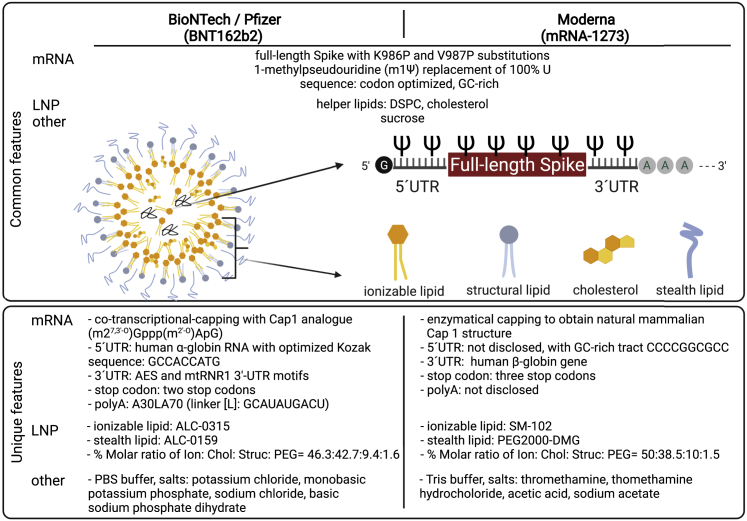
Widely used mRNA-based COVID-19 vaccines: Comparison of ingredients BNT162b2 (BioNTech/Pfizer) and mRNA-1273 (Moderna) are composed of 1-methylpseudouridine-modified full-length spike mRNA, with proline substitutions, that is GC rich, codon optimized, and composed of standard mRNA components: cap, 5′ UTR, coding sequence, 3′ UTR, and a poly(A) tail. BNT162b2 is co-transcriptionally capped with ((m27,3′-O)Gppp(m2′-O)ApG) cap1 and has human α-globin 5′ UTR, AES, and mtRNR1 3′ UTR motifs; two stop codons; and a poly(A) tail consisting of A30LA70., mRNA-1273 is enzymatically capped and has an undisclosed 5′ UTR and a human β-globin gene-based 3′ UTR, three stop codons, and a poly(A) tail of undisclosed length. In both cases, the mRNA is formulated using LNPs consisting of ionizable, structural, and stealth lipids and cholesterol. The LNPs of both mRNA vaccines contain DSPC and cholesterol. Unique features of BNT162b2 and mRNA-1273 LNP formulations are the use of ALC-0315 and SM-102 ionizable lipids and ALC-0159 and PEG2000-DMG, PEG-based stealth lipids, respectively.,,, Lipids are integrated into the LNPs under specific molar ratios.,,, In addition to the mRNA and LNP components, the only ingredients are salts (PBS and Tris buffers for BNT162b2 and mRNA-1273, respectively) and 10% sucrose that is used as a cryoprotectant for both mRNA vaccines.,. ALC-0159, 2-[(polyethylene glycol)-2000]-N,N-ditetradecylacetamide; DSPC, 1,2-distearoyl-sn-glycero-3-phosphocholine; K, lysine; mRNA, messenger ribonucleic acid; LNP, lipid nanoparticle; P, proline; PEG2000-DMG, 1,2-dimyristoyl-sn-glycero-3-methoxypolyethylene glycol; UTR, untranslated region; V, valine; AES, amino-terminal enhancer of split; mtRNR1, mitochondrially encoded 12S rRNA; ALC-3015, ((4-hydroxybutyl)azanediyl)bis(hexane-6,1-diyl)bis; SM-102, 9-heptadecanyl 8-{(2-hydroxyethyl)[6-oxo-6-(undecyloxy)hexyl]amino}octanoate. Figure was created with BioRender.com.
Figure 3
Figure 3
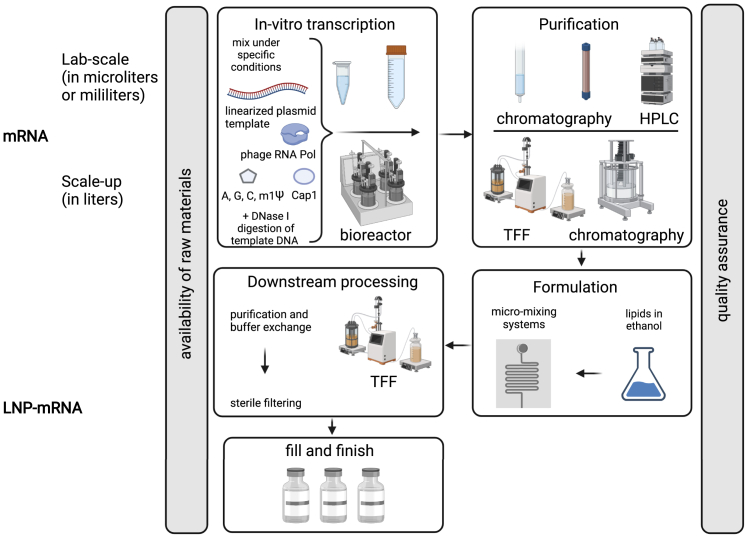
Manufacturing and scale-up of nucleoside-modified mRNA vaccines The first step in nucleoside-modified mRNA vaccine production consists of an IVT reaction. This reaction, which is conducted under specific conditions, is based on mixing linearized plasmid template, phage RNA polymerase, nucleoside-triphosphates (including m1Ψ), and the Cap1 structure when a co-transcriptional capping process is used. The IVT reaction can be performed at different scales and is typically followed by DNase I digestion, which allows DNA template depletion. Purification of mRNA is a process that allows depletion of unwanted IVT reaction by-products and other impurities. Depletion of dsRNA formed during IVT reactions by diverse types of chromatography, such as HPLC or TFF techniques, means that mRNA vaccine-triggered adverse events caused by systemic innate immune system responses are kept to a minimum. Purified mRNA is diluted in an appropriate buffer and then formulated with lipid components, which are dissolved in ethanol by a micro-mixing technology., , Downstream processes include further purification, buffer exchange, and sterile filtering prior to fill and finish. Availability of raw materials is of key importance for continual large-scale production when demands are high, such as during a pandemic. The process is tightly controlled by numerous quality assessments at the LNP, mRNA, and LNP-mRNA levels. HPLC, high-performance liquid chromatography; LNP, lipid nanoparticle; m1Ψ, 1-methylpseudouridine; mRNA, messenger ribonucleic acid; RNA Pol, RNA polymerase; TFF, tangential flow filtration. Figure was created with BioRender.com.

References

    1. Pollard A.J., Bijker E.M. A guide to vaccinology: from basic principles to new developments. Nat. Rev. Immunol. 2021;21:83–100. doi: 10.1038/s41577-020-00479-7. - DOI - PMC - PubMed
    1. WHO Vaccine tracker: vaccines as of 14th January. https://www.who.int/publications/m/item/draft-landscape-of-covid-19-cand...
    1. Corbett K.S., Edwards D.K., Leist S.R., Abiona O.M., Boyoglu-Barnum S., Gillespie R.A., Himansu S., Schäfer A., Ziwawo C.T., DiPiazza A.T., et al. SARS-CoV-2 mRNA vaccine design enabled by prototype pathogen preparedness. Nature. 2020;586:567–571. doi: 10.1038/s41586-020-2622-0. - DOI - PMC - PubMed
    1. Alameh M.-G., Weissman D., Pardi N. Messenger RNA-based vaccines against infectious diseases. Curr. Top. Microbiol. Immunol. 2020 doi: 10.1007/82_2020_202. - DOI - PubMed
    1. Pardi N., Hogan M.J., Porter F.W., Weissman D. mRNA vaccines - a new era in vaccinology. Nat. Rev. Drug Discov. 2018;17:261–279. doi: 10.1038/nrd.2017.243. - DOI - PMC - PubMed